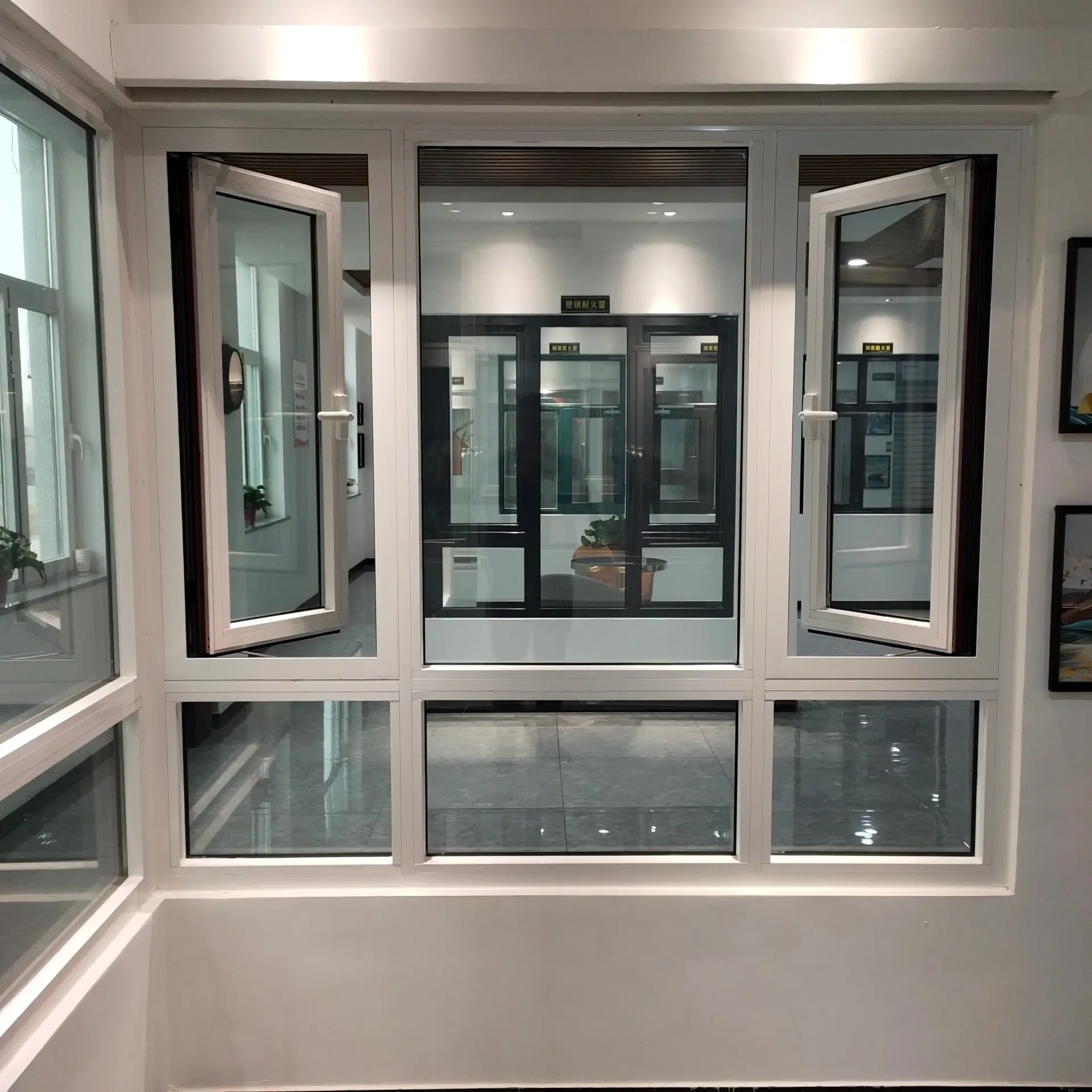
1. Poor thermal insulation of 55 Series single-hung windows: first check whether the sealing strip has failed.
The thermal insulation performance of 55 Series single-hung windows largely depends on the sealing strip to block air convection. If you feel that the window is leaking air and the insulation effect has significantly decreased in winter,the sealing strip is the easiest part to check and repair by yourself,without needing to remove the window or replace the glass.
How to determine whether the sealing strip is aged or deformed?
You can quickly check it by following the three steps below, each corresponding to a specific failure mode:
- Check the appearance: Open the window and observe the surface of the rubber seal. If there iscracks, hardening, or stickinessorpartial detachment, it indicates that the rubber seal has aged and failed.A normal rubber seal should be soft, elastic, and have a smooth surface.
- Check elasticity: Press the rubber seal with your finger. If after pressingit rebounds slowlyoror leaves an indentation without rebounding, it indicates the seal has lost the compression ability required for sealing.
- Test fit: After closing the window, shine a flashlight from outside inward, and observe the gap between the window frame and sash from inside. If you seeObvious light penetrates through, indicating that the rubber strip is not fully adhered and there is an air leakage channel.
Specific impact of failed sealing strips on thermal insulation performance
Failed sealing strips can lead to the following issues, directly affecting winter insulation:
- Direct cold air infiltration: After the rubber strip ages, the sealing gap between the sash and frame enlarges, allowing outdoor cold air to continuously enter the room, creating a noticeable "draft."
- Destruction of the insulation layer: Even if the glass and profiles themselves have normal insulation performance, once air convection forms, indoor heat will rapidly escape through the gaps, potentially reducing insulation effectiveness by 30%-50%.
- Increased risk of condensation: The window frame and glass near air leaks have lower temperatures, making them more prone to condensation and frost in winter, which may lead to mold on the window frame over time.
Key trade-off: If only the weatherstripping is aged, replacing it is low-cost (usually tens to a hundred yuan) and can restore most of the thermal insulation performance. There is no need to replace the window directly due to poor insulation. However, if the weatherstripping is intact but the window still has poor insulation, it is necessary to check the glass configuration (e.g., whether it is single-pane glass) or whether the profile cavity lacks insulation filling.
Next confirmation step: Check the weatherstripping condition according to the three steps above. If aging or deformation is found, contact the current website team to confirm the rubber strip model and replacement plan suitable for the 55 Series single-hung window. If the rubber strip is intact but the insulation is still unsatisfactory, please provide the team with the window dimensions and glass configuration to evaluate whether upgrading the glass or adding sealing measures is needed.
2. Check the glass configuration: Does the 5+12A+5 insulating glass meet your insulation needs?
The standard 5+12A+5 insulating glass (two 5mm glass layers with a 12mm air layer in between) for the 55 Series single-hung window can meet basic insulation requirements in most residential and general commercial projects. However, its applicability depends on the climate of the project location and the building orientation.
How to determine if the insulating glass is fogged or has seal failure
Fogging can be divided into two situations: If fogging occurs on the inner side (indoor side) of the glass, it is condensation caused by high indoor humidity and low window surface temperature,not a glass quality issue, which can be alleviated by ventilation or using a dehumidifier. If there is fog inside the hollow layer of the glass, it indicates that the seal has failed and moisture has entered the air layer.This is a product quality issue, and the entire piece of hollow glass needs to be replaced. The glass of the 55 Series single casement window is fixed by a bead structure, so it can be replaced individually without changing the window frame.
When is it necessary to upgrade the glass configuration?
The following scenarios recommend upgrading: In northern severe cold or cold regions (winter minimum temperature below -10°C), consider upgrading to Low-E hollow glass (such as 5+12A+5+Low-E) or triple-pane double-cavity (5+9A+5+9A+5);When the building has mandatory energy-saving standards (such as green building two-star or above);When the window area exceeds 2㎡, resulting in concentrated heat loss. The upgrade cost increases by about 30%-50%, but it can significantly reduce winter heating energy consumption.
3. Hardware Locking Points and Installation Gaps: Two Easily Overlooked Air Leakage Points
How can insufficient or misaligned locking points cause the window sash to close improperly?
Insufficient locking points (fewer than 2) or misalignment can cause uneven pressing force after the sash is closed, leading to slight outward bulging in the middle section under wind pressure, forming gaps. Inspection method: After closing the window, run your hand along the perimeter of the sash to feel for any airflow;Check whether the locking points and strike plates are fully aligned; if the locking point only catches the edge, it indicates misalignment. The standard configuration for a 55 Series single casement window is typically 2-3 locking points, with even distribution being more important than quantity.
Inspection method for insufficient foam filling or cracked sealant during installation
The gap between the window frame and the wall is filled with foam sealant, and the joint is sealed with sealant. Improper treatment can form a thermal bridge. Inspection steps: Remove the decorative cover to observe whether the foam sealant is full and continuous. If there are voids or shrinkage cracks, the filling is not solid.Press the sealant to see if it cracks or detaches, focusing on the bottom of the window frame and corners. If conditions permit, conduct a water spray test: spray water from outside the window at the joint and observe whether water seeps inside.
Construction quality is more critical than material brand. For batch procurement, it is recommended to randomly inspect 3-5 windows after the first installation to confirm process stability.
4. What to Do After Inspection: When to Repair and When to Upgrade?
After inspecting the insulation issues of the 55 Series single-hung window, your next steps depend on the root cause and your usage scenario. The following is a specific decision framework.
Common issues that can be handled by yourself or by contacting the supplier
Situations suitable for repair (no need to replace windows):
- Aging or falling off of weatherstripping: This is the most common cause.Check whether the weatherstripping between the window frame and sash is hardened, cracked, or missing.Replace it with the same specification weatherstripping yourself; the cost is very low.
- Loose hardware causing poor closure: Loose locking points or hinges can create gaps that let in drafts.Tightening the screws or adjusting the lock point position usually takes a few minutes to solve.
- Loose glass bead: If the bead is not pressed tightly, it can cause air leakage at the glass edge.Simply press it back or replace the bead.
- Cracked sealant between window frame and wall: Apply sealant to repair, no need to move the window frame.
Situations suitable for contacting the supplier:
- Fogging or condensation in the insulating glass layer: Indicates that the hollow seal has failed, leading to reduced thermal insulation performance.The hollow glass (5+12A+5 configuration) needs to be replaced, but the window frame and profiles can be retained.
- Obvious deformation or corrosion on the profile surface: If only partially damaged, a single window sash can be replaced;if the frame is severely deformed, a full replacement should be considered.
When should you consider upgrading to the 60 or 70 series?
Situations suitable for upgrading (replacing windows rather than repairing them):
- After inspection, it is confirmed that the profile itself has insufficient thermal insulation.: The 55 Series profile has a width of 55mm, with a narrower thermal break strip and a shorter heat transfer path.If the winter temperature in your area often drops below -10°C, and the window faces north or is on the windward side, the insulating glass configuration (5+12A+5) of the 55 Series may not meet insulation requirements.In this case, upgrading to the 60 or 70 Series, with increased profile width, wider thermal break strips, and more chambers, significantly improves insulation performance.
- : The glass configuration can no longer meet energy-saving requirements: The 55 Series comes standard with 5+12A+5 insulating glass, with a heat transfer coefficient (U-value) of approximately 2.8-3.0 W/(m²·K).The 60 or 70 Series can be paired with 5+20A+5 or triple-pane double-chamber glass (e.g., 5+9A+5+9A+5), reducing the U-value to 1.8-2.2 W/(m²·K), improving insulation by about 30%-40%.If the project has energy efficiency acceptance requirements, it is recommended to upgrade directly.
- : The gap between the window frame and the wall is too large and cannot be effectively sealed: The 55 series frame is relatively narrow, leaving limited clearance between the installed window and the wall. If the original opening has significant dimensional deviations, air leakage may still occur after caulking.The 60/70 series frames are wider, providing better installation allowance and sealing space.
Key trade-offs:
- Cost: Upgrading to the 60 or 70 series increases profile costs by approximately 20%-30%, with an additional 10%-15% for glass configuration upgrades.However, replacing the entire window solely due to seal strip or glass issues would be even more costly.
- Construction time: Repair can be completed in 1-2 days;Replacing windows requires re-measurement, production, and installation, usually taking 7-15 days.
- Effect: Repair can only restore original performance;Upgrading can significantly improve thermal insulation, sound insulation, and wind pressure resistance.
Situations not suitable for upgrading:
- The problem is only with the seals or hardware, and the lowest winter temperature in your area is not lower than -5°C.
- The project budget is tight, and the 55 Series already meets local energy efficiency standards (e.g., in hot summer and cold winter regions).
- The window frame size is already fixed and cannot accommodate the wider frames of the 60/70 Series (need to confirm the reserved opening dimensions).
Frequently Asked Questions
Q: How big is the insulation gap between the 55 Series and the 60 Series? A: With the same glass configuration (e.g., 5+12A+5), the 60 Series has a wider thermal break and more chambers, resulting in a heat transfer coefficient (U-value) about 0.3-0.5 W/(m²·K) lower than the 55 Series, improving insulation by about 10%-15%. If the 60 Series is paired with thicker insulating glass (e.g., 5+20A+5), the gap can expand to over 30%.
Q: My 55 Series windows have been used for 5 years and now leak air. Should I repair or replace them? A: First check the weatherstripping and hardware. If only the weatherstripping is aged, replace it; the cost is tens of yuan.
Only consider replacing the windows if the glass is fogged or the profiles are deformed. It is recommended to first contact the supplier for an on-site inspection before making a decision.
Q: If I upgrade to the 70 Series, can it be installed in my window opening? A: The frame width of the 70 Series is 15mm wider than that of the 55 Series, so it is necessary to confirm whether the reserved opening size is sufficient. If the original opening is a standard size (e.g., 1000×1000mm), it can usually be installed, but re-measurement and customization are required.
It is recommended to provide the opening dimensions to the supplier and let them determine whether it is compatible.
Q: Can the 55 Series be fitted with triple-pane glass? A: In theory, yes, but the profile cavity of the 55 Series is relatively narrow. Triple-pane glass (total thickness approximately 30-35mm) may not fit completely, and the increased weight requires confirmation of the profile's load-bearing capacity. It is recommended to directly consult the supplier whether this configuration is supported, or consider upgrading to the 60/70 Series.
Q: Can the insulation performance be restored to the level of a new window after repair? A: If only the sealing strip is replaced or sealant is applied, the sealing performance can be restored to factory condition, and the insulation effect will be the same as before. However, if the original window frame or glass itself has insufficient insulation capacity, repair cannot improve the insulation level.
Learn more
If after investigation you are still unsure of the root cause of the insulation problem, or need to confirm the optimal solution for a batch project, please feel free to contact the Qinhan System Windows and Doors team. Provide the window dimensions, glass configuration, and climate information of the project location, and we will help match the most suitable repair or upgrade solution.
Related products:55 Series single-opening aluminum window