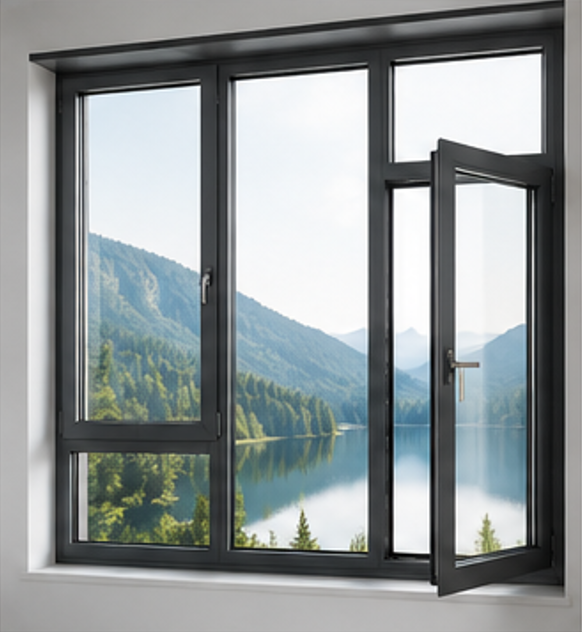
How often should the sealing strip of a 55 Series single casement window be replaced?What is the normal lifespan?
The normal service life of a sealing strip is usually 5 to 15 years , depending on the material, environment, and frequency of use. For 55 Series single casement aluminum windows, the strip is a key component for ensuring air and water tightness, but its aging rate is not fixed. Below, we break down the core factors affecting lifespan and how to determine if it's time for a replacement.
What factors affect the aging rate of sealing strips?
The lifespan of rubber strips is mainly controlled by three variables:
- Material differences: This is the most fundamental factor. Among common materials,EPDM rubber is the most durable, with a normal lifespan of 10-15 years, good UV resistance, and excellent high and low temperature performance.Silicone rubber has a lifespan close to EPDM, but is more expensive.PVC (Polyvinyl Chloride) The rubber strip has the lowest cost, but poor weather resistance. It typically hardens and cracks within 3-5 years, and ages faster in areas with large temperature differences or direct sunlight.Thermoplastic Elastomer (TPE) It falls between the two, with a lifespan of about 5-8 years.
- Environmental Conditions: Long-term exposure to direct sunlight, high temperatures (e.g., southern summers), high humidity, or coastal salt spray environments can accelerate the aging of rubber strips by 2-3 times.The lifespan of rubber strips for indoor windows is typically 30%-50% longer than that for outdoor windows.
- Frequency of UseFrequent opening and closing of windows, pushing and pulling, causes the weatherstripping to repeatedly compress and rub, accelerating wear.For the casement structure of a 55 Series single-hung window, the weatherstripping is compressed when closed. If opened and closed multiple times daily, its lifespan may be shortened by 2-3 years compared to windows that are rarely operated.
Key Trade-off: If your project is in a mild climate zone, with low window opening frequency and a limited budget, PVC weatherstripping can last about 5 years.However, if the project is in coastal, high-cold, or high-temperature areas, or if the windows are used in high-frequency residential or commercial spaces,it is recommended to directly choose EPDM or silicone rubber weatherstripping.Although the initial cost is 15%-30% higher, it avoids the maintenance cost of frequent replacement after 3-5 years.
How to determine if the weatherstripping has failed?
No professional tools are needed; you can evaluate it yourself in the following 4 steps:
- Visual inspection: Observe whether the surface of the rubber strip has cracks, hardening, discoloration (such as yellowing or whitening), deformation, or partial detachment.If fine cracks appear on the surface of the rubber strip, it indicates aging, and the sealing performance will decrease.
- Touch test: Press the rubber strip with your finger to feel its elasticity.A new rubber strip quickly rebounds after pressing;If obvious indentations remain after pressing, rebound is slow, or it feels like hard plastic, the elasticity has failed.
- Seal Test: Close the window, insert a piece of A4 paper between the weatherstrip and the window frame, then try to pull the paper out.If the paper can be pulled out easily (without significant resistance), the seal is not tight.Alternatively, shine a flashlight from outside the window and observe from inside for any light leaks.
- Water Leakage Check: After rain, check the inner side of the window frame for water stains or droplets.If the weatherstrip is intact but water leakage occurs, first check whether the weatherstrip is aged or deformed, rather than directly suspecting the window frame structure.
Next Confirmation Steps: If you have a sample of a 55 Series single casement window or an installed window, it is recommended to test it using the above method. If the weatherstrip shows cracks, loss of elasticity, or fails the sealing test, it needs to be replaced. When replacing, confirm with your supplier (such as the Hyperstron team) whether the material and cross-sectional dimensions of the weatherstrip match the current window type, as the depth and width of the weatherstrip groove may vary between different series.
Steps for Replacing the Sealing Weatherstrip on a 55 Series Single Casement Window: DIY or Hire a Professional?
After the sealing weatherstrip ages, the window sash may not close tightly, causing air leakage and water seepage, which is a common issue with 55 Series single casement windows. Replacing the weatherstrip is not complicated, but the choice between "doing it yourself" and "hiring a professional" depends on two key points:Whether the window sash can still close properly、Whether the weatherstrip groove is deformed。
What tools are needed to replace the sealing strip?
Doing it yourself is simple; the tools are basic:
- New sealing strip: Must match the 55 series window groove.It is recommended to first remove a small section of the old strip, measure the groove width (commonly 4mm, 6mm, 8mm), and then purchase the corresponding specification.
- Scissors: For cutting the strip.
- Roller or plastic scraper: Press the rubber strip into the groove; if you don't have one, an old bank card will also work.
- Alcohol or neutral detergent: Clean residual dust and oil stains inside the groove.
Detailed step-by-step replacement diagram instructions
- Remove old rubber strip: Gently pry up one end of the rubber strip from the corner of the window using your hand or a flat-head screwdriver, then pull out the entire strip.Be careful not to scratch the surface of the aluminum alloy profile.
- Clean the groove: Wipe the groove with a cloth dipped in alcohol to ensure there are no debris or oil stains.This step directly affects the fit of the new weatherstrip.
- Install the new weatherstrip: Starting from the top center of the sash, insert one end of the weatherstrip into the groove and press it evenly along the groove using a roller or scraper.When encountering corners, do not stretch the weatherstrip; maintain its natural curve.
- Cut and finish: After the weatherstrip goes around the sash, cut it with an allowance of about 2-3mm, and press the two ends together into the groove.Place the joint at the top or side of the sash to avoid water accumulation at the bottom.
How to check the sealing after replacing the rubber strip?
After closing the window, clamp a piece of A4 paper between the sash and the frame. If the paper can be easily pulled out, it indicates poor sealing, and you need to check whether the rubber strip is pressed in place or if the groove is deformed. You can also move a lighter along the outside of the window gap to see if the flame is blown by the wind.
In which situations is it recommended to call a professional?
- Difficulty closing the sash: If the sash cannot be closed or sealed properly after replacing the rubber strip, it may be due to an oversized rubber strip or a deformed groove. A professional needs to adjust the hardware or replace the profile.
- Deformation of the window frame or sash: If the sash itself is already deformed (e.g., corner cracking, profile bending), replacing the rubber strip will not solve the air leakage problem. You must contact the supplier or installation team for repair.
- Batch replacement: In engineering or batch orders, it is recommended that the installation team perform the replacement uniformly to ensure consistent sealing and avoid affecting the overall acceptance due to individual window sash issues.
One-sentence judgment: If the window sash opens and closes smoothly and the groove is intact, you can replace it yourself;If the window sash is deformed or does not close tightly, call a professional. If you are unsure about the groove specifications or the matching solution for the weatherstripping, directly provide the window sash model and groove dimensions to the hyperstron team, and they will provide the matching weatherstripping model and installation recommendations.
How to choose materials when replacing sealing strips?Why recommend EPDM or silicone?
When replacing the sealing strip of a 55 Series single casement window, the material selection directly determines the sealing effect and service life. Common sealing strip materials on the market include PVC, EPDM, and silicone. Below is a direct comparison of their core differences to help you quickly decide which one to choose.
Comparison of advantages and disadvantages of different material sealing strips
- PVC (Polyvinyl Chloride)
Advantage: lowest price, controllable initial cost. Disadvantage: poor weather resistance, softens and becomes sticky in summer, hardens and shrinks in winter, leading to seal failure;service life is usually only 1-2 years, prone to cracking after aging. Only suitable for temporary repairs or extremely tight budgets., it is not recommended as a long-term solution.
- EPDM (Ethylene Propylene Diene Monomer)
Its advantages include resistance to aging, ozone, and UV rays, stable elasticity within the range of -40°C to 120°C, and a service life of over 10 years. It has low compression set, allowing it to rebound after prolonged compression, ensuring lasting sealing. The disadvantage is that its price is about 2-3 times higher than PVC.
It is the conventional first choice for engineering and residential windows.。
- Silicone
Its advantages include a wider temperature range (-60°C to 250°C), excellent weather resistance, and being non-toxic, odorless, and food-grade safe. Its elasticity is better than EPDM, and it hardly hardens over long-term use. The disadvantage is that it has the highest price, about 1.5-2 times that of EPDM, and its surface friction coefficient is low, making it prone to slipping during installation.
Suitable for scenarios with special requirements for environmental protection and temperature resistance (such as kitchens, hospitals).。
Which is better, EPDM or silicone?
If only one is to be chosen, EPDM is a more balanced option. The reasons are as follows:
- For 55 Series single casement windows, the weatherstripping between the sash and frame mainly withstands wind pressure and temperature changes. EPDM's weather resistance and elasticity are fully sufficient, offering the best cost performance.
- The advantage of silicone lies in extreme temperatures or food contact scenarios, which are rarely used in ordinary residential and engineering projects, and the cost is relatively high.
- There is little difference in sealing effect between the two, but EPDM has a better installation feel (less prone to slipping), and workers can operate more efficiently.
Who is suitable for EPDM: Most residential buildings, engineering projects, and dealer bulk purchases. Who is suitable for silicone: Scenarios with clear environmental requirements (such as hospitals, food workshops), high-temperature heat sources near windows (such as kitchen windows), or customer-specified silicone.
Dimensions and shapes to pay attention to when purchasing
Choosing the right material is only the first step. If the size and shape are wrong, the sealing strip cannot be installed or the seal will be poor. Key parameters are as follows:
- Shape (Cross-section)
Commonly used for the 55 Series window areI-type (flat type) andO-type (hollow tube type) sealing strips.
- I-type: used for the bead seal between the window frame and glass.
- O-type (hollow tube type): used for the dynamic seal between the sash and frame, with good compression recovery and more reliable sealing.
Confirm the cross-sectional shape of your existing weatherstripping and purchase the same type directly.
- Dimensions (Width and Thickness)
The width and thickness of the weatherstripping must match the window frame/glass groove.
- Measure the width (mm) and depth (mm) of the old weatherstripping groove.
- For 55 Series windows, the weatherstripping width is typically between 5-8mm, and thickness between 3-5mm.It is recommended to use a caliper to measure the actual dimensions of the old weatherstripping, or directly provide the window type drawings to the Hyperstron team so they can match standard weatherstripping specifications.
- Hardness (Shore A)
EPDM weatherstripping commonly has a hardness of 60-70 Shore A, while silicone commonly has 50-60 Shore A.
- Too hard: difficult to install, poor sealing.
- Too soft: easily deformed, loses elasticity after long-term compression.
For standard 55 Series windows, EPDM rubber strips with a hardness of around Shore A 65 are sufficient.
Next Confirmation Steps
- If you have drawings or old rubber strip samples for 55 Series windows, contact the Hyperstron team directly, provide the groove dimensions and cross-sectional shape, and they will recommend matching rubber strip models and prices.
- If you don't have drawings for now, take a clear photo of the window frame groove (with a ruler), and the team can also determine the applicable specifications.
When is it not recommended to only replace the rubber strips?When should you consider upgrading the window solution?
Replacing only the rubber strips is the lowest-cost maintenance method, but it is only suitable if the window frame, hardware, and glass are in good condition. If your 55 Series single casement window exhibits the following conditions, replacing the weatherstripping is only a temporary measure, and a more comprehensive solution should be considered:
Window frame deformation or hardware damage must be addressed first
- Window frame deformation: If the aluminum alloy profile (e.g., 6063-T5) shows visible bending or twisting due to installation stress or long-term temperature differences, simply replacing the weatherstripping cannot restore the sealing gap, and air and water leakage will recur.In this case, it is necessary to evaluate whether to straighten or replace the window frame.
- Hardware failure: Worn or loose hinges, handles, and locking points can cause the window sash to close improperly.Before replacing the weatherstripping, the hardware should be repaired or replaced first;If the hardware can no longer match the existing profiles (e.g., old accessories are discontinued), a full window upgrade should be considered.
In which scenarios is it more cost-effective to upgrade to the 60 or 70 Series?
Upgrading the series means larger profile cross-sections and more cavities, significantly improving thermal and acoustic insulation performance. The following scenarios are worth the extra investment:
- Streetside or noise-sensitive areas: The 55 Series is standard with 5+12A+5 insulating glass, providing sound insulation of about 30-35 dB;the 60 or 70 Series can be equipped with 5+20A+5 or triple glazing with two cavities, improving sound insulation by 5-10 dB.If the project is located near a main road, school, or hospital, upgrading will significantly reduce customer complaints.
- Extreme climate zones: In severely cold northern regions or hot and humid southern areas, the 55 Series has limited thermal break width (usually 14-20mm), while the 60/70 Series can be equipped with thermal breaks of 24mm or more, combined with multi-chamber design, improving thermal insulation performance by about 20%-30%.In the long run, energy savings can cover the price difference.
- Bulk procurement with budget allowance: The price difference per window is about 15%-25%, but for bulk orders (e.g., entire residential buildings), the upgrade with unified specifications and reduced post-maintenance makes the overall cost controllable.
Is it more cost-effective to replace the gasket or the window? Key trade-offs
| Judgment dimension | Replace only the gasket | Upgrade the series or replace the entire window |
|---|---|---|
| Cost | Lowest (approximately 10-30 yuan/meter) | Higher (total window cost + installation fee) |
| Applicable prerequisites | Window frame, hardware, and glass are all intact | Window frame deformed, hardware failed, insufficient performance |
| Effect sustainability | 2-5 years (seal aging cycle) | 10-15 years (profile lifespan) |
| Performance improvement | None (only restores sealing) | Significant improvement in sound insulation, thermal insulation, and air tightness |
Conclusion: If your 55 series window frame and hardware are still functioning properly and the project has no special requirements for sound and thermal insulation, replacing only the seals is an economical choice. However, if the window frame is deformed, the hardware is damaged, or the project is located in a noisy/extreme climate zone, upgrading to the 60 or 70 series is more cost-effective—in this case, replacing the seals is only a delay, and you will eventually need to replace the windows, incurring additional labor costs.
Frequently Asked Questions
Q1: To what extent must the 55 Series window frame be deformed before replacement is necessary? A: Use a level or straightedge to check. If the diagonal deviation of the window frame exceeds 3mm, or if the gap between the sash and frame is uneven (tight on one side and loose on the other) after closing, the deformation has already affected sealing. Replacing the weatherstrip will be ineffective, and it is necessary to evaluate whether to correct or replace the window frame.
Q2: My 55 Series window hardware is still usable, but I want to improve sound insulation. Is it useful to only replace the weatherstrip? A: It is useless. Weatherstripping only addresses sealing issues; sound insulation mainly depends on glass configuration and profile cavities.
To improve sound insulation, you need to upgrade the glass (e.g., replace with 5+20A+5 or triple-glazed double-cavity) or switch to the 60/70 Series. You can provide on-site noise data to the hyperstron team, and they will match a glass solution.
Q3: After upgrading to the 60 Series, do the original window openings need to be modified? A: Usually not. The cross-section of the 60 Series profile is about 5mm wider than that of the 55 Series, but this can be addressed during installation by adjusting the sub-frame or using foam filling.
It is recommended to provide the window opening dimensions, and the hyperstron technical team will confirm whether partial modifications are needed.
Q4: Can replacing only the weatherstripping solve the water leakage problem? A: Not necessarily. Water leakage may be caused by aging weatherstripping, blocked window frame drainage holes, or cracked sealant during installation.
First, check: if the weatherstripping is hardened or cracked, replacing it can solve the problem;If water leaks between the window frame and the wall, re-caulking is required;If the window frame itself has pinholes or deformation, the window needs to be replaced.
Q5: How often should the weatherstripping of the 55 Series window be replaced? A: Under normal use, EPDM weatherstripping lasts about 5-8 years, while PVC weatherstripping lasts about 3-5 years. If the weatherstripping becomes hard, loses elasticity, or there is a noticeable gap after the window sash is closed, it should be replaced.
It is recommended to inspect every 2 years, especially at corners and near lock points.
Learn More
If you are unsure about the goal, target users, existing materials, or subsequent maintenance methods, it is recommended to confirm this information first before determining whether the 55 Series single-hung aluminum window is suitable.
Related Products:55 Series Single-Hung Aluminum Window