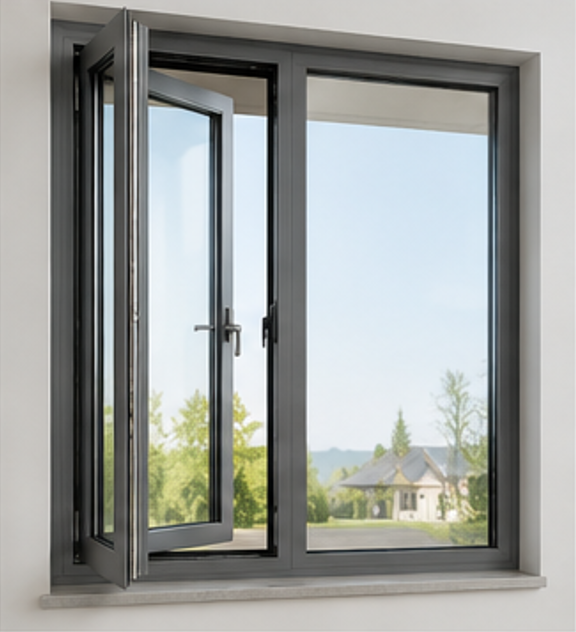
Why does the 55 Series single casement window profile oxidize or corrode? Three Common Causes
The 55 Series single casement window uses 6063-T5 aluminum alloy profiles, which are surface-treated with anodizing or electrophoretic coating at the factory, providing a certain degree of weather resistance. However, in actual use, white spots, blistering, peeling, or even corrosion pits on the profile surface are usually not due to material defects but rather the failure of the protective layer caused by external environment or human operation. Below, we break down the three most common causes to help you quickly determine where the problem lies.
1. Acidic or alkaline environments are the main triggers for surface corrosion of profiles
In environments with a pH below 4.5 or above 8.5, the oxide film on aluminum alloy will dissolve at an accelerated rate. If your windows are installed near the following areas, the risk of corrosion increases significantly:
- Coastal or industrial areas: Long-term adhesion of chloride ions (sea salt) or sulfides (acid rain) in the air can penetrate the oxide film, causing pitting or white spots.
- Kitchens, bathrooms, chemical plants: Acidic substances in cooking fumes, cleaning agent residues, and chemical gases directly contact the profiles.
- Newly renovated buildings: Alkaline components (such as calcium hydroxide) in cement mortar, putty powder, and wall coatings are not cleaned in time, forming a strong alkaline environment when exposed to water, which corrodes the profiles.
Judgment action: Check whether the white spots or corrosion areas are concentrated at the bottom frame of the window, where water accumulates on the windowsill, or near the exhaust outlet. If so, it is likely an environmental factor rather than a profile quality issue.
2. Installation damage and improper cleaning can destroy the protective layer
The oxide film on aluminum alloy windows is usually only 10-15 microns thick. Once scratched or worn, the substrate is directly exposed to air and will oxidize.
- Installation process: Friction between the profile and the ground or scaffolding during handling;Directly striking the window frame with a hammer during installation;Failure to protect the surface during cutting, causing metal chips to embed into the profile.
- Cleaning operations: Scrubbing with steel wool, hard brushes, or cleaners containing abrasives;Cleaning the window frame with strong acids (such as toilet bowl cleaner) or strong alkalis (such as abrasive powder) solutions;Directing high-pressure water jets at the joints between the sealing strips and profiles, causing the protective layer to peel off.
Judgment action: Observe whether the corrosion area is distributed along scratches, impact points, or cut edges. If so, it indicates that the protective layer was already damaged during installation or cleaning.
3. Long-term Water Accumulation and Poor Ventilation Accelerate Corrosion
Even if the environmental acidity and alkalinity are normal, if the window drainage is poor or the sealing strips are aged, rainwater or condensation water will remain on the profile surface for a long time (especially at the bottom and corners of the window frame), forming an oxygen concentration cell and leading to localized corrosion. This situation is actually more common on well-sealed 55 Series windows—because the drainage holes are blocked or not opened, preventing water from draining out.
Judgment action: Check if there is water accumulation at the bottom of the window frame and if the drainage holes are unobstructed. If corrosion is concentrated in the water accumulation area, first solve the drainage problem.
Key Trade-off: Material Issue vs. External Factors
| Judgment Dimension | Material Issue Itself | External Factors |
|---|---|---|
| Corrosion Pattern | Uniform distribution, large-area blistering or peeling | Localized, distributed along scratches/water accumulation/contact points |
| Time of appearance | Appears within a short period after factory delivery (1-3 months) | Gradually becomes apparent after half a year of installation and use |
| Location pattern | No significant difference across various parts of the entire window | Concentrated in specific areas (bottom frame, air vents, cleaning dead corners) |
Next confirmation action: If you find white spots on the profile surface, first check the three points above. If it is confirmed to be improper installation or cleaning, contact your construction team or cleaning crew to adjust their operations;If environmental acid-base corrosion is suspected, it is recommended to provide photos of the installation location and a description of the surrounding environment to the current website team. They can help you determine whether an upgrade to fluorocarbon spray or powder spray profiles (with stronger acid and alkali resistance) is needed. If the corrosion is uniform and appears in the same position on multiple windows, provide the batch information from the factory, and the team will confirm whether it involves a profile treatment process issue.
How to prevent surface oxidation of 55 Series single-hung window profiles?From material selection to daily maintenance
Pay attention to the surface treatment quality of profiles when selecting materials
Choose products with standardized surface treatment processes. For example, the Hyperstron 55 Series single-hung window uses 6063-T5 aluminum alloy with a wall thickness of 1.4mm, and the surface is uniformly anodized to reduce the risk of early corrosion. When purchasing, confirm whether the film thickness meets requirements: powder coating should be ≥40μm, and anodized film thickness is recommended to be ≥10μm.
Clean promptly after installation and inspect regularly
During installation, avoid direct contact between the profile and alkaline substances such as cement and mortar. Remove surface stains immediately after installation to prevent hard objects from scratching the profile. For daily maintenance, regularly wipe with clean water or a neutral detergent (pH 6-8), and avoid using acidic or alkaline cleaners. Check the sealing strips and drainage holes annually to prevent water accumulation from corroding the profile surface.
If the profile surface has slight oxidation or corrosion, can it still be treated?
If the profile surface shows white spots, discoloration, or slight corrosion, whether it can be treated depends on the depth of the damage. The following is a description classified by severity.
Mild white spots or discoloration can be handled by yourself.
If there are only white spots or discoloration on the surface, without obvious pits or peeling, it indicates that the corrosion is only on the surface oxide film layer. You can try the following steps:
- Cleaning: Wipe with a neutral cleaner and a soft cloth to remove surface dirt.
- Remove oxide layer: Use a microfiber cloth dipped in a small amount of aluminum alloy-specific polishing compound or toothpaste, and gently rub the white spot area in a circular motion.Avoid using steel wool or highly abrasive scouring pads.
- Rinse and dry: Rinse with clean water and wipe dry.
- Protection: After drying, apply a layer of transparent protective wax or a specialized antioxidant for aluminum alloy to delay re-oxidation.
Note: Self-treatment cannot restore the protective effect of the original factory oxide film, and enhanced daily maintenance is required after treatment.
Severe corrosion or structural damage: It is recommended to replace the profile.
It is recommended to replace the profile under the following circumstances:
- Corrosion causes the profile wall thickness to decrease by more than 20% (e.g., from 1.4mm to below 1.1mm).
- Penetrating holes or cracks appear in the corroded area.
- The profile is deformed, affecting window opening/closing or sealing.
- Corrosion occurs in load-bearing parts (e.g., window frame corners, mullion connections).
Judgment method: Gently scrape the corroded area with a fingernail; if powder or fragments are easily scraped off, the corrosion has penetrated deeply;Use a caliper to measure the wall thickness at the corroded area and compare it with the original wall thickness. If you cannot judge on your own, it is recommended to directly contact the supplier for testing or replacement solutions.
When should you contact the supplier?Determining whether replacement or upgrade is needed
In daily use of the 55 Series single-opening aluminum alloy window, when slight oxidation or corrosion appears on the profile surface, it can often be handled by cleaning and maintenance. However, once the degree of corrosion affects structural strength or sealing performance, it is necessary to contact the supplier for professional evaluation.
Minor issues can be handled by yourself, while serious issues require professional evaluation
Situations that can be handled by yourself:
- White spots, gray patches, or slight chalking on the surface without penetrating the oxide film
- The corrosion area is smaller than a fingernail and not concentrated on the load-bearing part.
- It only occurs on the outside of the window frame, while the inside remains intact.
Situations requiring contact with the supplier (e.g., Hyperstron/Qinhan System Windows and Doors):
- The corrosion has penetrated the oxide film, exposing the substrate and causing pitting.
- The corrosion area continues to expand, exceeding 5% of the total window area.
- The sealing strip between the window frame and glass is cracked or detached.
- Sticking, abnormal noise, or obvious deformation of the window sash when opening or closing.
- Corrosion occurs near connectors, hinges, or lock points, affecting structural stability.
If the above serious situation occurs, it is recommended to take photos immediately and contact the supplier for on-site evaluation. The supplier will determine whether partial repair, profile replacement, or direct full window replacement is needed.
When corrosion occurs frequently, consider upgrading to the 60 or 70 series.
When the 55 series windows still experience frequent corrosion under normal usage conditions (non-coastal, non-industrial areas), it indicates that the profile thickness or surface treatment process of this series may not meet your actual usage requirements. At this point, consider upgrading to the 60 or 70 series.
Scenarios suitable for upgrading:
- The project is located in a coastal high-salt-spray area, or in corrosive environments such as chemical plants or electroplating factories.
- The 55 series windows show obvious corrosion within less than 3 years of use.
- Corrosion issues occur on multiple windows in the same project simultaneously.
- Higher requirements for sound insulation and thermal performance of windows (60/70 series can be configured with thicker glass and thermal breaks).
Cost increase for upgrading to a higher-grade window:
- Upgrading from 55 series to 60 series: profile cost increases by approximately 15%-25%, with additional costs for glass configuration upgrades (e.g., from 5+12A+5 to 5+20A+5).
- Upgrading from 55 series to 70 series: profile cost increases by approximately 30%-45%, and hardware and sealing systems must be upgraded simultaneously.
- Note: Upgrade costs also include possible installation adjustment fees (e.g., wall openings may need to be enlarged).
Key trade-off: If corrosion issues occur only on individual windows and environmental conditions are normal, prioritize partial replacement over full series upgrade. If the entire project is in a harsh environment, or if the 55 Series has experienced corrosion multiple times, upgrading directly to the 60 Series is the most cost-effective choice—the cost increase is controllable, but the corrosion resistance and sealing performance are significantly improved.
Frequently Asked Questions
Q1: If slight white spots appear on the 55 Series windows, do I need to contact the supplier immediately? Not necessary. First, wipe with a neutral cleaner and observe for a week.
If the white spots disappear and do not reappear, it is only surface dirt. If the white spots recur or expand, then contact the supplier.
Q2: After upgrading to the 60 Series, can the corrosion problem be completely solved? There is no absolute guarantee of a complete solution, but the 60 Series typically uses thicker profiles (1.6mm-1.8mm) and better surface treatment processes (such as fluorocarbon spraying or powder coating), making its corrosion resistance significantly better than the 55 Series. Under the same environmental conditions, the probability of corrosion can be reduced by 60%-80%.
Q3: After the 55 Series window corrodes, can the profiles be replaced without changing the glass? Yes, but it requires evaluation by the supplier. If the glass is intact and the sealing strip is not aged, the profiles can be replaced separately.
However, note that after replacing the profiles, the sealant needs to be reapplied, and the fit tolerance between the new profiles and the old glass must be strictly matched. It is recommended to confirm after on-site measurement by the supplier.
Q4: How many years can the 55 Series windows last in coastal areas? Under normal maintenance, the service life of the 55 Series in coastal areas is about 5-8 years. If cleaning and anti-rust treatment are performed twice a year, the lifespan can be extended to 10 years.
After this period, it is recommended to proactively contact the supplier to evaluate whether an upgrade is needed.
Q5: After upgrading to the 70 Series, is the sound insulation improvement of the window obvious? Significantly. The 70 Series can be configured with 5+20A+5 or thicker insulating glass, and the sound insulation performance is improved by about 5-8 decibels compared to the 55 Series (from about 30 decibels to 35-38 decibels).
If sound insulation is the main requirement, upgrading to the 70 Series is more worthwhile than the 60 Series.
Learn More
If you have higher requirements for the weather resistance of the 55 Series casement window profiles, or need to assess the corrosion risk of existing projects, you are welcome to submit photos of the installation location, a description of the usage environment, and window specifications to the Qinhan System Windows and Doors team. We can assist in matching a more suitable surface treatment solution or recommend an upgraded model.
Related Products:55 Series Single-Hung Aluminum Window