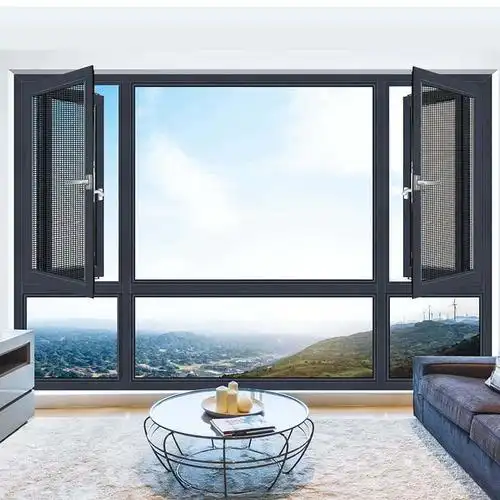
Fogging on glass is a sign of seal failure: first determine whether it is normal condensation or seal damage.
When fogging occurs on a 55 Series single casement window, many people's first reaction is 'the window is broken.' But fogging does not necessarily mean seal failure—first identify the cause before deciding whether to replace the glass or the entire window.
Two common causes of fogging in insulating glass units
The insulating glass unit (for example, the reference configuration of your window is 5+12A+5) is filled with dry air or inert gas and sealed with two layers of sealant to maintain airtightness. Fogging has only two possibilities:
- Normal condensation
When indoor humidity is high and outdoor temperature is low, condensation forms on the glass surface, especially at the edges. This occurs on the glassoutside, and disappears when wiped, without recurring. Common in winter kitchens, bathrooms, or newly renovated rooms.
- Seal Failure (True Fogging)
The sealant of the insulating glass unit ages or is damaged, allowing moist air to enter the cavity between the two glass panes. Water vaporis trapped between the glass panes, cannot be wiped off, and reappears repeatedly with temperature changes—turning into fog when cold, possibly disappearing when hot, but returning after a while.
Key difference:Location。 Condensation on the outside can be wiped off;Fog inside the interlayer that cannot be wiped off indicates seal failure.
Three-step self-check method: Confirm if the seal is truly compromised
If you are unsure, follow the steps below to judge for yourself—it only takes a few minutes to conclude:
- Check the location
Touch the foggy area with your hand. If the water vapor is on the glasssurface, it can be wiped off with a finger — it's condensation. If the water vapor is on thebetween the two panes of glass, and cannot be wiped off with a finger — the seal may be broken.
- Measure the temperature difference
Press the palm of your hand against the foggy area for 5 seconds. The condensation area will temporarily become clear due to the warmth of the palm;areas where the seal has failed (inside the interlayer) will show no change.
- Observe the pattern
Record for one week: if fogging occurs only in the morning or evening, or under specific weather conditions, and disappears during the day, it is most likely condensation. If the fogging persists, or comes and goes but stays in a fixed position, the seal has failed.
Next confirmation step: If you determine that the seal has failed, you need to provide the following information to the current website team so they can offer a matching replacement solution:
- Glass specification (the reference configuration for your 55 Series window is 5+12A+5, but the actual glass thickness and cavity size may differ)
- Dimensions of the foggy glass (length × width)
- Whether it is a single pane or multiple panes with fogging
- Age of the window (sealant aging typically occurs after 5-8 years)
Key trade-offs:
- If it is only condensation, there is no need to replace the glass—reducing indoor humidity (by opening windows for ventilation or using a dehumidifier) can alleviate it.
- If the seal has failed and the window has been in use for more than 5 years, it is recommended to directly replace the entire insulated glass unit (costing about 20%-30% of the total window cost) rather than resealing—resealing cannot restore the airtightness.
- If the fogging area is small (<10% of the glass area) and does not affect visibility, it can be left untreated for the time being, but the seal failure will worsen year by year, eventually leading to mold inside the glass.
What to do after seal failure?Comparison of two treatment options and applicable scenarios
Fogging in insulated glass indicates that the seal has failed. Moisture entering the air layer not only affects visibility but also reduces the window's thermal insulation performance. There are two main treatment methods:Replacing only the insulated glass unit and Replacing the entire window sash。
Below is a direct comparison of the operation process, cost, advantages, and disadvantages of the two options to help you determine which one is more suitable for you.
Option 1: Replace only the insulating glass (low cost, suitable when the glass is intact)
Operation Process:
- Remove the window sash and take out the old insulating glass from the aluminum alloy frame.
- Measure the original glass size, thickness (e.g., 5+12A+5), and the specifications of the sealing strip.
- Custom-order new insulating glass with the same specifications, reinstall it, and seal it with sealant.
Advantages:
- Lowest cost: Only pay for the glass and a small amount of labor, without replacing the profiles and hardware.
- Fast construction: usually completed in 1-2 days, with minimal impact on daily use.
Disadvantages:
- Only solves the problem of glass fogging, cannot improve window frame aging, loose hardware, failed sealing strips, etc.
- If the original window frame is deformed or the hardware is rusted, air leakage and difficulty in opening and closing may still occur after replacing the glass.
Cost Breakdown(Reference):
- Insulating glass (5+12A+5, approx. 1㎡): about 150-300 yuan (including processing fee).
- Labor and removal fee: about 50-100 yuan.
- Total: 200-400 yuan per sash.
Suitable Scenarios:
- The window frame, hardware, and sealing strips are in good condition, only the glass is fogged.
- Limited budget and no plan to replace the entire window in the near future.
Unsuitable Scenarios:
- The window frame is deformed, hardware is rusted, and sealing strips are aged.
- The window has been in use for over 10 years, and other components are near the end of their lifespan.
Option 2: Complete Sash Replacement (Better performance, suitable for old or upgrade needs)
Operation Process:
- Remove the old window sash (including profiles, glass, and hardware).
- Customize a new window sash according to the original opening dimensions (the original frame can be reused or replaced entirely).
- Install the new window sash, adjust the hardware, and apply sealant.
Advantages:
- Comprehensive performance improvement: new profiles, new hardware, and new sealing strips provide better air tightness, water tightness, and sound insulation than old windows.
- Upgradable configurations: for example, upgrading ordinary insulating glass to Low-E glass, adding argon gas filling, or increasing profile wall thickness (e.g., 1.8mm).
- Longer lifespan: a new window sash can last 15-20 years under normal use.
Disadvantages:
- High cost: replacing a single window sash costs approximately 800-1500 yuan (including profiles, glass, hardware, and installation).
- Long construction period: customization and installation typically take 3-7 days.
Cost Breakdown(Reference):
- 55 Series aluminum alloy profile (1.4mm, about 1㎡): about 400-600 yuan.
- Insulated glass (5+12A+5): about 150-300 yuan.
- Hardware (hinges, handles, etc.): about 100-200 yuan.
- Installation fee: about 150-300 yuan.
- Total: 800-1400 yuan per window.
Suitable Scenarios:
- Windows have been in use for more than 10 years, and the frames, hardware, and sealing strips are significantly aged.
- Desire to improve sound insulation and thermal performance (e.g., bedrooms facing the street, near air conditioner outdoor units).
- Plan to live or use for a long term, unwilling to frequently repair.
Unsuitable Scenarios:
- Only the glass is fogged, and other components are in good condition—replacing the entire window at this point offers poor cost-effectiveness.
- Budget is tight, and there are plans to move in the short term.
Key trade-off: How to choose?
| Comparison Item | Replace Only Insulating Glass | Replacing the entire window sash |
|---|---|---|
| Cost | 200-400 yuan per sash | 800-1400 yuan per sash |
| Scope of Solution | Only glass fogging | Full solution for profiles, hardware, sealing, and glass |
| Construction Time | 1-2 days | 3-7 days |
| Performance Improvement | None | Obvious (optional upgrade configuration) |
| Applicable window age | Within 5 years | Over 10 years |
Conclusion:
- If the window frame, hardware, and sealing strips are all intact, and the window age is within 5 years → Choose Plan 1, replace only the glass.
- If the window age exceeds 10 years, or the window frame and hardware have aged → Choose option two: replace the entire window sash to avoid repeated expenses.
- If the window is 5-10 years old but other components are still in good condition → First check whether the window frame is deformed, whether the hardware is smooth, and whether the sealing strip is hardened.If everything is normal, the glass can be replaced;If any one item is obviously aged, it is recommended to replace the entire window.
Next confirmation step:
- Check the four corners of the window frame for obvious gaps or deformation.
- Open and close the window to feel whether the hardware is smooth and whether there is any abnormal noise.
- Press the sealing strip with your hand to see if it is hardened or detached.
- Inform the current website team of the above situation; they can help you confirm whether glass-only replacement is supported, or recommend a matching upgrade solution for the 55 Series casement window.
When is direct upgrade recommended?Budget and performance trade-off between repair and replacement
Situations where repair is not recommended: deformed window frame, multiple repairs, increased performance requirements
When windows fog up, many people's first reaction is, 'Can I just replace the glass?' However, in the following three situations, repair is actually more costly:
- Window frame deformed or profile aged: The profile thickness of the 55 Series single casement window is 1.4mm. If the window frame itself is already bent, stuck, or has weatherstripping falling off, replacing only the glass cannot solve the structural problem.After installing new glass, frame deformation can cause air leakage again, wasting the repair cost.
- Already repaired more than twice: After the insulating glass seal fails, if the seal strip has been replaced or glue has been reapplied before, the success rate of another repair will drop significantly.Because the secondary sealing surface of the aluminum frame has been damaged, the lifespan of a third repair is usually less than one year.
- Higher requirements for sound insulation and thermal insulation: The original glass is 5+12A+5 (i.e., 5mm glass + 12mm air layer + 5mm glass). If the project now requires better thermal insulation (e.g., street-facing residences or west-facing rooms), repair can only restore the original condition and cannot improve performance.In this case, directly upgrading to double-layer insulating Low-E glass or triple-pane two-cavity configuration is a more cost-effective choice.
Budget allocation suggestion: Should the money be spent on glass, hardware, or overall upgrade?
If you decide to replace the windows, prioritize your budget allocation. Taking the 55 Series single-open window as an example, profiles and glass account for the majority of the cost (about 60%-70%), while hardware and installation each account for 10%-15%. Specific recommendations:
| Budget Priority | Where to Spend | Why It's Worth It |
|---|---|---|
| First | Glass Configuration | Directly determines the lifespan of sound insulation, thermal insulation, and anti-fogging performance. It is recommended to upgrade to 5+20A+5 or Low-E coated insulating glass, with a cost increase of about 15%-20%, but the sealing lifespan can be extended by 2-3 years. |
| Second, | hardware. | Affects the feel of opening and closing and long-term durability. |
| If the original hardware is already rusted or stuck, choose stainless steel or zinc alloy handles when replacing windows to avoid needing repairs after two years. | Third, |
Key trade-offsIf the budget is limited, prioritize upgrading the glass and hardware; the profiles and installation can remain as original. If the budget allows, replacing the entire window with a new one and upgrading the glass configuration at once is more hassle-free than repairing it in stages.
Next confirmation step
- Check whether the existing window frame has any visible deformation (use a level to check all four sides).
- Record the number of previous repairs and the content of those repairs.
- Clarify the specific requirements for sound insulation/thermal insulation (e.g., whether noise reduction is needed for street-facing windows).
After organizing the above three points, contact the current website team to confirm whether the 55 Series single-hung window supports customized glass configuration and wall thickness upgrades, as well as the delivery time and cost changes after the upgrade.
How to prevent glass from fogging up again?Key control points from selection to installation
The root cause of glass fogging is the failure of the insulating glass seal, allowing moisture to enter the air layer. To avoid this problem, it is not enough to rely on post-treatment; instead, control should be implemented in advance from three stages: selection, installation, and daily maintenance.
Pay attention to the quality of glass and sealing strips when selecting
The lifespan of insulating glass depends on two lines of defense: the first is the edge sealant (butyl rubber + structural adhesive) of the glass, and the second is the sealing strip between the window frame and the glass. For products like the 55 Series single-opening aluminum alloy window, focus on confirming the following two points during selection:
- Glass Configuration: The reference configuration is "5+12A+5" (5mm glass + 12mm air layer + 5mm glass). This combination is sufficient to handle normal temperature differences in residential and engineering scenarios.If the project is located in a high-humidity area (such as a coastal city), you can require the manufacturer to adopt a "double seal" process—that is, butyl rubber as the first seal and polysulfide or silicone sealant as the second seal.This detail directly affects the sealing lifespan. When purchasing, you can directly ask the supplier: "Is your insulating glass double-sealed?”
- Sealing strip materialFor the sealing strip between the window frame and glass of the 55 series, it is recommended to use EPDM rubber or silicone rubber, and avoid using ordinary PVC strips.PVC strips tend to harden and shrink under temperature changes, leading to water ingress through gaps.EPDM strips maintain their elasticity for a long time and are a common choice for engineering projects.
Key trade-offsIf the budget is tight, do not compromise on the cost of glass sealing process—the cost of replacing insulating glass later is much higher than the initial upgrade of the sealing process.
Post-installation acceptance: water spray test and daily inspection
After the new windows are installed, do not just look at the appearance; a water spray test must be carried out to verify the sealing performance.
Water spray acceptance steps:
- Use a spray gun or hose to continuously spray water from outside the window at the joint between the window frame and glass for 5 minutes (simulating heavy rain).
- Check the inside of the indoor observation window frame, the edge of the glass, and the overlap between the sash and the frame for water seepage or water droplets.
- Pay special attention to the bottom edge of the sash—this is where water is most likely to seep in.
- If water seepage is found, immediately mark the location and ask the installer to adjust the sealing strip or reapply sealant.
Daily Maintenance Tips:
- Check the sealing strip every quarter: press it with your hand to see if it springs back normally;if it becomes hard, cracked, or detached, replace it promptly.
- Clean the drainage holes: there are usually drainage holes at the bottom of the window frame. If they are blocked by dust or debris, water can back up into the glass channel, accelerating seal failure.Use a thin wire or a toothpick to clear them.
- Avoid wiping the glass edges with strong acid or alkali cleaners — these chemicals may corrode the sealant.
Suitable / Unsuitable Judgment:
- Suitable: Residential balconies, bedroom windows, and bulk procurement for engineering projects — these scenarios have clear requirements for sealing performance and allow for water spray acceptance testing.
- Unsuitable: If the project is located in an area with extreme temperature differences (e.g., winter below -30°C), the glass configuration of the 55 Series single-hung window may need to be upgraded to "5+20A+5" or use Low-E glass; otherwise, the sealant is prone to premature aging under thermal expansion and contraction.In such cases, it is recommended to confirm with the supplier whether customization of a thicker air layer or special glass is supported.
Frequently Asked Questions
Q1: Can the insulating glass of the 55 Series single casement window be replaced by myself? Not recommended. The sealing process of insulating glass requires professional equipment (such as a two-component glue dispenser). Self-replacement makes it difficult to ensure sealing performance, and it is more prone to fogging.
It is recommended to contact the original supplier or a professional door and window company for handling.
Q2: Can the glass be repaired if it has already fogged up? Yes, but the repair cost is close to replacing the glass with a new one. The common practice is to remove the glass, clean off the old sealant, re-dry the air layer, and reseal with new sealant.
If the glass itself is not damaged, the repaired effect is comparable to new glass.If the glass already has scratches or aging, it is more cost-effective to replace it directly.
Q3: If the water spray test shows no leakage, does that mean there will be no fogging? Not necessarily. The water spray test mainly checks the installation sealing, while fogging in insulating glass is more often caused by the glass's own sealing process issues.
If the sealant on the glass had minor defects at the factory, fogging may appear within six months to a year after installation. Therefore, during acceptance, in addition to the water spray test, you should also check whether the sealant at the glass edge is uniform and free of bubbles.
Q4: How long can the sealing strips of a 55 Series casement window last? Under normal use, EPDM strips have a lifespan of about 8-10 years, while silicone rubber strips last about 10-15 years. If the rubber strip becomes hard and loses elasticity, it is recommended to replace it in advance even if there is no leakage, because the sealing effect will gradually decrease after hardening.
Q5: What should be noted during daily cleaning? Wipe the window frame and glass with a soft cloth and neutral detergent, avoiding steel wool or cleaners containing abrasives. When cleaning the edges of the glass, do not press hard on the sealing rubber strip to prevent it from shifting.
Learn More
For further selection advice, please submit your working condition parameters, and our technical team will provide professional judgment.
Related Products:55 Series Single-Hung Aluminum Window