FG110F Double inward-opening thermal break window customization step one: What should be confirmed during the drawing review stage?
Drawing review is not just a formality; it directly determines whether the FG110F double inward-opening thermal break window you receive is 'ready to use' or 'requires three months of rework.' At this stage, the manufacturer's focus is not on 'whether the drawing is correct' but on 'whether this drawing can be produced according to the FG110F profile system and whether it can achieve the performance you need after installation.'
Core content of drawing review: dimensions, opening method, and profile series
After receiving your drawing, the manufacturer will focus on verifying three sets of information:
1. Opening dimensions and grid logic
- Confirm whether it isrough opening dimensionsOrthe clear opening dimensions—the difference between the two is the installation gap, and getting it wrong directly results in the window frame not fitting or air leakage.
- Confirm the glazing layout: whether the division between fixed and operable sashes is reasonable.The FG110F is a double inward-opening structure; if the operable sash is too large, the hardware load-bearing capacity and the compression of the weatherstripping must be recalculated;if the operable sash is too small, the ventilation area will not meet requirements.
- Confirm whether there are corners, irregular shapes, or extra-large spans.These directly affect the profile splicing plan and whether steel reinforcement is needed.
2. Opening method and hardware matching
- FG110F isdouble inward opening, and the drawings must indicate the opening direction of each sash (left-opening/right-opening) and whether it is equipped with a screen sash.
- Double inward opening means both sashes open toward the interior, and the drawings must confirm theclearance relationship between the opening sashes—if the two sashes are adjacent at a corner, the opening angle and handle position may conflict.
- The configuration of hardware (hinges, locking points, and transmission gears) depends on the weight and size of the sash; during drawing review, the manufacturer will confirm whether reinforced hardware is needed based on these factors.
3. Profile series and wall thickness confirmation
FG110F uses 6063-T5 aluminum alloy profiles, with a reference wall thickness of 2.0mm. During drawing review, the manufacturer needs to confirm:
- Does your project have special requirements for profile wall thickness (for example, thickening is needed after wind pressure calculation for high-rise buildings)?
- Whether surface treatment is requiredStrip-type thermal breakOrPour-and-degassing thermal break—FG110F is a thermal break structure, but different processes have different requirements for the width of the thermal break strip and machining precision.
- Has the surface treatment method (powder coating, fluorocarbon, anodizing) been determined? This affects the procurement lead time of the profiles.
Why is drawing review the key step to avoid rework?
Because FG110F is acustomized product, not a standard stock item. Once the profile is extruded or cut, the cost of modification is far higher than at the drawing stage.
If the drawing review stage does not confirm clearly, the most common rework is:
- Inconsistent dimension standards: You quote net dimensions, but the manufacturer cuts based on gross dimensions, and it cannot be installed on site.
- Conflicting opening methods: The opening direction is not marked on the drawing, and after production, it is found that the handle hits the wall or two windows interfere with each other.
- Mismatched glass configuration: The reference configuration for FG110F is 5+27A+5 insulated glass, but if your area has sound insulation or energy-saving requirements, the glass configuration needs to be adjusted, and the glass dimensions and profile grooves must be matched in advance.
Supplementary information you need to proactively provide during the drawing review stage:
- The city where the project is located (for wind pressure calculation and insulation requirement assessment)
- Floor height and the location of the opening (whether it is on the windward side)
- The thickness of the interior and exterior finish layers (affects the window frame installation node)
- Whether the glass has special requirements (laminated, Low-E, tempered)
The more complete this information is, the closer the drawing review conclusions will be to your actual installation conditions. If the drawings themselves are incomplete, the manufacturer will first mark the missing items rather than starting production directly—at this point, what you need to do is complete the information, not rush to place the order.
The key trade-off at this stage is: Spending 2-3 extra days on drawing review pays off with a one-time pass in production. If you skip the review and place the order directly, you save communication time but gamble on the dimensions and performance of the entire batch of windows. For engineering procurement, this gamble is not worth it.
Sample confirmation stage: Why is this the watershed for the success or failure of customization?
Drawing confirmation addresses 'what to do,' while sample confirmation addresses 'whether what is made is correct.' For customized products with relatively complex structures like the FG110F double inward-opening broken-bridge window, samples are not just a formality, but one of the key choices before mass production—an opportunity to simultaneously verify design, process, and assembly. Skipping or rushing this step will directly amplify subsequent issues across the entire batch of orders.
Key inspection items for sample confirmation: hardware, glass, and sealing performance
The core of the double inward-opening structure lies in hardware linkage and sealing coordination. After receiving the sample, it is recommended to inspect in the following order:
- Hardware linkage: Repeatedly open and close the two inward-opening sashes to feel whether the operation is smooth, with any jamming or abnormal noise.Double inward-opening means there is a set of linkage hardware between the two sashes; any length deviation in a connecting rod will be exposed during opening and closing.Focus on testing whether the compression between the sash and frame is uniform in the locked state.
- Glass configuration: Check whether the glass matches the confirmed configuration (e.g., 5+27A+5 insulating glass), and inspect the airspace for dust, moisture, or sealant overflow.Glass is one of the highest-cost components in customization, so errors here are the least worthwhile.
- Sealing performance: After closing the sash, check along the perimeter whether the weatherstripping is continuously fitted, with no breaks or obvious gaps.You can test the compression by inserting a piece of paper between the sash and frame—the resistance when pulling should be similar at all points.The thermal insulation performance of thermal break aluminum profiles depends on the quality of profile splicing; visually inspect whether the joints are flat and free of misalignment.
How does sample confirmation set quality standards for mass production?
The essence of sample confirmation is that both parties reach a consensus on what constitutes 'acceptable'. What you confirm is not just one sample, but the acceptance baseline for every subsequent product.
The specific approach is: during sample confirmation, clarify the key indicators from the inspection items above—whether the hardware operating force is acceptable, the tightness of the rubber seal, the allowable range of glass appearance defects, etc. These standards can be recorded on the confirmation sheet and used as the basis for spot checks during mass production. Without standards locked in during the sample stage, disputes that arise after bulk delivery often lead to each party insisting on their own version, making it difficult to determine responsibility.
Key verification points for the double inward-opening structure: In addition to single-leaf functionality, also verify the coordination when both leaves open and close simultaneously—whether the two leaves are on the same plane and whether the locking points are synchronized. This structure demands high processing precision; problems found during the sample stage can still be adjusted, but changes during the mass production stage become issues of cost and delivery time.
Who should focus on investing in the sample stage: For engineering projects, bulk procurement, or orders with clear requirements for insulation or sealing, it is worth spending time on sample confirmation. Who can simplify: If it is only a small batch trial installation or a temporary use with low performance requirements, the process can be accelerated after confirming key items (hardware, glass).
Next step: After receiving the sample, check it item by item according to the above three items and take photos for records, then provide written feedback to the Haipaisichuang team, clarifying which items need adjustment and which items will serve as batch acceptance standards.
From sample to mass production: How does the FG110F double inward-opening thermal break window ensure quality consistency?
After sample confirmation, the core issue in mass production is how to replicate the sample's condition for every window. The quality consistency of the FG110F double inward-opening thermal break window is mainly controlled through standardization of raw materials, processes, and inspection.
Key control points in mass production: profiles, glass, and assembly process
Profile batch management. The FG110F uses 6063-T5 aluminum alloy profiles with a wall thickness of 2.0mm. During mass production, profile quality fluctuations typically stem from alloy grade stability and wall thickness tolerance control.
It is recommended to specify the profile supplier and batch number in the order, agree on the wall thickness sampling method, and avoid mixed batches that could lead to surface treatment color differences.
Glass customization and inspection. The reference configuration is 5+27A+5 insulating glass; the actual project can adjust the thickness or the width of the air gap. During mass production, glass cutting dimensional errors, insulating glass seal quality, and consistency of raw glass sheet sources all affect the performance of the finished window.
It is recommended to lock the glass configuration parameters in bulk orders and proceed with mass cutting only after first-article confirmation.
Standardize the assembly process. The double inward-opening structure requires high precision in hardware installation and consistency in gasket sealing. During mass production, use positioning fixtures and torque tools to ensure consistent frame-sash clearance and hardware tightening torque.
You can confirm with the manufacturer: whether the assembly line has first-article inspection records, and whether key processes have standard operating procedures.
What is the quality inspection process before shipment?
Pre-shipment inspection typically involves three steps, but the specific scope needs to be confirmed with the manufacturer:
| Inspection Stage | Inspection Content |
| Incoming raw material inspection | Check whether profile wall thickness, surface treatment, and glass specifications meet order requirements |
| In-process inspection | During assembly, conduct spot checks on frame-sash fit, hardware functionality, and gasket continuity |
| Final product outgoing inspection | Check appearance, opening flexibility, and sealing performance;For some projects, water spray tests or air tightness spot checks may be required |
Different manufacturers may have different definitions of "outgoing inspection"—some only perform appearance and functional checks, while others conduct whole-window performance spot checks. If the project has strict requirements for water tightness or air tightness, the inspection items and sampling ratio should be clearly specified before placing the order.
Delivery and Acceptance: For custom FG110F double inward-opening thermal break windows, which items must be confirmed in advance?
When the custom process reaches the delivery stage, what truly determines the success of the project is not production speed, but whether the acceptance criteria are clearly written during the drawing confirmation phase. As a product made to order, the FG110F double inward-opening thermal break window is most prone to disputes at delivery in three areas: packaging method, logistics responsibility division, and what to inspect upon acceptance.
Key Communication Points in the Delivery Stage: Packaging, Logistics, and Acceptance Standards
The packaging of custom windows is not one-size-fits-all. The reference configuration for the FG110F double inward-opening thermal break window is 6063-T5 aluminum alloy profile, 2.0mm wall thickness, 5+27A+5 insulating glass, with a single sash reference size of 1000×1000mm. However, the actual order's dimensions, glass configuration, and quantity may differ, leading to different packaging solutions.
Before placing an order, you must confirm three things with the Haipaisi Chuang team:
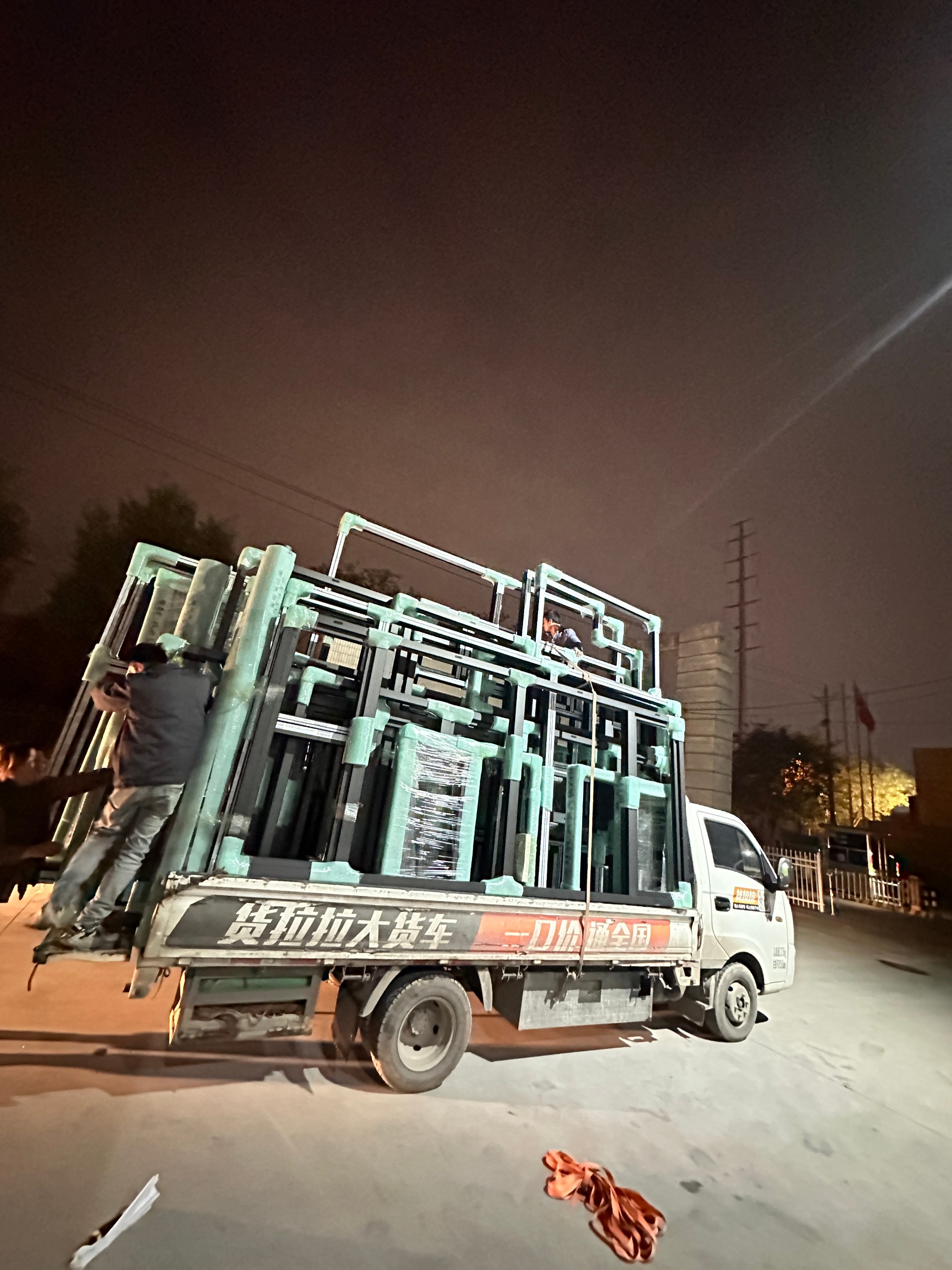
- Packaging form: Is it reinforced with a wooden frame or packed in cartons?Is the glass surface individually protected?This directly affects the shipping damage rate, especially for large-volume orders.
- Logistics responsibility division: Is it the ex-factory price or the price including freight?Who bears the responsibility for shipping damage?It is recommended to specify in the contract the procedure for handling damage discovered during acceptance upon delivery, rather than negotiating after a problem arises.
- Acceptance Standards: What should be checked when accepting custom windows?It is recommended to follow a three-step process: appearance, dimensions, and functionality.Appearance inspection: check the surface of the profiles for scratches or color differences;Dimension inspection: sample-check the diagonal error of the frame and the fit clearance between the opening sash and the frame;Functionality testing: check whether opening and closing are smooth, whether the locking points are aligned, and whether the weatherstripping has fallen off.If the order quantity is large, you can agree on a sampling inspection ratio, for example, 5%-10% of each batch.
Which projects are suitable for the FG110F customization process?Which ones need to be re-evaluated?
Projects suitable for customizing the FG110F double inward-opening broken-bridge window according to drawings typically have three characteristics: clear requirements, complete drawings, and a clear usage scenario.
- Residential community projects: If the project party has clear requirements for thermal insulation, sealing, and the inward-opening structure, and the window dimensions and opening method have already been determined by the architectural design, it is suitable for the customization process.The double inward-opening structure facilitates unified installation and maintenance, and the insulated glass configuration provides practical help with sound insulation.
- Street-facing residences or cold northern regions: For projects with strict requirements for sound insulation and thermal insulation, the glass configuration and profile wall thickness can be adjusted based on the reference configuration.For such projects, as long as the performance targets are clearly defined, the customization process can be effectively matched.
- OEM/ODM projects: If you are a brand purchaser who needs to sell this window type under your own brand, the customization process is naturally suitable—from profile surface treatment, glass configuration, to packaging and labeling, everything can be adjusted according to your requirements.
Cases where customization should not be initiated are often not due to issues with the product itself, but rather because the prerequisites are not in place:
- Requirements are still changing: If the project plan has not been finalized, and the window dimensions, opening methods, and glass configuration are still being frequently adjusted, it is not recommended to place an order hastily.Once customized windows enter production, changing the drawings means changing the materials, which will cause both cost and schedule to spiral out of control.
- Incomplete drawings: If there are only renderings without node diagrams, without accurate opening dimensions, or without clear specifications for the number of opening sashes and hardware configuration, such cases require completing the missing information before starting.What is missing is a "producible drawing"—a detailed drawing that specifies the profile series, wall thickness, number of glass panes, and opening method.
- Comparing only prices without comparing solutions: If the buyer only compares prices based on a reference configuration without confirming whether this configuration is suitable for their project, the customization process will amplify the risk of mismatch.For example, whether the glass configuration of 5+27A+5 meets local energy-saving standards needs to be confirmed by the project party first.
Final decision recommendation: If your project requirements are clear, drawings are complete, and usage scenarios are well-defined, the customization process for the FG110F double inward-opening broken bridge window can proceed directly;if requirements are still uncertain and drawing depth is insufficient, take time to freeze the solution first, then start customization. This step cannot be skipped; the cost of skipping it is rework and disputes at delivery.
FAQ
Q1: What is the minimum order quantity for custom FG110F double inward-opening thermal break windows? The MOQ depends on the specific configuration and process complexity; different wall thicknesses, glass configurations, and surface treatment methods may have different minimum order requirements. We recommend providing your drawings and quantities directly to the HIPAISICHUANG team to confirm whether the minimum order conditions are met.
Q2: Can the glass configuration be changed? For example, change to 6+12A+6? Yes, it can be adjusted, but two points need to be confirmed: first, whether the profile grooves can accommodate the thicker glass combination, and second, whether the change in the overall window weight affects the hardware load-bearing capacity and the opening/closing feel.
It is recommended to submit the target performance (sound insulation, thermal insulation) and the glass solution together, and let the team confirm the compatibility.
Q3: If scratches are found on the surface of the profiles during acceptance inspection, how should this be handled? This depends on the acceptance standards and liability allocation specified in the contract. It is recommended to clarify the "criteria for judging appearance defects" and "the number of days after delivery within which objections can be raised" before placing the order.
If damage occurs during transportation, the logistics responsible party usually bears the liability, but you need to take photos as evidence upon receipt and provide feedback in a timely manner.
Q4: Can we put our own brand logo on the window types for OEM orders? Yes, but the position, method, and process of the brand logo (spraying, labeling, engraving) need to be specified during the drawing confirmation stage. Different processes have an impact on the production process and delivery time, so the earlier the confirmation, the better.
Q5: The project schedule is very tight. How much lead time should generally be reserved for the customization process? The production cycle depends on the order quantity, configuration complexity, and the current production scheduling situation. It is recommended to request a confirmed delivery date from the Haipaisi Chuang team after the drawings are confirmed, and include the logistics time in the overall project schedule.
If the schedule is particularly tight, it needs to be communicated in advance so that feasibility can be assessed.
Learn More
If you are preparing a customization project for the FG110F double inward-opening thermal break window, you are welcome to submit the drawings and project requirements to us. The team will assist in confirming configuration compatibility and provide production scheduling recommendations.
Related Products:FG110F Double Inward-Opening Thermal Break Window