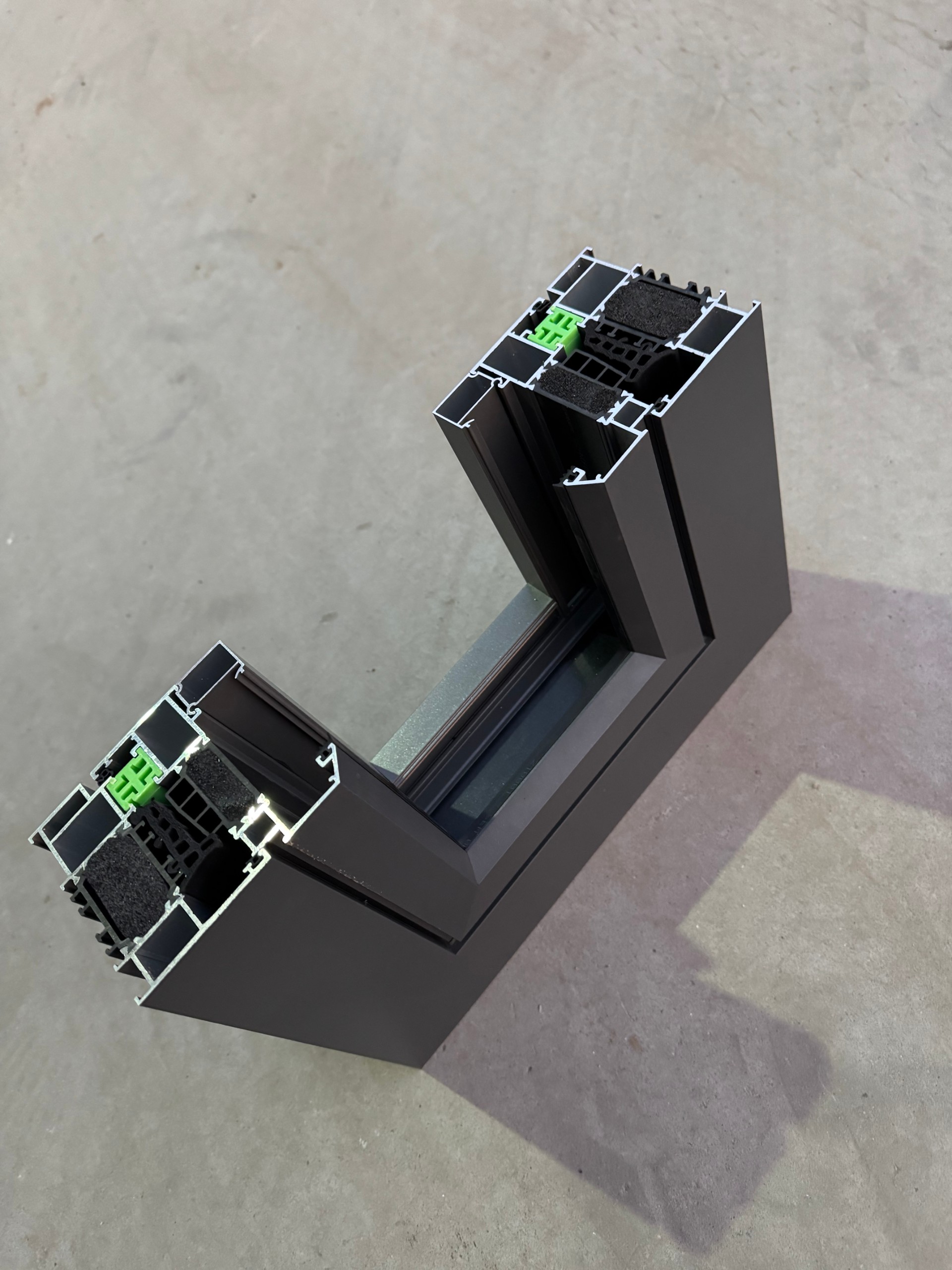
Aluminum alloy window wall thickness difference: How does a 0.2MM gap affect structural performance?
What are the 'wall thickness' and 'load-bearing performance' of aluminum alloy window profiles?
The 'wall thickness' of an aluminum alloy window refers to the thickness of the wall of the aluminum alloy profile at a specific cross-section position that forms the window frame. It does not refer to the thickness of the entire window, but is a core parameter that determines the strength of the profile itself. Load-bearing performanceis primarily reflected in two aspects: the static load-bearing capacity to support the weight of the glass and other components, and the dynamic resistance to deformation against outdoor wind pressure.
Wall thickness directly affects the section's moment of inertia, i.e., its resistance to bending, which is the physical foundation for load-bearing and wind pressure resistance.
What are the differences in the mechanical basis between 1.8MM and 2.0MM wall thickness?
The wall thickness increases from 1.8mm to 2.0mm. Although the safer value differs by only 0.2mm, it can directly improve the profile'ssection modulusandoverall rigiditywhile maintaining the same material (such as 6063-T5 aluminum alloy). This means the profile's ability to resist bending and deformation is enhanced.
For products like the Hyperstron 80 Series (profile thickness 1.8mm), their wall thickness already meets structural safety and wind pressure resistance design specifications for conventional residential buildings, standard commercial buildings, and most climate regions. Increasing wall thickness is typically used to handle more demanding scenarios, such as ultra-high-rise buildings, coastal strong-wind areas, or large floor-to-ceiling windows, to provide a higher safety margin and long-term deformation control. The choice must be based on the load requirements and risk assessment of the specific project.
Comparison of Load-Bearing Performance Between 1.8mm and 2.0mm Aluminum Alloy Windows: Data and Scenario Analysis
What are the performance differences between the two under conventional residential conditions and standard wind pressure?
In standard ceiling height residential buildings (such as floors 1-6) and areas with normal wind pressure,Profiles with an 1.8mm wall thickness typically offer sufficient load-bearing performance.to meet daily usage requirements. Take the Hyperstron 80 Series (wall thickness 1.8 MM) as an example; it is designed for residential window configurations and can reliably support the glass and maintain structural stability under normal wind pressure. At this time, the 1.8mm wall thickness has been widely validated in the market as a safe and economical choice.
In the face of high-rise buildings or coastal strong wind conditions, will the performance difference be magnified?
When the project is located in a high-rise building (e.g., above 20 floors) or in a coastal high-wind area, the wind load experienced by the windows increases significantly. A 2.0MM wall thickness, compared to 1.8MM, can provide a higher material strength foundation, thereby offering additional safety redundancy and dimensional stability.However, the final performance depends not only on the 0.2MM difference in wall thickness but, more critically, on the overall cross-sectional design of the profile (such as cavity structure and reinforcement ribs).
Therefore, when making a choice, you should not rely solely on the wall thickness number; instead, you must comprehensively consider the project's specific design wind pressure value, window opening size, and whether the product has passed the corresponding wind pressure test certification.
Which projects are suitable for choosing 1.8MM wall thickness?In which scenarios is upgrading to 2.0MM recommended?
For the selection of aluminum alloy window wall thickness, the core is to determine the balance between the actual demand for profile strength in your project and the budget. The following are specific scenario-based criteria for judgment.
Residential Window Configuration: Applicable Scope for 1.8MM Wall Thickness
For the vast majority of conventional residential projects, a 1.8MM wall thickness represents a reasonable starting point that balances performance and cost. Specifically, if your project meets the following conditions, then the 1.8MM wall thickness solution for the 80 Series will be well-suited to your needs:
- Building HeightTypically refers to low-to-mid-rise residential buildings (e.g., 1-8 stories).At these heights, the wind pressure on windows is relatively low, and a 1.8MM wall thickness is sufficient to provide the necessary structural support.
- Geographic Location and ClimateSituated in inland areas or regions with non-extreme climates, without long-term threats from strong typhoons or high wind pressure.
- Window Type and SizeIt uses a conventional opening method (e.g., casement window), and the area of a single sash is within the standard range (e.g., within 1.5 square meters).Oversized sashes or non-standard dimensions may require additional assessment.
- Design Style and Glass ConfigurationIt uses common single or insulated glass (e.g., a 5+22A+5 configuration), with the overall weight kept within a reasonable range.
The core advantage of choosing a 1.8 mm wall thickness lies in cost control; it allows for the delivery of compliant products at a more economical cost.
Project Procurement: When to Consider the 2.0 mm Wall Thickness Solution
When your project encounters one or more of the following situations, from a performance and safety perspective, you should seriously consider upgrading to a 2.0 mm or thicker wall thickness solution:
- High-rise buildings or special locations:The project is located in a high-rise building (e.g., above the 9th floor), or in areas such as the windward side or corners of the building where wind pressure increases significantly.
- Harsh climatic environments:The project is situated in coastal areas or strong wind zones, requiring windows that can withstand higher instantaneous wind loads and potential corrosive environments.
- Oversized or special openings:Designs include large fixed windows, floor-to-ceiling windows, or heavy-duty sliding doors, which demand higher load-bearing and anti-deformation capabilities from the profiles.
- Long-term maintenance and brand positioning:The project aims for an extremely long service life and minimal maintenance rate, or is positioned as high-end residential or important public buildings, with stringent product quality requirements.
Upgrading the wall thickness is not mandatory, but it is a targeted investment for higher safety and durability. The increased thickness directly enhances the profile's wind resistance, deformation resistance, and overall strength.
How do I determine which situation my project falls into?
You can quickly conduct the following three-step self-assessment:
Step 1: Clarify the core parameters of the project List the building's height, the wind pressure rating for the city (refer to local building codes), the specific wall location where the windows will be installed (whether it faces the wind), and the estimated maximum size and weight of a single window sash.
Step 2: Assess risk and priority of needs If your project is located in a high-rise or windy area and features large single-window areas, then the weight of 'structural safety' should be higher than that of 'initial cost'. If the project is a standard residential building with standard parameters, then "cost-effectiveness" may be prioritized.
Step Three: Confirm the matching plan with the current website team. This is the most critical step. You can provide your compiled project parameters (e.g., building height, city location, window type size examples) to the product team of the current website. Based on Hyperstron's profile library and engineering experience, they can provide you with the most accurate recommendations for wall thickness and series matching, and clearly inform you whether the standard 80 Series (1.8mm wall thickness) is sufficient for your specific project, or if a thicker profile configuration is required.
Decision Checklist: Signals for Choosing Thicker Wall Materials When any of the following signals appear, it is worth considering the 2.0mm or thicker option:
- Building height exceeds the typical range for mid-to-low-rise residential buildings.
- Project located in high-wind or coastal areas
- Single window unit area approaching or exceeding 2 square meters
- Engineering contracts or design standards have explicit performance specification requirements
Must-read before procurement decisions: What parameters to focus on beyond profile wall thickness?
Profile wall thickness (e.g., 1.8mm or 2.0mm) is one of the key parameters for evaluating the structural strength of aluminum alloy windows, but the final thermal insulation, sound insulation, and long-term durability of a window are a systemic result of the combined performance of the profile, glass, hardware, and installation. Taking the 80 Series aluminum alloy window of this product as an example, its 6063-T5 aluminum alloy profile and 5+22A+5 double-glazing Configuration needs to work in synergy with wall thickness to meet the project's full life cycle requirements.
How does glass configuration synergize with wall thickness to impact overall performance?
Glass accounts for approximately 80% of the window area, directly affecting thermal and acoustic performance. This product uses 5+22A+5 configuration, its 22mm hollow air layer It helps improve thermal and acoustic insulation performance. The profile's wall thickness and chamber structure provide a sturdy support frame for this glass.
Therefore, once you have determined the wall thickness requirement, you must simultaneously confirm the glass's air layer thickness, gas filling, and other configurations to ensure they match the project's specific requirements for insulation and soundproofing.
What long-term value is determined by the combination of profile material and wall thickness?
Wall thickness is primarily related to structural safety, while profile material affects durability and surface quality. Used by this product 6063-T5 Aluminum Alloyis a material with a good balance in strength, corrosion resistance, and machinability. However, the long-term weather resistance of the final product, especially in coastal or humid environments, also depends on the grade of surface treatments such as anodizing, electrophoresis, or powder coating.
A profile with sufficient wall thickness but weak surface treatment may have lower long-term stability than a product with moderate wall thickness but high-standard treatment.
After determining the wall thickness requirements, it is recommended to review the overall solution with the supplier, including glass configuration and profile material, to match the specific application scenario and budget of the project.
Frequently Asked Questions
Does increasing wall thickness mean improved insulation performance?
Not directly equivalent. Thermal insulation performance mainly depends on the glass configuration (such as the thickness of the hollow layer, Low-E film) and the cavity insulation design of the profile (such as the thermal break strips). Wall thickness mainly affects structural strength. However, a thicker profile can sometimes accommodate a more complex cavity structure, providing a foundation for optimizing thermal insulation performance, but this requires overall design to achieve.
How to verify whether the wind resistance performance of an aluminum alloy window meets the standards?
You should request the supplier to provide theWind Pressure Deformation Performance Test Reportissued by an authoritative third-party testing institution, which will clearly indicate the product's wind resistance performance level (such as the kPa value).This is more direct and reliable than looking at wall thickness data alone.You can compare the performance level in the report based on the wind load standard for the region where the project is located.
Is a window with a 1.8mm wall thickness used on a high floor definitely non-compliant?
The basis for determining "non-compliance" is the specific requirements of the local building design codes.In many regions, windows for mid-to-high-rise residential buildings also commonly use a 1.8mm wall thickness combined with a reasonable cross-sectional design to meet the codes.The key is whether the product's overall performance (including wall thickness, cross-sectional design, and hardware) has passed wind pressure calculations and testing targeted for that floor height.It is recommended to submit the project parameters to the Qinhan System Windows and Doors technical team for a compliance assessment.
Does choosing a thicker wall thickness mean the product is of a higher grade?
Wall thickness is one of the important indicators for measuring the product's structural performance, but not the only one.A high-end window product's performance is collectively defined by its profile (including wall thickness, material, and surface treatment), glass system, hardware fittings, and installation technique.A quality product with a wall thickness of 1.8mm may have superior overall performance compared to one with only increased wall thickness but other aspects being rough.A systematic evaluation should be conducted based on the specific requirements of the project.
Learn More
Window type selection is a key step for project success.If you have specific project drawings, building parameters, or performance requirements, please feel free to submit the information to the Qinhan System Doors and Windows team.We will provide you with a matching solution and precise quotation based on the 80 Series thickened aluminum alloy window, to assist in your project decision-making.
Related Products:80 Series Thickened Single-Opening Aluminum Alloy Window