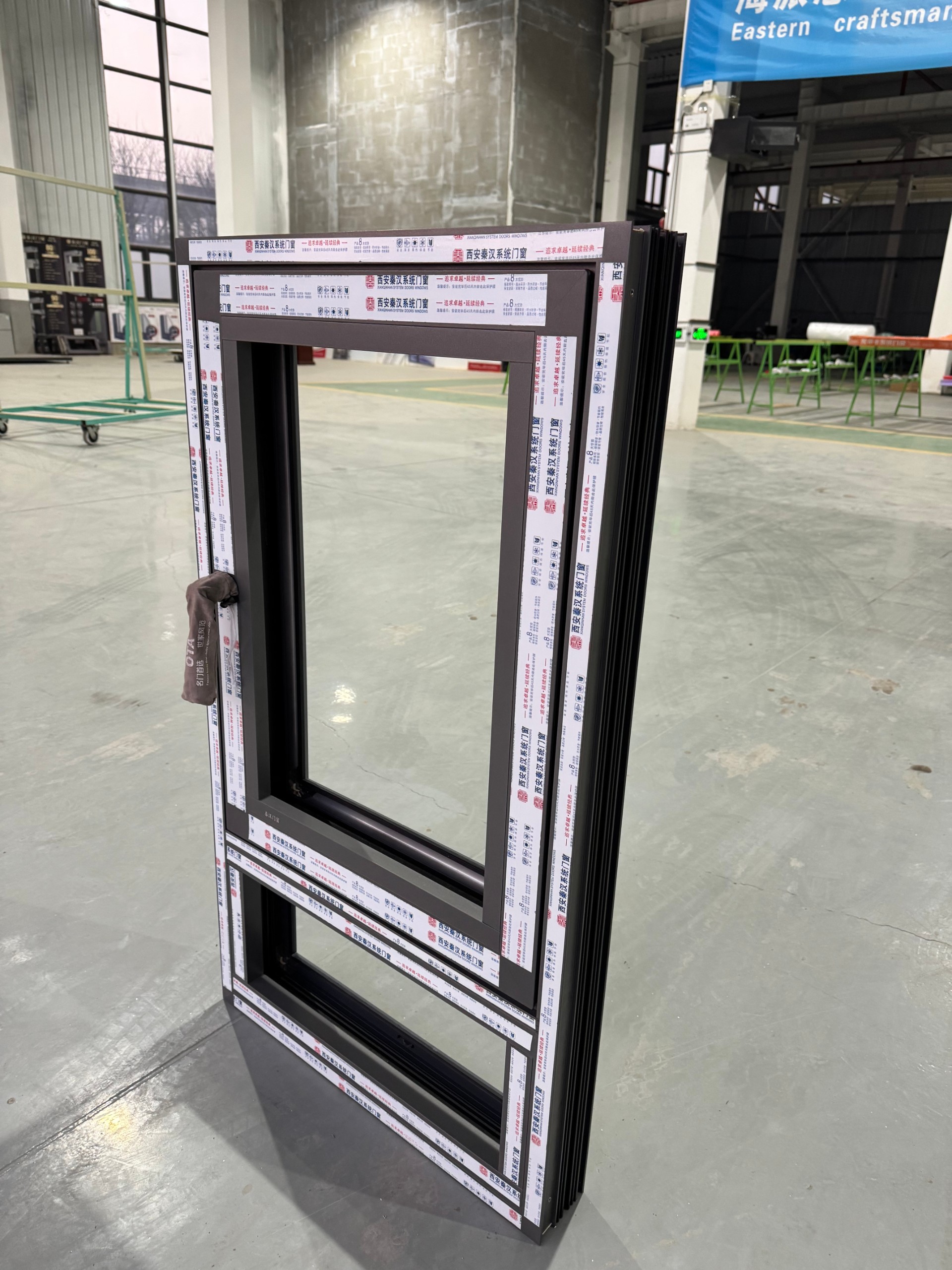
Why does the 55 Series aluminum alloy window require annual maintenance?
Many buyers, when first encountering aluminum alloy windows, tend to have an intuition: aluminum does not rust or deform, so it should not require much care. This idea is half correct—the aluminum alloy profile itself is indeed corrosion-resistant, but the lifespan of a window depends not on the aluminum, but onthe sealing strips, hardware, and drainage system—the three components most prone to aging.
Hidden wear and tear from daily use
Every day, windows undergo three things: friction from opening and closing, temperature deformation, and dust accumulation. Specifically:
- Sealing strips: After prolonged exposure to sun and rain, they become hard and shrink, causing air and water leakage when the window is closed.This deterioration is gradual; it is almost imperceptible in the first year, but by the third year, the gap may reach 1-2 millimeters.
- Hardware (handles, hinges, transmission bars): Each time the window is opened or closed, the lubrication layer wears down a little.Dust and moisture accelerate wear, eventually causing sticking during operation and misalignment of locking points.
- Drain holes and tracks: When dust, leaves, or insect debris block the drain holes, rainwater can backflow into the window frame, and prolonged water accumulation will corrode screws and connectors.
These wear and tear will not cause the window to suddenly fail, but they will reduce the sealing performance and operating feel year by year. By the time obvious air leakage or difficulty in opening and closing occurs, replacement of parts is often already needed.
How big is the lifespan gap between maintenance and non-maintenance?
Taking the 55 Series single-opening aluminum alloy window (6063-T5 profile, 1.4mm wall thickness, 5+12A+5 hollow glass) as a reference:
| Condition | Sealing performance retention period | Smooth hardware usage period | Overall window without major repair period |
|---|---|---|---|
| No maintenance | 3-5 years | 4-6 years | 8-10 years |
| Basic maintenance once a year | 8-10 years | 10-12 years | 15-20 years |
The key difference lies inSeals and Hardware。 The profile itself can last 20 years without issues, but without maintenance, the rubber seals may need replacement or hardware adjustment around the 5th year, and after the 8th year, the probability of water leakage, air leakage, and sticking or jamming of opening mechanisms increases significantly. Spending 15-20 minutes per year on cleaning and lubrication can extend the effective service life of the entire window from 10 years to over 15 years.
Who Needs Special Attention for Maintenance?
- Projects in coastal high salt spray areas (salt spray accelerates hardware corrosion)
- Projects near streets or with high dust levels (tracks are prone to clogging)
- Windows in high-rise residential buildings (high cost and difficulty of replacing parts)
Who Can Relax Maintenance Frequency Appropriately?
- Tilt-and-turn windows (hardware is more weather-resistant, and tracks are less prone to dust accumulation)
- Indoor partition windows (not exposed to wind and rain)
Next confirmation action: Provide our technical team with the climate conditions of the project location (whether it is coastal, whether there is acid rain, the lowest winter temperature), and we can provide targeted maintenance cycle recommendations and a replacement schedule for accessories.
Annual Maintenance Checklist: Five Steps to Extend Window Service Life by Ten Years
For the profiles, hardware, and seals of 55 Series single-opening aluminum alloy windows, performing systematic maintenance once a year can prevent most problems such as "windows not closing tightly," "handles hard to turn," and "water leakage during rain." The following five steps each target a common failure point. Pay attention to specific methods during operation and avoid using brute force.
Step 1: Clean profiles and glass to prevent corrosion
What to do: Use a soft cloth or sponge with neutral detergent (dish soap mixed with water is fine) to wipe off dust, grease, and cement stains from the profile surface and glass. Pay special attention to the lower edge of the window frame and the joints of the glass seal strip, as these areas tend to accumulate dust and absorb water. If not cleaned for a long time, they will accelerate the aging of the sealant.
Note: Do not use steel wool, hard brushes, or cleaners containing strong acids or alkalis (such as toilet bowl cleaner or abrasive powder), as they will scratch the oxidation film of the profile, causing surface corrosion and whitening. After cleaning, rinse with clean water and dry with a dry cloth.
Step 2: Lubricate hardware fittings to eliminate jamming and abnormal noise
What to do: Handles, hinges, lock points, transmission rods—these moving parts should be lubricated once a year. First, wipe off old grease and dust with a dry cloth, then spray or drip onto the moving jointssilicone-based lubricant(also called silicone spray, available at hardware stores or online for a few dollars per bottle). After spraying, open and close the window 3-5 times to let the oil penetrate the gaps.
Note:Do not use motor oil, cooking oil, or WD-40.。 Motor oil and cooking oil attract dust, quickly turning black and sticky, making the handle even stiffer.WD-40 provides temporary lubrication but evaporates quickly and is not long-lasting; it can also dissolve existing grease. Silicone-based lubricant does not attract dust or corrode rubber seals, making it a key and recommended choice.
What should I do if the window handle won't turn? Don't force it first. Check if the screw at the base of the handle is loose—tighten it with a Phillips screwdriver.
If it still feels stiff after tightening, it's likely that the locking points or transmission rod lack lubrication; follow the steps above to lubricate. If it remains stuck after lubrication, the locking points may be misaligned or the hardware deformed, requiring contact with the installer or manufacturer for inspection and replacement.
Step 3: Check and replace the weatherstripping
What to do: Run your hand along the weatherstripping between the window frame and sash, focusing on corners and joints. If the weatherstripping is hardened, cracked, detached, or has lost elasticity (doesn't spring back when pressed), the seal has failed and needs replacement.
Note: The sealing strip of the 55 series single casement window is usually made of EPDM material. When replacing, buy an EPDM strip with the same cross-sectional shape, and do not use PVC strips (which become hard in winter and sticky in summer). Before replacement, clean the old strip residue and dust in the groove. After pressing the new strip into the groove, cut a 45-degree angle at the joint and butt them together without overlapping.
Step 4: Clean the drainage holes to prevent water backflow
What to do: There are usually 2-4 small holes (drainage holes) on the outer side of the window frame bottom. Use a thin iron wire or a toothpick to poke them and clear out the clogged sediment and debris. Then pour a cup of water from the inside of the window frame and observe whether the water can flow out smoothly from the drainage holes. If the water flow is not smooth, it means there is still blockage inside the holes. Use a thin iron wire to repeatedly clear them.
Note: Do not remove the plastic cover (windproof cover) on the outside of the drainage holes; it only blocks wind but not water. If there is standing water or mold around the drainage holes, it indicates poor drainage. Be sure to clean them thoroughly; otherwise, rainwater will backflow into the room through the window frame gaps during the rainy season.
Step 5: Check screws and sealant, tighten loose points
What to do: Use a screwdriver to check whether the expansion screws at the connection between the window frame and the wall, and the fixing screws of the window sash hinges are loose. If the screws are loose, the window sash will sag, causing poor closure or scraping of the rubber seal. At the same time, check whether the sealant (usually weather-resistant sealant) between the window frame and the wall has cracks, peeling, or detachment. If so, use a utility knife to remove the old sealant and reapply weather-resistant sealant.
Note: Before applying sealant, ensure the gap is dry and dust-free. After application, smooth it with a scraper and avoid contact with water for 24 hours.
Key Trade-offs: Among these five steps,lubricating hardwareandcleaning the drainage holesmust be done annually, with almost zero cost, yet it can prevent 90% of daily failures. The replacement cycle for sealing strips and sealant depends on the usage environment (sun exposure, coastal salt spray accelerate aging), generally check every 3-5 years. If your windows already show signs of "not closing tightly" or "water seepage", do not just clean them; first check the sealing strips and drainage holes.
Next confirmation action: If you are unsure whether the 55 Series window type you have matches the above maintenance methods, or need to know the sealing strip specifications and hardware model numbers for this series, you can directly contact our technical team, provide the window model or photos, and we will give a specific accessory matching solution.
When is it necessary to upgrade the maintenance plan or consider replacement?
With normal maintenance (checking sealing strips, drainage holes, hardware annually and cleaning the tracks), the 55 Series single-hung aluminum window can last more than 10 years. But maintenance is not a panacea; some malfunctions are signs of aging, while others are due to a mismatch between the product itself and the usage environment. The following will help you distinguish the boundaries.
Which malfunctions can be handled by yourself, and which must be reported to the supplier?
Common issues that can be handled by yourself (within the scope of maintenance):
- Window does not close tightly: First, check whether the sealing strip is aged, hardened, or detached.If so, replace it with a sealing strip of the same specification (low cost, can be purchased and installed by yourself).Then check whether the hinges or friction stays are loose, and tighten the screws with an Allen wrench.
- Water leakage on rainy days: First, clean the drainage holes (small holes at the bottom of the window frame) using a thin wire or toothpick.If the drainage holes are blocked, cleaning them will solve the problem.If the drainage holes themselves are too small or improperly positioned, contact the supplier to evaluate whether to add a drainage cover or replace the profile.
- Difficulty in opening and closing: The tracks or hinges are dusty or lack lubrication.After cleaning, apply specialized door and window lubricant (silicone-based, not regular oil) to restore smooth operation.
Faults that require contacting the supplier (beyond maintenance capability):
- Window frame deformation or profile cracking: Indicates insufficient strength of aluminum alloy profiles or uneven stress during installation.The 55 series has a wall thickness of 1.4mm. If subjected to excessive wind pressure for a long time (e.g., high-rise buildings, coastal areas), deformation may occur.Maintenance is ineffective at this point; it is necessary to evaluate whether to replace with the 60 or 70 series (wall thickness 1.6mm or 1.8mm).
- Fogging in the glass insulating layer: Seal failure, irreparable, glass unit must be replaced.If the window is still under warranty, contact the supplier for handling;If out of warranty, the insulating glass unit must be ordered separately.
- Hardware breakage or sliding support unable to bear weight: The standard hardware of the 55 series has limited load-bearing capacity. If the window size exceeds 1.2 square meters or is frequently opened and closed, the hardware may fatigue and break.Need to contact the supplier to replace the same model hardware or evaluate upgrade options.
Decision boundary for upgrading from 55 series to 60 or 70 series
Under what circumstances should you replace windows with 60 or 70 series?
| Judgment conditions | Is the 55 series sufficient? | Recommended action |
|---|---|---|
| Floor ≤ 10 stories, non-coastal, no strong winds | Sufficient | Continue maintenance, no upgrade needed |
| Floor >10 floors, or coastal areas, or typhoon-prone areas | Insufficient | Upgrade to 60 Series (wall thickness 1.6mm) or 70 Series (wall thickness 1.8mm + multi-chamber) |
| High sound insulation requirements (near streets, airports) | Insufficient | Upgrade to 70 Series (can be equipped with triple glazing or laminated glass) |
| High insulation requirements (severe cold regions) | Insufficient | Upgrade to 70 Series (multi-chamber + thermal break design) |
| Window size >1.5㎡ (large floor-to-ceiling window) | Insufficient | Upgrade to 60 or 70 Series (higher profile strength) |
| Limited budget and mild usage environment | Sufficient | No upgrade needed, 55 Series offers the best cost performance |
Key Trade-offs: Upgrading from 55 Series to 60 or 70 Series increases cost by about 30%-60% (profiles, glass, hardware all upgraded). If your usage environment has no strong winds, large temperature differences, or high noise issues, the 55 Series is fully sufficient with proper maintenance. However, if your project is located in a high-rise, coastal, or severely cold area, even the best maintenance of the 55 Series cannot compensate for the inherent deficiencies in profile strength or thermal insulation performance—at this point, maintenance is meaningless and replacement is necessary.
Next confirmation action: Provide the current website team with your project floor, location (whether coastal/typhoon zone), and maximum window size. They can help confirm whether the 55 Series meets wind pressure and insulation requirements, or recommend a matching solution from the 60/70 Series.
What projects are suitable for the 55 Series casement windows?When is it not recommended?
The positioning of the 55 Series single-opening aluminum windows is "adequate and economical." Its reference configuration is 1.4mm wall thickness and 5+12A+5 hollow glass, which can meet the basic requirements of sound insulation, thermal insulation, and wind pressure resistance for most conventional projects, but it is not designed for extreme performance scenarios. Below are the judgment criteria directly provided.
Recommended scenarios: residential balconies, bulk procurement for engineering projects, and product selection for distribution channels.
- Residential balcony or bedroom windows: Moderate size (reference 1000×1000mm), insulated glass provides basic isolation from daily noise and temperature, cost-effective.Suitable for family projects with limited budget and no special performance requirements.
- Engineering project bulk procurement: Uniform specifications (1.4mm wall thickness, 5+12A+5 glass), suitable for mass production with controllable costs.Suitable for schools, office buildings, economy residential projects with less stringent acceptance standards.
- Distribution channel product selection: Balance between price and quality, covering mainstream market demands.Dealers can use it as an entry-level or volume product, paired with higher series to meet different customers.
- OEM/ODM Custom Projects: Supports custom sizes and configurations according to drawings (such as adjusting glass thickness or profile color), with sufficient flexibility to handle non-standard orders.
Not Recommended Scenarios: Projects with Unclear Objectives or Extreme Performance Requirements
- Projects with Unclear Goals and Insufficient Data: If the project has not yet determined specific window type dimensions, glass configuration, or installation conditions, directly selecting the 55 Series may lead to rework or performance failure later.For example, ordering blindly without confirming local wind pressure levels or thermal insulation requirements may waste costs.
- Scenarios with Extreme Requirements for Sound Insulation and Thermal Insulation: The sound insulation and thermal insulation capabilities of the 55 Series insulating glass (5+12A+5) are limited.If the project is located in a high-noise area near a street, a severe cold region, or requires passive house certification, it is recommended to upgrade to the 60 Series or configure triple glazing, Low-E glass, etc.
- Projects with frequently changing expected results: If the buyer is still repeatedly modifying window types, sizes, or performance indicators, the fixed configuration of the 55 Series (such as 1.4mm wall thickness) may not be flexible enough to adapt, increasing the cost of mold modification or scrapping.
How to choose between the 55 Series and the 60 Series?
| Comparison item | 55 Series single casement window | 60 Series (reference) |
|---|---|---|
| Profile thickness | 1.4mm | Usually 1.6mm or above |
| Glass configuration | 5+12A+5 | Can be configured with 5+20A+5 or triple glazing |
| Applicable scenarios | Standard residential, economical projects | High-rise buildings, cold regions, high sound insulation requirements |
| Cost | Low | 15%-25% higher |
Key Trade-offs: If the project has clear mandatory requirements for insulation, sound insulation, or wind pressure resistance (e.g., K value ≤ 2.0, sound insulation ≥ 35dB), choose the 60 Series;If it only needs to meet basic residential or office needs, the 55 Series is sufficient.
Next confirmation action
Provide the following information to our team, and we will provide a matching solution:
- Project location (for evaluating wind pressure and climate requirements)
- Window opening dimensions and opening types (single opening, double opening, etc.)
- Whether there are special performance requirements such as sound insulation, thermal insulation, or fire protection
- Budget range (per square meter or total project)
Frequently Asked Questions
Q1: Can the 55 Series single opening window be used in high-rise residential buildings? Yes, but it is necessary to confirm the local basic wind pressure and floor height. The 1.4mm wall thickness usually meets requirements in conventional high-rise buildings (≤100 meters). If it exceeds this or is in a typhoon zone, it is recommended to upgrade the wall thickness or series.
Q2: Is the main difference between the 55 Series and the 60 Series only the wall thickness? Not exactly. The 60 Series usually has wider thermal breaks and larger hollow layers, providing better thermal and sound insulation performance.
The 55 Series focuses more on cost-effectiveness and is suitable for projects with lower performance requirements.
Q3: Can the 55 Series be equipped with Low-E glass? Yes. The 55 Series supports adjustable glass configurations, but it is necessary to confirm whether the profile grooves and sealing strips are compatible.
It is recommended to confirm the specific plan with our team before placing an order.
Q4: For bulk procurement of the 55 Series in engineering projects, what is the minimum order quantity? The minimum order quantity varies depending on size and configuration, typically 50-100 square meters. Please contact our sales team for a specific quotation.
Q5: What is the warranty period for the 55 Series window? The standard warranty period is 2 years, covering non-artificial quality issues of the profiles and glass. The warranty period for hardware may differ; it is recommended to specify it in the contract.
Learn More
If you are selecting or maintaining 55 Series single-opening aluminum windows for your project, please provide the project location, window opening dimensions, opening method, and special performance requirements. Our technical team will match the best solution and provide maintenance cycle recommendations.
Related Products:55 Series Single-Hung Aluminum Window