
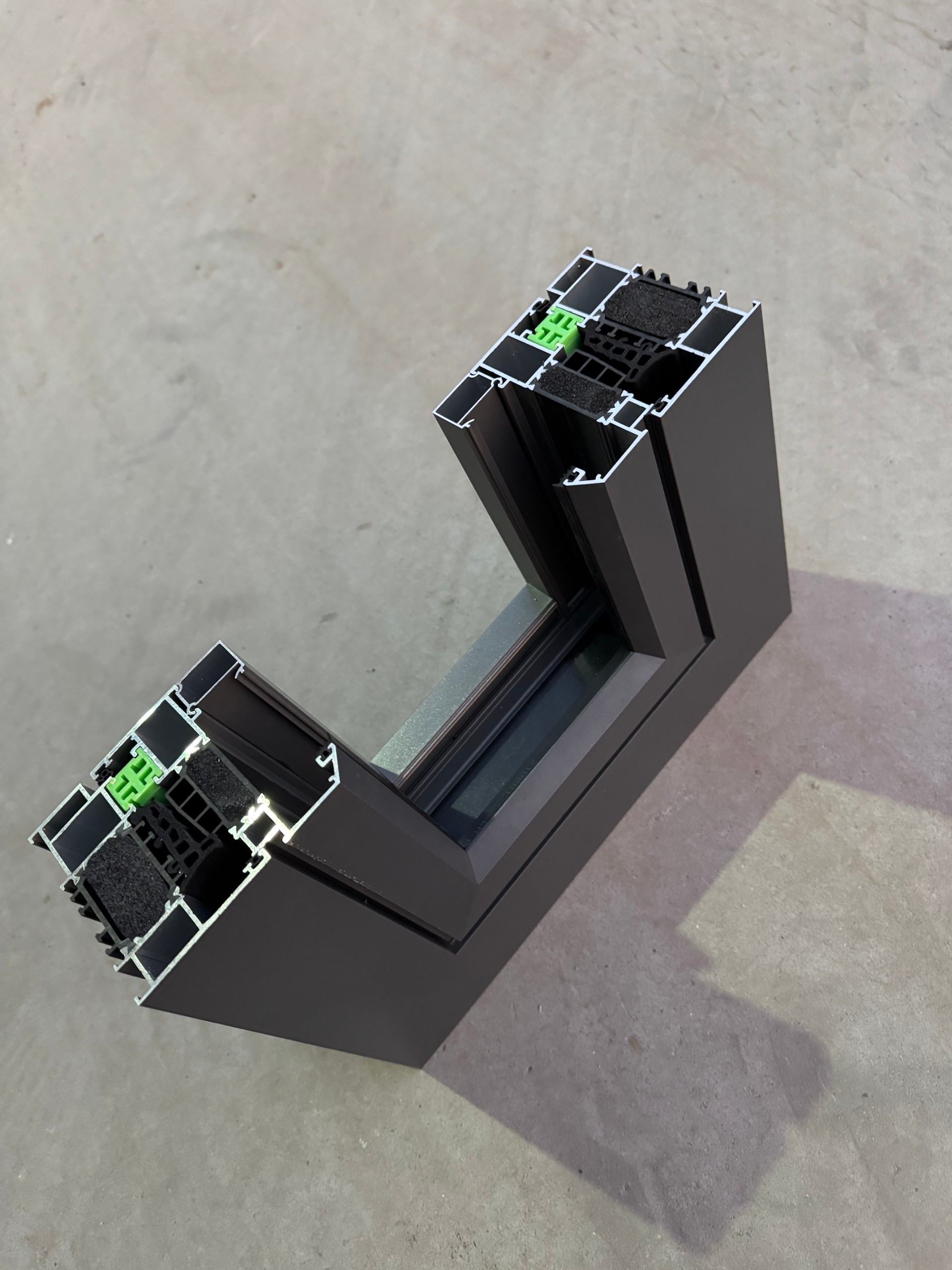
What is the FG110F double inward-opening thermal break window?At what levels is its customization capability reflected?
The FG110F double inward-opening thermal break window is an aluminum alloy window product from the hyperstron brand, using 6063-T5 aluminum alloy profiles, and belongs to the thermal break aluminum alloy window category. The meaning of its name is: FG110F is the product series code, "double inward-opening" means the window sash can open toward the interior, and "thermal break" refers to the thermal barrier strips installed in the profiles to reduce heat conduction. This product is suitable for aluminum alloy window projects that require thermal insulation, sealing, and inward-opening structures.
Defining the customization boundaries from the product perspective: profiles, structure, and reference configurations
The reference configuration of the FG110F is a 2.0mm profile wall thickness and 5+27A+5 insulating glass (two 5mm glass panes with a 27mm air layer in between), with a reference size of 1000×1000mm. It should be clarified that these parameters are baseline configurations rather than fixed specifications, and the customization space in actual projects is developed around these dimensions.
Customization is not just about changing dimensions: glass, wall thickness, window types, and hardware matching
The customization capability of FG110F is not limited to size adjustments; it also involves the following dimensions:
- Glass configuration: The glass thickness, the width of the insulating layer, and the glass type can be adjusted, but they are subject to the constraints of the profile grooves and the overall load-bearing capacity of the window.
- Profile wall thickness: 2.0mm is a reference value; the specific choice needs to be comprehensively evaluated based on factors such as the project's floor height and wind pressure requirements.
- Window type series: Under the double inward-opening structure, specific opening methods can be further selected, and different window types correspond to different hardware systems.
- Hardware matching: The choice of hardware affects the opening method, sealing performance, and user experience, and must be considered in coordination with the glass and profile configurations.
It should be emphasized that customization is not an independent adjustment of each dimension; an increase in glass weight may require a synchronous upgrade of wall thickness or hardware. The specific customization plan needs to be determined based on the project conditions and confirmed with the manufacturer.
Can the glass configuration and profile wall thickness be customized?How do they affect performance and cost?
The reference configuration for the FG110F double inward-opening thermal break window is 5+27A+5 insulating glass and a 2.0mm profile wall thickness, but neither of these is fixed. As an engineering procurement party, you need to understand that:Customization space exists, but every adjustment corresponds to clear performance trade-offs and cost changes, and it is not as simple as "the thicker the better" or "the larger the glass, the better."
Glass configuration customization: options from 5+27A+5 to soundproof, thermal insulation, and safety glass
The meaning of 5+27A+5 is: two 5mm glass panes with a 27mm air layer in between. The core value of this configuration lies inthermal insulation and condensation prevention—the 27mm air layer effectively cuts off the heat conduction path, making it suitable for residential and office projects with thermal insulation requirements.
You can adjust it in the following directions:
- Sound insulation priority: If the project is located near a street or airport, you can switch to asymmetric glass of different thicknesses (such as 5+12A+8), leveraging the resonance frequency differences of different glass thicknesses to reduce noise.Note that simply thickening the glass does not necessarily improve sound insulation linearly; asymmetric combinations are often more effective.
- Enhanced thermal insulation: Replace the air layer with argon gas filling, or apply a Low-E coating on the glass surface.This will increase costs, but in cold regions or facades with severe western sun exposure, the energy savings usually cover the price difference.
- Safety requirements: If used on lower floors or with large glass areas, you can upgrade to tempered or laminated glass.Laminated glass fragments do not fall off when shattered, making it suitable for places with a risk of falling objects from height or with dense crowds.
Profile wall thickness selection: 2.0mm is the baseline, but it should be evaluated in conjunction with project working conditions.
The 2.0mm wall thickness is the reference baseline for FG110F and a reliable starting point for most engineering projects. It determines the window frame's resistance to wind pressure deformation and its structural stability under long-term use. When selecting wall thickness, do not just look at the number; consider three working conditions:
- Floor height and wind pressure: For high-rise buildings or coastal typhoon-prone areas, wind pressure loads increase significantly, and 2.0mm may only be the lower limit, requiring an assessment of whether to increase the thickness.
- Window type and size: If the area of a single window sash exceeds 1 square meter (reference size is 1000×1000mm), the self-weight of the glass and sash increases, and the load-bearing requirements on the profile are correspondingly higher.
- Opening method and hardware load-bearing: The double inward-opening structure imposes long-term load requirements on the hardware. Insufficient wall thickness may lead to sash sagging after long-term use.
Key trade-offs: Increasing wall thickness and upgrading glass will directly raise material costs and the price per square meter. If your project is for ordinary residential floors, non-typhoon areas, and window sizes close to the reference specifications, the reference configuration of 2.0mm + 5+27A+5 is sufficient, and there is no need to pay for unused margin. Conversely, if the project is located in high-rise or wind-pressure-sensitive areas, it is recommended to provide the specific floor height, window size, and local wind pressure data to the Haipaisichuang team, and let them give matching suggestions for wall thickness and glass combination—this is more accurate than self-thickening and avoids cost waste.
Which projects are suitable for choosing the FG110F double inward-opening thermal break window?In which situations is it not recommended?
To determine whether the FG110F double inward-opening thermal break window is suitable for your project, focus on three key points:Whether the installation conditions allow inward opening, whether the project's requirements for thermal insulation and sealing are clear, and whether you can accept the space occupation caused by double inward opening.Below, we will elaborate by scenario.
Recommended scenarios: residential communities, street-facing residences, cold northern regions, and commercial office buildings.
Residential community projects (especially mid-to-high-rise buildings): The double inward-opening structure means that the window sash can be opened towards the interior, so installation and subsequent maintenance do not require workers to lean out of the window, reducing property management and construction safety pressures. For residential projects delivered uniformly, this structure also facilitates unified subsequent maintenance.
Street-facing residences: If you plan to configure insulating glass (reference configuration: 5+27A+5), dual inward opening combined with thermal break profiles has practical significance in sound insulation. However, note that sound insulation effectiveness depends on the glass configuration and installation sealing quality, and is not solely determined by the window type. Before placing an order, you need to confirm with the Haipaisichuang team whether your selected glass combination matches the groove design of this window type.
Cold northern regions: The main value of the thermal break structure lies in reducing heat conduction through the profile itself. The FG110F uses 6063-T5 aluminum alloy profiles with a wall thickness of 2.0mm, and the thermal break design helps improve indoor condensation and heat loss during winter. It is suitable for projects with clear winter insulation requirements, but if your region experiences extreme low temperatures in winter and has strict acceptance standards for insulation performance, it is recommended to first provide the project location and energy-saving requirements so that the Haipaisichuang team can determine whether this window type meets local regulations.
Commercial office buildings: The inward-opening window allows office staff to ventilate and clean the glass on their own, resulting in low property maintenance costs. For office building projects with standard floor heights and regular window opening dimensions, the customization capabilities of FG110F (wall thickness, glass configuration, series selection) can match the unified specification requirements of different floors.
Scenarios not recommended: projects with limited space, unclear objectives, or frequent requirement changes
Projects with limited indoor space are not recommended。 When both inward-opening sashes are fully opened, they occupy indoor space. If there are fixed furniture, equipment pipes, or passageways in front of the windowsill, the inward-opening windows will directly affect usage. Such projects are more suitable for outward-opening or sliding solutions—but this is not the product direction of FG110F. You need to explain the space constraints to the Hipex Creative team and let them determine whether other series can match.
It is not recommended to place an order directly when project requirements are still being frequently adjusted。 FG110F supports customization according to drawings and adjustments in different wall thicknesses and glass configurations, but the premise of customization is that requirements have already been finalized. If you are still comparing multiple window type options, have not finalized the glass configuration, or even the project purpose is unclear, it is meaningless to discuss customization at this point.
It is recommended to organize the following information first before contacting the Haipaisichuang team to confirm the matching solution:
- Project type (residential/commercial/public building) and climate conditions of the region
- Window opening dimensions and opening method requirements (whether inward opening is mandatory)
- Glass configuration requirements (whether insulated, laminated, Low-E, etc. are needed)
- Whether there are energy-saving acceptance standards or sound insulation index requirements
Projects that are extremely cost-sensitive and only seek basic shelter from wind and rain are also not suitable。 The structure and profile costs of double inward-opening thermal break windows are higher than ordinary single-glazed windows. If the project itself has no requirements for thermal insulation, sealing, or inward-opening maintenance, paying for these features is not cost-effective. In this case, you need to clearly communicate your budget boundaries and minimum functional requirements to the Hipex Creative team, and let them determine whether a simpler configuration is available.
Key Trade-off Summary
| Evaluation Dimension | Suitable for FG110F | Recommend Reconsideration |
| Opening Method | Inward opening is acceptable and convenient for maintenance | Indoor space is tight, inward opening may obstruct passage |
| Thermal insulation requirements | Clear thermal insulation requirements | No special requirements, only basic functions |
| Clarity of requirements | Drawings, glass, and wall thickness are basically determined | Still comparing multiple options, with frequent changes |
| Project type | Residential, street-facing, northern residential, office buildings | Low-requirement scenarios such as industrial plants and temporary buildings |
Final step: If you confirm that your project falls into the left-side scenarios, organize the four pieces of information above (project type, window opening dimensions, glass requirements, and energy-saving requirements) and directly confirm the customized matching solution and delivery time for FG110F with the Hipeisichuang team. If the right-side scenarios dominate, it is recommended to clarify your needs first and then return for evaluation, to avoid paying for features you will not use.
How to confirm the customized solution?What are the key steps for sample confirmation and batch orders?
The FG110F double inward-opening thermal break window supports customization according to drawings, but customization does not start from "sending a drawing." For engineering procurement parties and OEM/ODM customers, what really needs to be confirmed is three levels:Whether the profile structure matches, whether the glass configuration meets performance targets, and whether the hardware and opening method align with usage habitsOnly after these three layers are confirmed does the drawing become meaningful.
Customization Process: The Essential Steps from Drawing Confirmation to Sample Verification
Step one: Confirm basic compatibility first. The reference profile thickness for the FG110F is 2.0mm, made of 6063-T5 aluminum alloy, with a reference glass configuration of 5+27A+5. If your project has different requirements for profile wall thickness or glass configuration, you need to first confirm whether the current production line can accommodate the adjustment—this is not a question of "can it be done," but rather whether the impact on thermal insulation and sealing performance after the adjustment is still within your acceptable range.
Step two: Submit the drawings and clearly mark key information. The drawings need to clearly indicate: window dimensions, opening method (whether the dual inward opening is retained), number of glass panes and spacer thickness, profile color, and surface treatment requirements. If any of these items are missing, rework may be required during sample confirmation.
Step 3: Sample verification. The core of sample confirmation is not "does it look right," but checking three things after installing it in the actual opening:whether the weatherstripping fits evenly, whether the inward opening operation is smooth, and whether there is a risk of condensation between the glass and the profile. These three factors directly determine the rework rate for batch orders.
Step 4: Lock in the "sealed sample standard" before batch orders. After sample confirmation, require that the sample itself or detailed photos, dimension records, and glass configuration descriptions of the sample serve as the baseline for batch acceptance. Without a sealed sample standard, every batch of a bulk order may have slight deviations.
Budget allocation suggestion: prioritize core performance first, then consider profiles and hardware.
When the budget is limited, the allocation priority should be:Glass configuration > Profile wall thickness > Hardware > Surface treatment。
Glass configuration has the most direct impact on thermal and acoustic insulation. The 5+27A+5 insulated glass configuration already covers the basic needs of most residential and commercial projects, but if the project is located on a street-facing or cold area, increasing the number of glass layers or adjusting the spacer thickness is more worthwhile than replacing the profile.
Regarding profile wall thickness, 2.0mm is already the engineering-grade standard. Unless the project has special wind pressure resistance requirements, there is no need to add budget for wall thickness. Hardware affects the long-term feel and sealing lifespan. It is recommended to choose suppliers with warranty records, but there is no need to pursue the highest-end series. Surface treatment is the last consideration—color and texture affect aesthetics but not performance, so it can be upgraded when the budget allows.
Who is suitable for the full customization process? When the project's opening dimensions are non-standard, there are clear performance requirements for thermal and acoustic insulation, or there is a need to unify window configurations across multiple buildings, the customization process is worth completing.
Who is it not suitable for? If the project is still in the schematic phase and the opening dimensions and performance targets are not yet determined, it is recommended to first use the FG110F reference configuration for a preliminary plan, and then start customization once the requirements are stabilized. Otherwise, repeated drawing revisions and sample confirmation costs will exceed the value brought by customization itself.
Frequently Asked Questions
Q: Does FG110F support fully customized according to drawings? Yes, but the scope of customization needs to be confirmed. Profile wall thickness, glass configuration, dimensions, and surface treatment can usually be adjusted, but the opening method (double inward opening) and the thermal break structure are the basic design of the product and are not recommended to be changed.
The exact extent of adjustment possible needs to be confirmed after providing drawings to the Hipaisichuang team.
Q: What should be the top priority when confirming samples? Focus on three points: whether the weatherstripping is evenly compressed when closed, whether the inward-opening operation is smooth without jamming, and whether there are abnormal stress marks on the glass edges. These three factors directly affect the installation efficiency and long-term sealing performance of bulk orders.
Q: With a limited budget, which customization requirements can be cut? Prioritize keeping the customization of glass configuration, as it is the core of performance. Surface treatment and hardware upgrades can be postponed.
If the profile wall thickness needs adjustment, first confirm whether the project has strict requirements for wind pressure resistance or load-bearing capacity; if not, maintaining 2.0mm is sufficient.
Q: How are acceptance criteria for bulk orders determined? Based on the confirmed sample, document the sample's dimensional records, glass configuration description, and profile color number in writing, serving as the acceptance basis for bulk orders. After each batch arrives, conduct three random inspections: dimensional deviation, seal strip integrity, and glass scratches.
Q: What generally affects the delivery time for custom orders? It is mainly affected by glass configuration and surface treatment. Non-standard glass (such as thickened, laminated, or coated) requires additional procurement lead time, and special color spraying also increases production scheduling time.
If the project schedule is tight, it is recommended to confirm the delivery time for glass and surface treatment during the drawing confirmation stage.
Learn more
If you are planning a residential or commercial door and window project and have questions about custom matching for the FG110F double inward-opening thermal break window, you are welcome to submit the project type, window opening dimensions, glass requirements, and energy-saving requirements to the Hypersun team. We will provide you with targeted configuration recommendations and delivery time assessments.
Related Products:FG110F Double Inward-Opening Thermal Break Window