
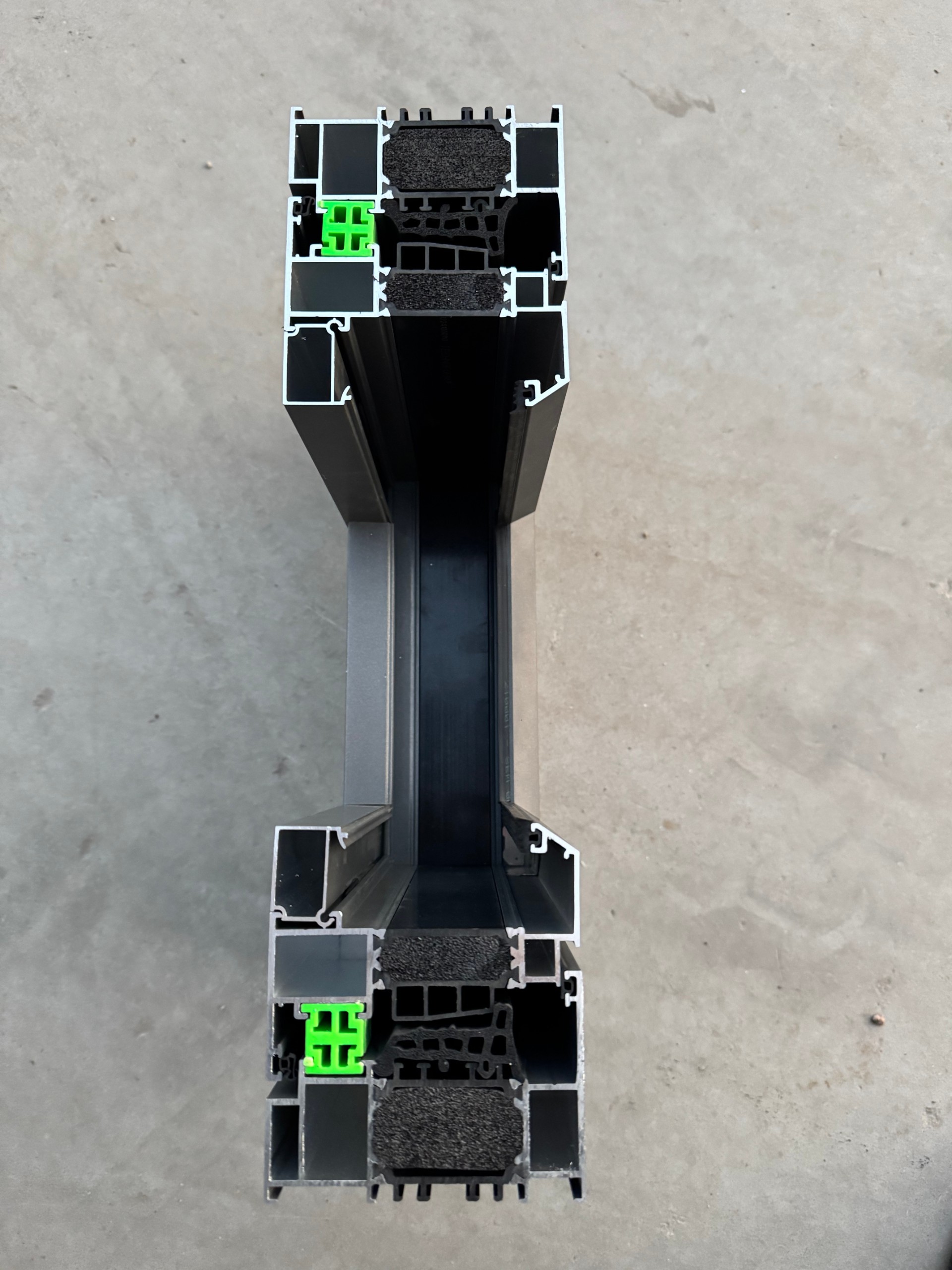
What is 6063-T5 aluminum alloy?Why is it commonly used for thermally broken window profiles?
Material definition and basic characteristics of 6063-T5
6063-T5 is a commonly used aluminum alloy material for building door and window profiles. "6063" belongs to the aluminum-magnesium-silicon alloy series, and "T5" represents the heat treatment state—after high-temperature extrusion, the profile is air-cooled and then subjected to artificial aging treatment to achieve stable mechanical properties.
The balance of 6063-T5 is reflected in three aspects:Good extrusion formability, enabling stable formation of complex cross-sections required for thermally broken windows (thermal break strip grooves, drainage cavities, sealing gasket slots, etc.);High adaptability to surface treatment, with mature processes such as anodizing and powder coating;Sufficient mechanical properties and economical, with a tensile strength of approximately 160–205 MPa in the T5 temper, meeting the conventional load-bearing requirements for building door and window profiles at a lower cost than higher-strength alloys.
Its positioning differs from other aluminum alloy grades (such as 6061 and 6060)
| Grade | Positioning | Application in doors and windows |
| 6063-T5 | First choice for decorative and architectural profiles | For thermal break windows, sliding windows, and curtain wall frames, suitable for complex cross-sections and surface finish requirements |
| 6060 | Similar to 6063, with slightly lower strength | Often used in interior partitions and other applications with lower strength requirements |
| 6061 | Higher strength, more difficult to extrude | Mostly used for structural parts and industrial profiles, rarely as main profiles in doors and windows. |
Therefore, the FG110F double inward-opening thermal break window uses 6063-T5 profiles (reference wall thickness 2.0mm), which means it achieves a balance between cross-section complexity, surface treatment, strength, and cost suitable for building doors and windows.
What specific advantages does the FG110F double inward-opening thermal break window gain from using 6063-T5 profiles?
The FG110F double inward-opening thermal break window uses 6063-T5 aluminum alloy profiles with a wall thickness of 2.0mm. This combination is not arbitrary; it directly determines the load-bearing capacity, durability, and processing precision of the window.
The matching relationship between structural strength and 2.0mm wall thickness
6063-T5 belongs to the aluminum-magnesium-silicon alloy series. The T5 condition (air quenching + artificial aging) stabilizes its yield strength above 160MPa while maintaining sufficient ductility. This means that the profile will not fracture brittly under stress, but will first undergo predictable deformation, which is very important for long-term opening and closing of the window sash and withstanding wind pressure.
Is 2.0mm wall thickness sufficient for this product? The answer is:For the typical application scenarios of FG110F, it is sufficient.There are three reasons for this judgment:
- Profile cross-section design: FG110F features a thermal break structure, where the main load-bearing cavity distributes loads through multiple reinforcing ribs. With a 2.0mm wall thickness combined with a reasonable cross-section geometry, the overall rigidity is superior to solutions that merely increase wall thickness but have mediocre cross-section design.
- Window type dimensions: The product's reference size is 1000×1000mm. At this specification, a 2.0mm wall thickness can better control the sagging deformation of the window sash within a reasonable range.If the project requires oversized panels (e.g., a single sash exceeding 1.5 m²), you need to confirm with the Hipeisichuang team whether the profile needs to be thickened or additional steel reinforcement is required.
- Industry practice: 2.0mm is the mainstream wall thickness for engineering doors and windows, balancing strength and profile cost. It is not a compromise of "good enough" but a balanced point.
Key trade-off: If you are pursuing wind pressure resistance for super high-rise buildings or extreme wind pressure areas, 2.0mm wall thickness may not be the optimal solution. You need to separately calculate wind loads and confirm whether the profile needs to be upgraded.
Compatibility of corrosion resistance and surface treatment (powder coating/anodizing)
Another advantage of 6063-T5 lies in its adaptability to surface treatment. Its alloy composition is pure with low impurity content, and whether powder coating or anodizing is used, a uniform and dense film layer can be obtained.
- Powder coating: 6063-T5 has no obvious extrusion lines on the surface, and after coating, the adhesion is good. It is suitable for the fluorocarbon paint or polyester powder commonly used on building facades, with stable weather resistance.
- Anodizing: If the project specifies a silver-white or champagne-colored anodized surface, the silicon-magnesium ratio of 6063-T5 can better ensure a transparent oxide film and consistent color, making it less prone to color differences.
Practical impact: When FG110F is used in coastal high-salt spray environments or industrial pollution areas, the choice of surface treatment affects service life more than the profile itself. It is recommended to clarify the environmental grade of the project location during procurement and confirm with the Hypex Creative team whether the corresponding surface treatment process meets the corrosion resistance life requirements of that area.
Next confirmation steps: If you have a specific project at hand, it is recommended to directly provide the window division dimensions, the basic wind pressure in the region, and whether it is a coastal or highly corrosive environment, and let the Hipeisichuang team confirm based on these conditions whether the 2.0mm wall thickness and surface treatment plan are suitable, rather than making a decision based solely on the profile grade.
Which projects are suitable for choosing the FG110F double inward-opening broken-bridge window using 6063-T5 profiles?
To determine whether FG110F is suitable for your project, the key is to look at three points: whether an inward-opening structure is needed, how high the requirements are for thermal insulation and sealing, and whether the project allows batch ordering after confirming with samples. Below, we break it down by project type.
Residential and commercial projects: matching thermal insulation, sealing, and inward-opening requirements
Projects suitable for selection:
- Residential projects in cold northern regions: The 6063-T5 profile combined with the broken-bridge structure, along with the reference configuration of 5+27A+5 insulating glass, has clear value in winter thermal insulation scenarios.If your region experiences large temperature differences in winter and heating costs are a concern, this configuration is worth prioritizing.
- Homes on busy streets or in high-noise environments: The double inward-opening structure combined with insulating glass provides practical help with sound insulation and noise reduction.Especially in spaces like bedrooms and studies where quiet is required, the sealing and pressing effect of inward-opening windows is more controllable than that of sliding windows.
- Multi-story or mid-rise residential communities: Double inward-opening windows are easier to install uniformly, maintain, and clean later, making property management and resident self-care more convenient.For residential projects delivered in batches, this uniformity reduces subsequent service costs.
- Commercial spaces with ventilation and cleaning requirements: Inward-opening windows can be fully opened, and cleaning both the interior and exterior glass surfaces does not require additional hoisting or special tools, making them suitable for office buildings, street-front shops, and other scenarios where the facade needs regular maintenance.
Projects not suitable for selection:
- Exterior windows of super high-rise buildings: Inward-opening windows pose safety risks under strong wind pressure and occupy indoor space when opened.If your project is a super high-rise, you need to first confirm the local wind pressure standards and building code restrictions on inward-opening windows.
- Compact layouts extremely sensitive to indoor space utilization: Double inward-opening windows occupy indoor space when opened, and furniture should not be placed in front of the windowsill.If the project has a compact layout and the space near the windows has clear functional planning, the impact of the opening sashes needs to be evaluated.
- Projects with extreme climate or special performance requirements: If your project needs to achieve passive house-level air tightness, or faces strong typhoon/high salt spray environments, the reference configuration of FG110F may not be sufficient. You need to confirm with the Hipex Creative team whether there are higher-grade profiles or glass solutions available.
Custom projects: flexibility with multiple series and different wall thickness/glass configurations
The reference configuration of FG110F is 2.0mm wall thickness, 5+27A+5 glass, and 1000×1000mm dimensions. However, in actual projects, the wall thickness and glass configuration can be adjusted, which determines its adaptability boundaries.
Situations suitable for customization:
- Projects with clear energy-saving or sound insulation targets: For example, if local energy-saving acceptance requires a certain heat transfer coefficient, you can bring specific indicators to confirm whether the glass configuration needs to be upgraded from 5+27A+5 to triple-glazed double-cavity or Low-E combinations.
- Need to match different opening sizes: The reference size is 1 m², but actual project opening sizes vary.FG110F supports customization according to drawings, suitable for projects with non-uniform opening specifications. Simply provide the door and window schedule and node details.
- Contractors or distributors need to confirm samples: If you need to first make samples to verify installation techniques, sealing performance, or appearance matching before deciding on bulk orders, FG110F supports this process, suitable for buyers who need physical confirmation in the early project stages.
Additional confirmation scenarios:
- If your project involves oversized panels (e.g., single sash exceeding 2 m²) or irregular-shaped windows, it is necessary to confirm whether the profile reinforcement solution meets wind load resistance requirements.
- If the project has special requirements for profile surface treatment (such as specific colors, wood grain transfer, or fluorocarbon spraying), it is necessary to confirm whether the current supply system covers these.
- If you need outward-opening windows, sliding windows, or top-hung windows, FG110F is a double inward-opening product and does not belong to the same structural type. It should be directly excluded or another series should be selected.
Key trade-offs: The value of FG110F lies in being 'sufficient and adjustable'—the standard configuration covers most residential and conventional commercial projects, while customization capabilities address non-standard openings and performance upgrade needs. If your project requirements are clear and specifications are well-defined, this product is worth including in the comparison.If the project is still in the stage of repeated plan adjustments, it is recommended to first lock down the opening dimensions and performance specifications, then conduct sample confirmation to avoid frequent changes after customization.
How to determine whether 6063-T5 profiles meet project requirements during selection?
The key to determining whether 6063-T5 profiles are sufficient is not the material itself, but whether it matches your project conditions. The reference configuration for FG110F double inward-opening thermal break windows is 2.0mm wall thickness and 5+27A+5 insulating glass. This combination already covers the conventional needs of most residential and commercial projects. But "standard" does not mean "one-size-fits-all"; the following three questions will help you quickly identify the right choice.
Key Decision Points: Wall Thickness, Glass Configuration, and Sealing Design
How to Choose Wall Thickness? 2.0mm is the wall thickness of the main load-bearing profiles, meeting engineering-grade standards. For standard residential windows (with a single sash area not exceeding 1.5㎡ and a floor height not exceeding 30 stories), 2.0mm is sufficient to meet wind load resistance and daily use strength requirements.
If your project involves super high-rise buildings, large sash divisions (single sash exceeding 2㎡), or strong typhoon-prone areas, you need to consider thickened profiles or additional steel reinforcement. In such cases, you should provide the specific sash dimensions and the basic wind pressure value of the project location to the Haipaisichuang team for verification of suitability.
How to Determine Glass Configuration? The reference configuration 5+27A+5 (5mm glass + 27mm air layer + 5mm glass) is a balanced solution for sound insulation and thermal insulation. The 27A air layer has a significant attenuation effect on mid-frequency noise (such as traffic noise), making it suitable for street-facing residences and ordinary commercial projects.
However, if the project is near an airport or high-speed rail line, or is located in a cold region requiring higher thermal insulation levels, it may be necessary to upgrade to Low-E glass, triple glazing with two cavities, or increase the air layer thickness. These adjustments will affect the overall window weight and hardware load-bearing capacity, so it is necessary to confirm whether the profile cavity can accommodate thicker glass assemblies.
What should you look for in the sealing design? The double inward-opening structure itself imposes high requirements on the design and installation precision of the sealing strips. When selecting, focus on confirming whether the three seals are complete (exterior side, equalization cavity, interior side), and whether the drainage hole positions of the opening sash match the rainfall conditions of the project location.
This part cannot be directly determined from profile parameters; it requires checking sample windows or node drawings.
Working condition information that needs to be confirmed with the supplier
Before inquiring or confirming a solution with the Hipeisic team, prepare the following information to significantly reduce back-and-forth communication costs:
- Project type and floor height: Residential, commercial, and public buildings have different requirements for profile strength;The higher the floor, the greater the wind pressure.
- Maximum single-pane size: This directly determines whether the 2.0mm wall thickness is sufficient.
- Climate conditions at the project location: Minimum winter temperature, maximum summer temperature, and whether there are frequent typhoons and heavy rain.
- Glass configuration requirements: Whether special combinations such as Low-E, laminated glass, or triple glazing are specified.
- Opening method preferences: Whether double inward opening meets all window positions, or some positions need to be changed to inward opening and inward tilting.
When is it not recommended to choose?
In the following three situations, FG110F may not be the optimal solution:
- The project has mandatory certification requirements for energy efficiency levels(such as passive houses or nearly zero-energy buildings), requiring the profile manufacturer to provide complete test reports and certification documents.If the project is overseas and there are specific local standards, it is necessary to confirm in advance whether the profiles meet the local market access requirements.
- High proportion of oversized grids or irregularly shaped windows, the 2.0mm wall thickness may not meet deflection control requirements, and a customized reinforcement solution is needed.
- Extremely budget-sensitive and with low requirements for sound and thermal insulation, the double inward-opening thermal break structure itself has higher costs than ordinary sliding windows or single inward-opening windows. If the project has no clear insulation and sealing requirements, choosing a simpler window type is more cost-effective.
Budget allocation suggestion: The profile is the skeleton of the window. It is recommended to prioritize ensuring the wall thickness and surface treatment quality, followed by the glass configuration, and finally the hardware brand. If the budget is limited, first confirm that the wall thickness and sealing structure are not compromised. The glass can start with ordinary insulating glass, and later evaluate whether an upgrade is needed during use.
How to choose in the end: If your project is a regular residential or commercial window with moderate mullion sizes and clear but not extreme requirements for sound and thermal insulation, the 6063-T5 profiles and reference configuration of FG110F can be used directly as the basis for selection. Organize the above working condition information, confirm with the Hipeisichuang team whether the wall thickness and glass combination match, and then you can proceed to the sample confirmation stage.
Frequently Asked Questions
Q1: What is the difference between 6063-T5 and 6060-T5, and which one is better? Both are common materials for aluminum alloy building profiles, with similar mechanical properties. 6063-T5 is more mature in extrusion and surface treatment, and is the mainstream choice in the market.
FG110F uses 6063-T5, which provides better assurance in supply stability and surface quality consistency.
Q2: Is the 2.0mm wall thickness a measured value or a nominal value? It is recommended to use calipers to measure the thinnest part of the load-bearing profile members during the sample confirmation stage. Different manufacturers may have different definitions of "wall thickness" (whether it includes the paint film, or whether it refers to the local thinnest point); the actual measured value should prevail during confirmation.
Q3: Can I purchase only the profiles and configure the glass and hardware myself? FG110F is a complete window product; the compatibility of profiles, glass, and hardware directly affects sealing and opening performance. If you configure them yourself, you need to confirm that the glass weight is within the hardware's load-bearing range and that the sealing strip specifications match the profile grooves.
It is recommended to conduct sample testing based on the complete window solution first, and then decide whether to split the procurement.
Q4: The project is overseas, and the profile standards differ from Chinese standards. What should be done? You need to inform us in advance of the country where the project is located and the local performance requirements for doors and windows (such as wind pressure rating, air permeability and water tightness standards). Haipaisichuang can evaluate whether the existing configuration meets your project conditions, or adjust the solution to meet local acceptance requirements.
Q5: What key parts should be focused on during sample confirmation? Focus on three areas: whether the sealing strip compression is uniform after the opening sash is closed, whether the drainage hole positions are reasonable and free from backflow risk, and whether the profile corner cuts and joints are smooth and free of burrs. These details reflect actual processing quality better than parameters.
Learn More
If you have a specific project at hand, it is recommended to directly provide the window type and grid dimensions, the basic wind pressure in the region, and whether it is coastal or a highly corrosive environment. The Haipaisichuang team will then confirm whether the 2.0mm wall thickness and surface treatment solution match based on these conditions, rather than making a decision solely based on the profile grade.
Related Products:FG110F Double Inward Opening Thermal Break Window