
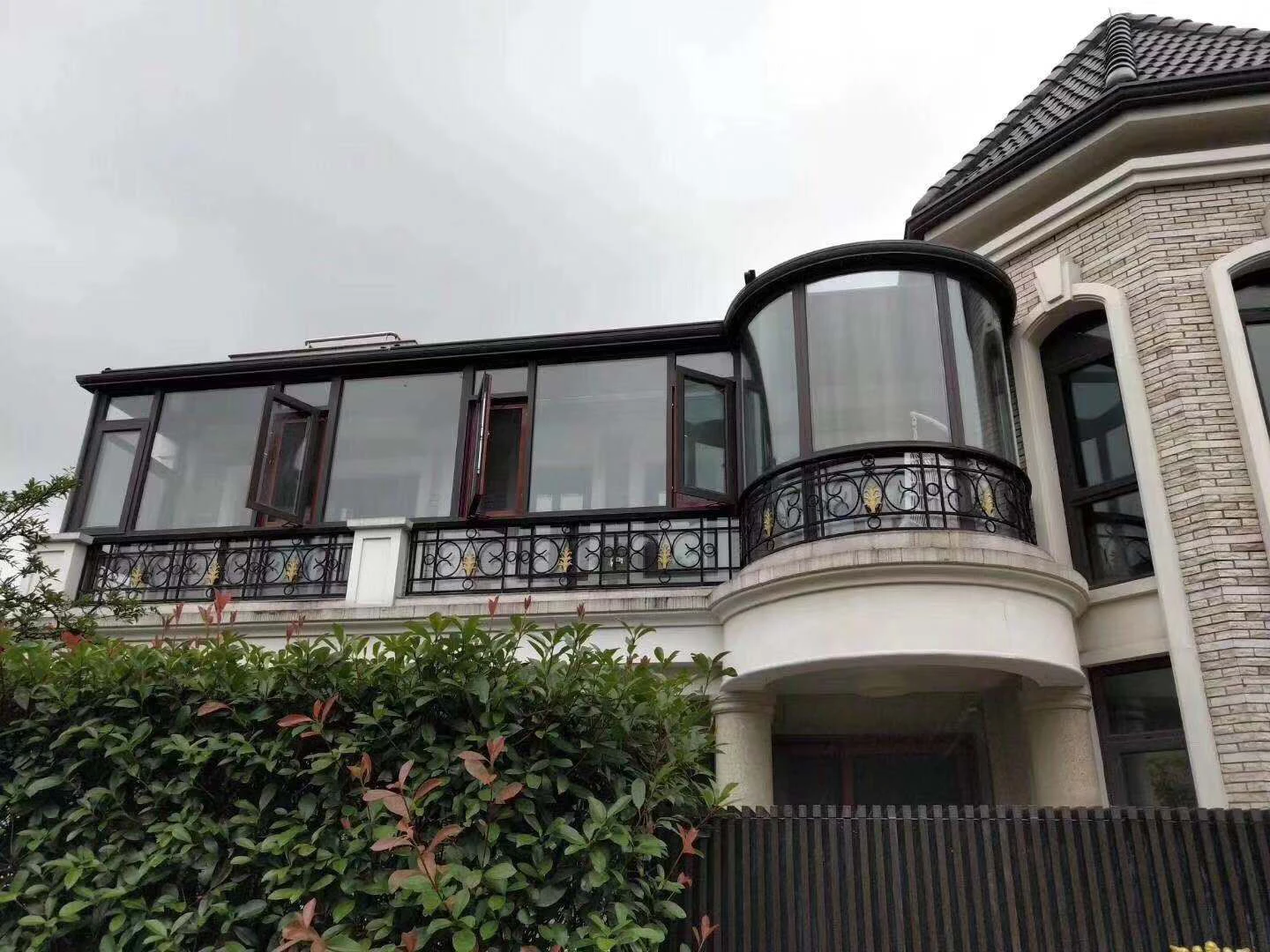
What determines the sound insulation effect of the 80 Series single casement window?What are the roles of the profile and the glass?
When purchasing single casement windows, many people directly equate "thicker profiles" with "better sound insulation." This judgment is only half correct. The sound insulation performance of the 80 Series thickened single casement window is the result of the profile and the glass each handling their own part. Understanding the division of labor will help you know where to spend your money.
The role of profile wall thickness and sealing structure in sound insulation
The 80 Series uses 6063-T5 aluminum alloy profiles with a wall thickness of 1.8mm. This thickness has limited direct contribution to sound insulation—sound is not blocked by the aluminum material itself, but by the sealing system after the window sash is closed. The true value of a 1.8mm wall thickness lies in the fact that the profile is more rigid, less prone to deformation over long-term use, and the overlap between the sash and frame can remain stable, preventing gaps in the sealing strips due to profile distortion.
In other words, with a thicker wall, the more reliable aspect is the 'non-degradation of sound insulation performance' rather than a 'higher initial sound insulation value'.
The sealing structure of the profile (number of sealing strips, overlap method) determines how many gaps leak sound when the window sash is closed. If the sealing is not adequate, even thicker glass will be useless. Conversely, no matter how good the sealing is, if the glass itself has weak sound insulation, the overall effect will still not be up to par.
Glass configuration is the core variable in sound insulation performance.
The reference configuration for this product is 5+22A+5 insulating glass. Insulating glass provides sound insulation not because of the glass itself, but because of the air layer in between. 22A refers to the thickness of the air layer between two layers of 5mm glass being 22mm (A is the abbreviation for Air).
After sound passes through the outer glass, it attenuates in the air layer, and then passes through the inner glass, with energy being significantly weakened. The thicker the air layer, the better the attenuation effect for mid-frequency noise (such as human voices and street traffic sounds). 22mm is a relatively thick air layer configuration, and among single-opening windows of the same level, its sound insulation performance is at an upper-middle level.
It should be clarified that 5+22A+5 addresses mid-to-high frequency noise (speech, traffic flow), but has limited effect on low-frequency noise (subway vibrations, outdoor air conditioner hum). If the project is near a main road or rail transit, consider upgrading to laminated insulating glass. This is a glass configuration adjustment, and this product supports customization as needed, but the noise type and decibel requirements must be specified when requesting a quote.
Decision recommendation:
- For ordinary residences, or those facing the street but not on a main road: 5+22A+5 is sufficient, no need to spend extra money.
- High-rise residential buildings (high wind pressure): 1.8mm wall thickness is a plus, prioritize confirming the quality of the sealing structure
- Adjacent to highways, railways, or airports: consider upgrading to laminated glass configuration; relying solely on this configuration may not meet requirements
- High acoustic insulation requirements: also need to confirm the on-site installation opening treatment and wall sound insulation; the window is only part of the system
Next confirmation step: provide the manufacturer with the project's floor height, main noise source type (low-frequency or high-frequency), and window orientation, and let them determine whether the glass configuration or sealing solution needs adjustment.
How should glass configurations be selected under different noise environments?Which scenarios are suitable for 5+22A+5?
5+22A+5 (5mm glass + 22mm air layer + 5mm glass) is a common starting configuration for residential doors and windows, but it is not a one-size-fits-all answer. Before choosing glass, first determine which type of noise you are facing—this decides whether 5+22A+5 is sufficient or whether you need to move up.
For normal residential noise environments, 5+22A+5 is a safe starting point.
If your project is located in an ordinary residential area, with noise mainly from daily traffic, voices within the community, and occasional car horns, and the windows do not directly face a main road, 5+22A+5 is basically sufficient. The 22mm air layer effectively attenuates mid-to-high frequency noise (voices, bird calls, distant traffic sounds), and combined with the sealing structure of the 80 Series 1.8mm thickened profile, it can meet the sound insulation needs of regular rooms such as bedrooms and living rooms.
Scenarios suitable for 5+22A+5:
- Buildings within the community, not facing the street or more than 50 meters from the main road
- Windows facing gardens or internal community roads
- Floors in the mid-to-low zone with no direct noise reflection surfaces
High-noise environments (street-facing, near subways) require upgraded configurations
For street-facing residences, along subway lines, beside elevated roads, and under airport flight paths, the noise in these scenarios has two characteristics: first, high sound pressure levels; second, a high proportion of low-frequency components (tire friction, subway wheel-rail, aircraft engines). 5+22A+5 is effective for mid-to-high frequencies, but its attenuation capability for low-frequency noise is limited—low-frequency wavelengths are long and easily bypass the air layer to propagate.
Is 5+22A+5 sufficient for street-facing residences? If the window directly faces a road with four or more lanes in both directions, and there is no green belt or sound barrier for shielding, it is not sufficient. Recommended upgrade directions:
- Increase glass thickness: Upgrade the glass on both sides from 5mm to 6mm or 8mm to increase surface density and improve low-frequency sound insulation.
- Use unequal-thickness glassFor example, 6+22A+5, where the different glass thicknesses on both sides can reduce the overlap of resonance frequencies, resulting in better sound insulation than equal-thickness configurations.
- Consider laminated glassIf the noise problem is severe, replace the inner glass with PVB laminated glass (e.g., 5+0.76PVB+5), which significantly suppresses mid-to-low frequency noise.
What glass should be used near subways or airports? For such scenarios, it is recommended to skip 5+22A+5 and instead use 8+12A+6 or a laminated insulating glass combination. Also, keep in mind: glass is only one part of the sound insulation chain; profile sealing, hardware clamping force, and foam filling during installation also determine the final effect.
The 80 Series 1.8mm thickened profile provides allowance for upgrading the glass configuration, but to determine the maximum glass combination it can support, please confirm with our team whether the profile groove and hardware load-bearing capacity match.
How to determine which type of noise environment your home belongs to?
A simple on-site judgment method: stand in front of the window with the window closed and speak at a normal volume—
- If the other person can clearly hear every word you say: high-noise environment, need to upgrade the configuration
- If you can hear the sound but cannot understand the content: medium noise, 5+22A+5 can meet most needs
- If you can hardly hear outside sounds: low-noise environment, 5+22A+5 is more than sufficient
A more objective way is to focus on the type of noise source: continuous low-frequency rumbling (subway, elevated roads, airports) is harder to handle than intermittent mid-to-high frequency noise (horns, dog barking). The former requires upgraded glass, while the latter can usually be handled by 5+22A+5.
Key trade-offs: 5+22A+5 is the most cost-effective starting point, suitable for most conventional residences;But if you are facing noise from a main road, subway, or airport, do not expect this single configuration to solve all problems—upgrading glass thickness or switching to laminated glass combinations, while confirming the matching capability of the frame and hardware, is the complete solution.
Do floor height and climate conditions affect the glass configuration?Is a wall thickness of 1.8mm sufficient?
High-rise residential buildings: wind pressure and safety take priority, and wall thickness and glass must be matched accordingly.
Whether a 1.8mm wall thickness is safe for high-rise residential buildings depends on the floor height and the basic wind pressure in the area where the building is located; it cannot be answered simply by asking 'Is 1.8mm enough?' 1.8mm is a thickened profile. In conventional high-rise residential buildings (under 30 floors, non-typhoon zones), when paired with reasonable window grid divisions and hardware, its wind pressure resistance performance is sufficient. However, there are two prerequisites that need to be confirmed:
- Grid division size: If the area of a single window exceeds 2 square meters, or the width exceeds 900mm, the wind load will increase significantly. In such cases, a 1.8mm wall thickness can still be used, but the grid division should be reduced or mullions added to share the load.
- Wind pressure zone of the city where the building is locatedFor high-rise buildings in coastal cities prone to typhoons (such as Shenzhen and Xiamen), it is recommended to confirm with the current website team the maximum allowable mullion size for this profile under this wind pressure zone, rather than directly applying conventional configurations.
In terms of glass configuration, 5+22A+5 insulating glass in high-rise residential buildings mainly serves sound insulation and thermal insulation functions,and does not bear the primary responsibility for wind pressure resistance—wind pressure is mainly borne jointly by the profile, hardware, and glass thickness. If the floor exceeds 50 stories or is in a strong wind zone, it is recommended to upgrade the glass to 6mm or 8mm tempered glass, but this is not a problem with the 80 series profile itself, but rather a separate review required for glass selection.
Coastal areas or regions with large temperature differences: consider corrosion resistance and thermal insulation needs
Using 80 series aluminum alloy windows in coastal areas is appropriate. This product uses 6063-T5 aluminum alloy profiles, which inherently have good corrosion resistance, but the key in coastal high-salt environments lies inthe surface treatment process—the salt spray resistance of anodizing, powder coating, or fluorocarbon spraying varies greatly. If your project is within 1 km of the coastline, it is recommended to confirm with the current website team whether the surface treatment level of this batch meets local salt spray test requirements, rather than assuming all batches are suitable for coastal areas.
The thermal insulation performance of 5+22A+5 in cold northern regions needs to be evaluated based on your heating method and energy-saving standards. The heat transfer coefficient (U-value) of 5+22A+5 is approximately 2.7-3.0 W/(m²·K). This level is sufficient in hot summer and cold winter regions (such as Shanghai, Wuhan), but in severe cold regions (such as Harbin, Urumqi), if the project requires 65% or 75% energy-saving standards, this configuration may be insufficient. At this point, there are two adjustment directions:
- Keep the 80 Series profiles and upgrade the glass: Change to double insulating glass of 5+12A+5+12A+5, or Low-E coated insulating glass, and the K value can be reduced to 1.8-2.2, without the need to replace the profile itself.
- Confirm the project's energy-saving requirements: If the project has a clear K value target, directly use that target to match the glass solution, which is more effective than simply asking whether it is 'sufficient'.
Key trade-offs: A wall thickness of 1.8mm is a safe and economical starting point for most residential and commercial projects; the scenario that truly requires an upgrade is the combination of 'oversized mullions and strong wind pressure zones'. The glass configuration can be flexibly adjusted according to the project location, and the 80 Series profile itself does not constitute a bottleneck for insulation upgrades. As a next step, we suggest you prepare the project city, floor height, maximum single window size, and energy-saving K value requirements, and directly request a matching solution from the current website team.
How to determine the final configuration based on project requirements?In which situations is it not recommended to directly apply the standard configuration?
The reference configuration for the 80 Series thickened single casement window is 1.8mm profile + 5+22A+5 insulating glass, which is suitable for most residential and ordinary commercial projects. However, in actual procurement, the configuration should be derived from the project conditions, not directly from the product catalog. Below is a three-step decision path.
Three-step decision method: lock in the configuration based on noise, floor level, and budget.
Step 1: Determine the glass first, then the profile. Glass is the core variable for sound insulation performance. 5+22A+5 insulating glass has a stable attenuation effect on mid-to-high frequency traffic noise, making it suitable for residences on both sides of ordinary urban roads.
But if the project is adjacent to an airport, high-speed rail line, or a traffic light intersection on a main road, low-frequency noise dominates, and the sound insulation improvement of insulating glass is limited. In this case, a laminated insulating combination (such as 5+1.14PVB+5+12A+5) should be considered. The judgment method is: during the day, listen at the intended installation location for 1 minute. If the noise is dominated by continuous roaring or low-frequency vibration from heavy trucks passing by, the standard glass configuration is insufficient.
Step 2: Decide whether thicker profiles are needed based on floor level and orientation. A wall thickness of 1.8mm is in the thickened range within the 80 Series, and its wind pressure resistance is sufficient to cover most high-rise residential buildings (non-super high-rise below 30 floors). However, if it is a coastal high-rise, a typhoon-prone area, or the building is located in a wind-prone terrain, you need to provide the hyperstron team with the floor height and the basic wind pressure value of the building's region to confirm whether the profiles need to be upgraded or reinforced with steel liners.
Similarly, if the window size exceeds the reference 1000×1000mm, for example, above 1500×1500mm, the glass self-weight and wind pressure load will increase, and whether the standard wall thickness is still valid needs to be recalculated.
Step 3: Use the budget to deduce the order of trade-offs. When the budget is limited, prioritize the glass configuration (because the sound insulation effect is directly determined by the glass), then the quality of hardware (affecting sealing and service life), and finally consider the surface treatment of the profiles. If the budget can only cover the standard configuration, accept the sound insulation limit of the standard configuration, and do not reduce the glass to 5+9A+5 to save costs—this will significantly reduce sound insulation performance, while the money saved is not much.
Boundary conditions that need to be confirmed with the manufacturer
The following four situations are not recommended to directly apply the standard configuration. You need to provide specific information to the hyperstron team to confirm the matching solution:
- The opening size exceeds the reference range. The standard configuration is based on a window type of about 1 square meter.If the area of a single window exceeds 1.5 square meters or the height exceeds 1.8 meters, it is necessary to confirm whether the glass thickness needs to be upgraded from 5mm to 6mm or 8mm, and whether the profile needs to be thickened.
- There are clear decibel requirements for sound insulation. If the project contract specifies indoor noise limits (such as ≤30dB at night), you need to provide the target decibel value, window-to-wall ratio, and wall construction to the manufacturer, and they will calculate the glass combination solution.Without these parameters, no glass configuration can be more confidently guaranteed to meet the requirements.
- Special environmental conditions. In coastal high-salt fog areas, industrial acid rain environments, or extreme temperature difference regions, it is necessary to confirm whether the surface treatment process (powder coating, anodizing, fluorocarbon spraying) matches.The surface treatment of standard configurations may not cover these scenarios.
- Dimensional tolerance requirements for batch orders. For engineering batch procurement, if the on-site opening errors are large, it is necessary to confirm in advance the adjustable range of the profiles and whether a sub-frame solution is needed.This will affect the quotation and delivery time.
Frequently Asked Questions
Q: Can the standard configuration of the 80 Series be used in a bedroom facing the street? If the street is a secondary urban road or an internal community road, 5+22A+5 insulating glass can significantly reduce daily traffic noise and is generally sufficient. If it is a major urban road with heavy traffic, it is recommended to first confirm the type of noise—if it is mainly mid-to-high frequency, the standard configuration is usable; if there is obvious low-frequency rumbling, an upgrade to a laminated insulating glass solution is needed.
Q: Is a wall thickness of 1.8mm better the thicker it is? No. Increasing the wall thickness enhances wind pressure resistance, but it also increases the weight and cost of the profile.
For ordinary residential buildings, 1.8mm is already higher than the conventional engineering standard of 1.4mm. Unless it is a super high-rise, large-size, or strong wind zone project, further thickening does not help with sound insulation and only increases the budget.
Q: Can the glass configuration be changed by only adjusting the thickness of the air layer? Yes, but an overall assessment is required. For example, changing the 22A air gap to 12A makes the overall glass thickness thinner, which may cause the profile groove to mismatch, and the sound insulation performance will also decrease.
Changing the configuration is not just replacing a number; the manufacturer needs to confirm profile compatibility and performance changes.
Q: What information is needed for custom windows? At minimum, you need: opening dimensions (width × height × wall thickness), floor and city, glass configuration requirements (if any), opening method (inward opening/outward opening/top hung), whether a screen window is needed, and batch quantity. If the project has special requirements (sound insulation decibels, wind pressure resistance rating, fire resistance requirements), provide them as well.
Learn more
If you are matching the configuration plan for the 80 Series reinforced single casement window for a specific project, you can directly submit the opening dimensions, city and floor height, and the main type of noise source. Our team will provide glass combination and profile compatibility recommendations based on the project conditions.
Related Products:80 Series Thickened Single-Hung Aluminum Alloy Window