
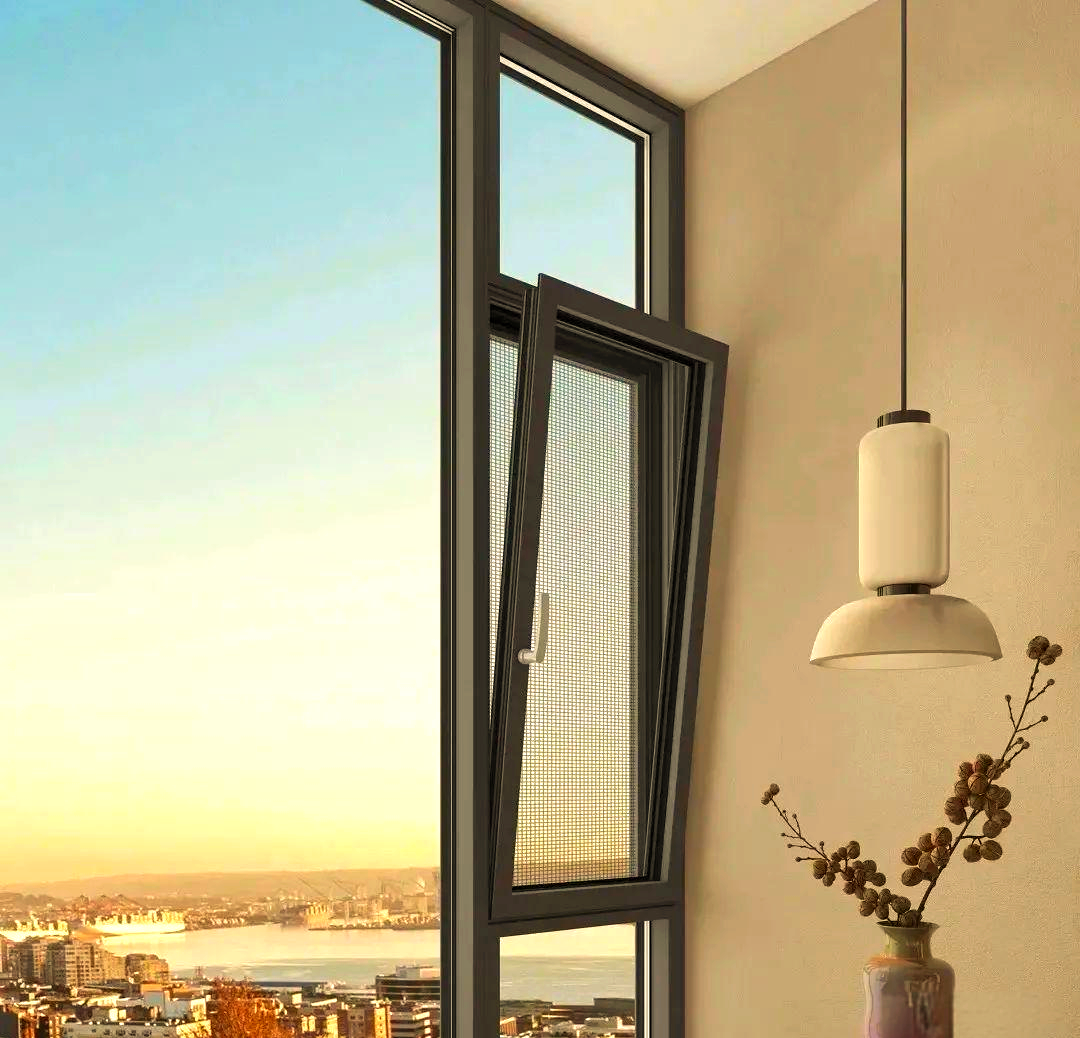
What determines the sound insulation and thermal insulation performance of the 80 Series single casement window?Profiles, glass, and installation are all indispensable.
When evaluating the 80 Series single casement window, many buyers habitually ask first, "What is the wall thickness?" as if a 1.8mm wall thickness automatically means good sound and thermal insulation. This judgment is incomplete. Sound and thermal insulation are a systemic result. The profile, glass, and installation each bear different responsibilities, and missing any one will significantly reduce the final performance.
What role do profiles and wall thickness play in sound and thermal insulation?
Profiles and wall thickness mainly address two things:Structural stability and sealing foundation.。
Compared to the conventional 1.4mm, the direct benefit of a 1.8mm wall thickness is that the window frame is more rigid. In high-rise or coastal areas with high wind pressure, the window frame is less likely to deform, which directly affects the durability of the weatherstrip seal—if the frame undergoes slight deformation under wind pressure, even the best sealing strip will develop gaps, and sound insulation and thermal insulation will fail accordingly. Therefore, the value of a 1.8mm wall thickness is more reflected in 'ensuring the long-term stable operation of the sealing system' rather than the wall thickness itself directly providing 'sound insulation'.
Another easily overlooked point is the thermal break strip design of the profile. The 80 Series belongs to a series with a wider frame, leaving space for a multi-chamber structure and the arrangement of thermal break strips. The multi-chamber structure can delay heat conduction, while the thermal break strips cut off the cold bridge of the aluminum profile.
But note:Different manufacturers may have different chamber designs and thermal break strip materials under the same series number.When purchasing, you cannot just look at the name "80 Series"; you need to confirm with the current website team the specific profile cross-section design and thermal break strip configuration of this product.
Why is glass configuration the core variable for sound insulation and thermal insulation?
In the total window area, glass usually accounts for 70%-80%, so the glass configuration contributes much more to sound insulation and thermal insulation than the profile. The reference configuration of this product is 5+22A+5 insulating glass, that is, two 5mm glass panes with a 22mm air layer in between.
The sound insulation and thermal insulation capability of this configuration is above average: the 22mm air layer can effectively weaken mid-frequency noise (such as human voices and street traffic sounds), and the insulating layer also significantly inhibits heat conduction. But if you are facing the following scenarios, this configuration may not be sufficient:
- Near a street or airport: Low-frequency noise (engine and tire sounds) has strong penetration, and insulating glass has limited effect; you need to consider laminated glass or triple glazing with two cavities.
- For extremely cold or hot regions: The thermal performance of 5+22A+5 is sufficient for temperate climates, but in extreme temperature differences, Low-E coating or additional glass layers would be more suitable.
The glass configuration can be adjusted. This product supports changing the glass solution according to requirements, butadjustments will change the overall window weight and hardware load-bearing requirements, so it's not simply a matter of swapping a piece of glass. If you have specific noise or insulation needs, it is recommended to inform the current website team of your usage environment (floor height, orientation, surrounding noise sources, local climate), and let them confirm the matching glass solution and hardware configuration.
Installation: The Most Underestimated Variable
The profiles and glass determine the "theoretical performance" of this window, while installation determines the "actual performance." The treatment of the gap between the window frame and the wall, whether the foam filling is full, and whether the exterior sealant is continuous—if any of these steps have problems, the overall sound insulation and thermal insulation of the window may drop by a full level. This is not something the product itself can solve, but the buyer needs to confirm the installer's installation standards in advance, especially for batch engineering projects.
Next steps:If you are evaluating this 80 Series single casement window, first clarify two questions—the wind pressure level and noise environment of the project area, and your specific requirements for thermal insulation. Then provide these two conditions to the current website team to confirm whether the profile cross-section design, thermal break strip configuration, and optional glass upgrade solutions of this product match your needs.
Misconception 1: Does thicker wall thickness mean better sound insulation?What is the real significance of 1.8mm wall thickness?
When many buyers receive the profile parameters, their first reaction is, "Is thicker wall thickness more stable and more soundproof?" This intuition is only half right. Wall thickness mainly determinesstructural strength and wind pressure resistance, and its relationship with sound insulation is indirect—sound insulation performance depends more on glass configuration, number of sealing strips, and cavity design.
Putting all the budget into wall thickness often won't get you the expected quietness.
In what situations is 1.8mm wall thickness sufficient?
This product's 80 Series single casement window uses 1.8mm wall thickness, 6063-T5 aluminum alloy profiles, with reference glass configuration of 5+22A+5 insulating glass. This combination is sufficient in the following scenarios:
- Bedrooms and living rooms in ordinary residential buildings: For floors not higher than mid-rise buildings and not directly facing typhoon winds, a 1.8mm wall thickness combined with insulating glass can already meet daily sound insulation and thermal insulation needs.
- Projects with moderate sound insulation requirements and budget sensitivity: If the surrounding environmental noise is below 70 decibels (ordinary urban streets, inside residential communities), the configuration of 1.8mm wall thickness plus insulating glass is a cost-effective starting point.
- Regular stock for distribution channels: As a standard model, 1.8mm wall thickness fits most standard openings, and does not increase profile costs or processing difficulty due to excessive wall thickness.
Which scenarios require considering thicker profiles?
In the following situations, it is recommended to confirm with the current website team whether it is necessary to upgrade the wall thickness or adjust the profile series:
- High-rise or super high-rise residential buildings (generally referring to buildings above 20 floors): Wind pressure increases significantly with height, and the deformation allowance of 1.8mm wall thickness may be insufficient under extreme weather conditions.At this time, it is necessary to combine the basic wind pressure value at the project location and have the team calculate whether the wind pressure resistance level meets the requirements.
- Coastal areas with high salt spray or frequent typhoons: Although 6063-T5 itself has good corrosion resistance, repeated strong winds impose higher requirements on the stiffness of the profile, and thicker wall thickness or reinforced profiles can provide greater safety redundancy.
- Large window sashes (single sash area exceeding 1.5㎡): The larger the window sash, the greater the flexural deformation the profile withstands.The 1.8mm wall thickness performs well at a reference size of 1 square meter, but when the dimensions are enlarged, it needs to be recalculated.
- For projects with specific decibel requirements for sound insulation: If the project contract specifies a specific sound insulation index (such as weighted sound reduction index ≥35dB), the wall thickness is not the main variable; the glass configuration (such as laminated insulating glass) and the sealing structure are.In this case, you should confirm the overall window solution with the target decibel value in mind, rather than simply thickening the profile.
Key trade-off: The 1.8mm wall thickness is a balance point between "sufficient" and "economical." It addresses the structural safety and basic sound insulation issues of conventional residential and engineering projects;If the project is located in a high-rise area, a high-wind zone, or has strict sound insulation requirements, it is necessary to supplement the floor height, opening size, and actual noise measurement data, and the current website team will provide a matching solution, rather than deciding on your own how much to thicken.
Misconception 2: Is a thicker air layer in insulating glass always better for sound insulation?The logic behind the 5+22A+5 configuration
Many buyers have an intuition when selecting windows: the thicker the air layer in insulating glass, the better the sound insulation. So when they see 5+22A+5 (5mm glass + 22mm air layer + 5mm glass), their first reaction is often, "The air layer is only 22mm; can we increase it to 30mm or even thicker?" ”
This intuition is only half right. The air layer in insulating glass does affect sound insulation and thermal performance, butit is not a linear relationship.。 Increasing the air layer from 6mm to 12mm results in a significant performance improvement;from 12mm to 22mm, there is still a gain;However, beyond 25mm, noticeable convective circulation begins to form inside the air layer, which actually weakens the sound insulation and thermal insulation effects.
This is why the air layer of mainstream high-performance insulating glass units is mostly concentrated between 12mm and 24mm—22mm happens to fall within the balanced range between performance and profile compatibility.
What is the sound insulation and thermal insulation principle of 5+22A+5 insulating glass?
The configuration logic of this glass is divided into two layers:
- Sound insulation: The 5mm glass already provides basic blocking of mid-to-high frequency noise (such as human voices and traffic sounds), while the 22mm air layer mainly targets mid-to-low frequency noise (such as traffic rumbling and air conditioner outdoor units).The wider the air layer, the longer the path for low-frequency sound waves to attenuate between the two panes of glass.However, beyond the critical width, convection forms inside the air layer, and sound waves can actually "bridge" through it, so sound insulation no longer improves.
- In terms of thermal insulation: The thermal conductivity of air is much lower than that of glass itself, and a 22mm air layer can effectively block heat conduction.However, if the air layer is too thick, it can cause internal convection, which will carry away heat and reduce insulation performance.
In other words, 5+22A+5 is not a 'randomly chosen number' but the result of balancing sound insulation, thermal insulation, and profile thickness. For the 80 Series thickened profile (1.8mm wall thickness), the 22mm air layer also ensures a better match between the glass and the profile—if the air layer is too thick, it will squeeze the visible surface of the profile and affect the overall structural strength of the window.
When is it necessary to upgrade the glass configuration?
5+22A+5 is suitable for most residential and commercial projects, but the following scenarios require re-evaluation:
| Scenario | Judgment Criteria | Recommendations |
|---|---|---|
| Residences Adjacent to Streets or Elevated Highways | Nighttime noise consistently exceeds 70 decibels, predominantly low-frequency | Consider laminated insulating glass (e.g., 5+1.14PVB+5+12A+5); the laminated layer is more effective at suppressing low frequencies |
| For extremely cold or hot regions | Winter indoor-outdoor temperature difference exceeds 30°C, or summer air conditioning load is extremely high | Consider Low-E coated insulating glass; radiative heat resistance is more effective than simply thickening the air layer |
| Extreme requirements for sound insulation | Special functional spaces such as recording studios, practice rooms, and conference rooms | Relying solely on insulating glass is insufficient; an overall design combining window frame sealing and wall sound insulation is required. |
The core of the upgrade decision is not 'whether the air layer is thick enough,' but 'what type of noise frequency and temperature difference are involved.' If the noise is predominantly mid-to-high frequency, 5+22A+5 is already sufficient;If low frequency dominates, thickening the air layer is less effective than adding a laminated layer. If the project is located in an extreme climate zone, the benefit of Low-E coating far outweighs increasing the air layer from 22mm to 30mm.
Next confirmation action: Provide the current website team with the noise type (low or high frequency) in the project area, the lowest winter temperature and highest summer temperature, and the window orientation, to confirm whether 5+22A+5 matches, or whether it needs to be adjusted to a laminated/Low-E combination. Don't make decisions based solely on the idea that 'the thicker the air layer, the better.'
How do you determine whether the 80 Series single casement window is suitable for your project?Draw conclusions based on scenarios and budget.
In which scenarios is it recommended to choose the 80 Series thickened single casement aluminum window?
Spaces in residential bedrooms, living rooms, and other areas with clear requirements for sound insulation and thermal insulation are the most suitable applications for this window. The 1.8mm thickened profile combined with 5+22A+5 insulating glass can significantly reduce mid-to-high frequency traffic noise in typical urban noise environments, while also reducing the cold radiation sensation near the window in winter. If you are doing bulk purchasing for residential projects or bidding on engineering projects, and the project specifications clearly require 'insulating glass + thickened profiles,' this window can be directly matched without needing to compromise on the design.
High-rise residential and coastal projects are also worth prioritizing. In high-rise buildings where wind pressure is high, the 1.8mm wall thickness provides higher profile stiffness than conventional 1.4mm products, offering stronger resistance to wind pressure deformation.In coastal high-salt spray environments, the corrosion resistance of 6063-T5 aluminum alloy is superior to ordinary 6063-T6 or profiles without surface strengthening treatment. If your construction site falls into these two scenarios, the 80 Series thickened version is the 'worry-free' choice.
When selecting products for distribution channels, if your customer base is mainly residential renovation projects and frequently encounters demands for 'thicker and sturdier' windows, this window can serve as a regular stock item for mid-to-high-end single casement windows. It supports customized dimensions and glass configurations according to drawings. After sample confirmation, bulk orders can be placed, making it suitable for engineering contractors and distributors to establish a stable product line.
In which situations is it not recommended?Where is the budget limit?
If your project involves temporary structures, simple factory buildings, temporary partitions, or is extremely budget-sensitive with no strict requirements for sound insulation and thermal insulation, the 80 Series thickened version is not recommended. For such scenarios, ordinary single-opening windows with 1.4mm wall thickness can meet the basic wind and rain protection requirements. The cost premium of thickened profiles and insulating glass (about 20%-35% higher than standard configurations, depending on glass and surface treatment) does not bring practical benefits here.
Where should the budget be prioritized? Judge in the following order:
- First, confirm whether the glass configuration meets the energy-saving or sound insulation requirements of the project location. 5+22A+5 insulating glass is the reference configuration. If your project is in a severe cold region or adjacent to a main road, you may need to upgrade to Low-E coating or thicker glass—this has a more direct impact on performance than profile wall thickness.
- Next, confirm the surface treatment method of the profiles. In coastal or high-humidity areas, the thickness of powder coating or anodized layer directly determines the service life, and this cost cannot be saved.
- Finally, consider the profile series and wall thickness. The 80 Series thickened profile is already an 'upgrade item'. If the budget is limited, prioritize the glass and surface treatment. The profile can be downgraded to the 70 Series with standard wall thickness, and the performance difference is much smaller than the loss from downgrading the glass.
Situations not recommended for selection also include: the project is still in the design phase, and window dimensions and opening methods are subject to frequent changes. The mold opening and customization cycle for thickened profiles is longer than for standard products. If the design is not frozen, each size change incurs additional costs. In such cases, locking down the design before placing the order is more cost-effective than rushing to order the product.
Frequently Asked Questions
Q: What is the actual sound insulation difference between the 80 Series thickened single casement window and the ordinary 70 Series single casement window? A: With the same glass configuration, the 80 Series, due to its thicker profile and deeper sealing grooves, has a sound insulation difference of about 2-3 decibels, which is not noticeable to the human ear. What really makes a difference is the glass—if you upgrade the glass from insulating to laminated insulating, the sound insulation improvement is much greater than the profile upgrade.
Therefore, for projects adjacent to main roads, prioritize upgrading the glass;For ordinary residential communities, the sealing stability of the 80 Series thickened profiles is sufficient.
Q: Is a 1.8mm wall thickness always better the thicker it is? A: No. A 1.8mm wall thickness is already a thickened configuration for residential and conventional commercial projects, providing sufficient wind pressure resistance and hardware load-bearing capacity.
Wall thicknesses exceeding 2.0mm are mainly used in super high-rise buildings or large-pane windows, where costs increase but are unnecessary for ordinary projects. If your window has a single pane area exceeding 2 square meters or the floor is above the 30th floor, confirm with the team whether a higher wall thickness is needed.
Q: Can the 5+22A+5 glass configuration be changed? A: Yes, it can. This configuration is a reference baseline, and it supports adjustments to glass thickness, the width of the insulating air layer, and whether to add a coating, based on project requirements.
You need to provide the energy-saving standards or acoustic insulation requirements of the project location, so that the team can propose a matching glass combination solution.
Q: For coastal projects, does this window require any additional treatment? A: The profile itself is made of 6063-T5, which provides a basic level of corrosion resistance, but you need to confirm the surface treatment method. If it is powder coating, it is recommended to choose fluorocarbon or super-durable powder;If it is anodizing, the film thickness should not be less than AA15 grade.
Before placing an order, provide the team with the project's environment and expected service life, and they will give corresponding surface treatment recommendations.
Q: For bulk purchases, can the dimensions and opening methods be fully customized according to the drawings? A: Customization according to drawings is supported, but it is recommended to confirm with samples before placing a bulk order. The machining tolerances and hardware compatibility of the thickened profiles differ slightly from standard products. Sample confirmation can avoid issues such as difficulty in opening or poor sealing after mass production.
The sample lead time is usually 3-5 days longer than standard products. Please reserve this time before scheduling bulk production.
Learn More
If you are evaluating whether the 80 Series thickened single-leaf window is suitable for your current project, it is recommended to first organize three pieces of information: the wind pressure level and noise environment of the project area, the specific requirements for thermal insulation, and the window opening dimensions and opening method.Provide these three items to the current website team, and we can help you confirm whether the profile cross-section design, thermal break strip configuration, and glass upgrade solutions match your needs, and provide corresponding quotes and sample lead times.
Related Products:80 Series Thickened Single-Opening Aluminum Alloy Window