
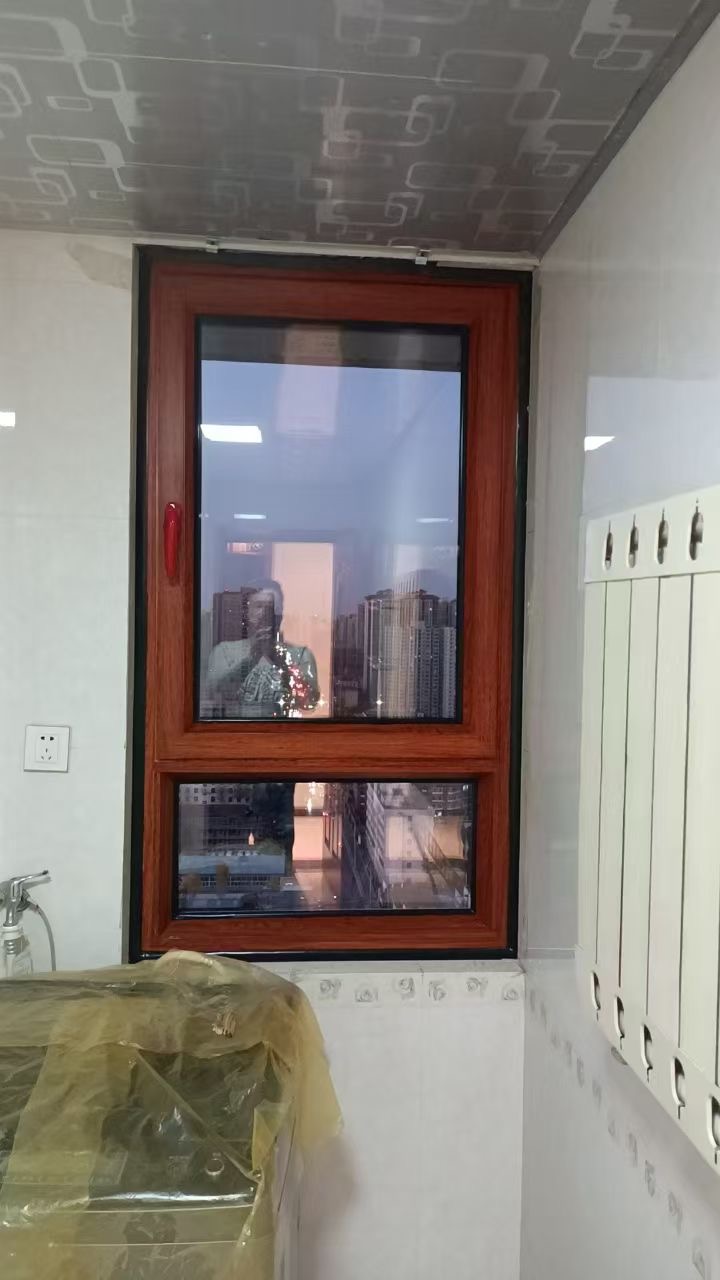
What is the sound insulation and thermal insulation principle of the FG110F double inward-opening broken bridge window?
To determine whether this window is suitable for your project, first understand where its performance comes from. The sound insulation and thermal insulation capabilities of the FG110F mainly come from two structures: the broken bridge aluminum profile and the insulating glass. Each handles a different aspect, and both are indispensable.
How the broken bridge aluminum profile blocks heat conduction
Ordinary aluminum alloy is an excellent heat conductor, and outdoor heat or cold is directly "bridged" into the interior through the window frame. The broken bridge approach involves inserting a low-thermal-conductivity thermal break strip (usually polyamide PA66) in the middle of the profile, physically separating the aluminum profile and cutting off the heat conduction path.
The FG110F uses 6063-T5 aluminum alloy profiles with a wall thickness of 2.0mm, combined with the broken bridge structure, mainly addressingTemperature differential conductionProblem—In winter, indoor heat is not easily dissipated, and in summer, outdoor heat does not easily enter. It should be noted that the thermal break structure is effective for insulation, but the specific insulation performance also depends on the profile cavity design, the width of the thermal break strip, and the sealing process of the entire window. These parameters need to be confirmed with the Hipex Creative team for the specific configuration of your required model.
The role of insulating glass in sound and thermal insulation
Glass accounts for over 70% of the window area, and its configuration directly determines the upper limit of sound and thermal insulation. The reference configuration for FG110F is5+27A+5 insulating glass, which means:
- Two pieces of 5mm thick glass: Provides basic strength and sound insulation quality
- 27A: The middle air layer is 27mm thick; the thicker the air layer, the better the thermal and sound insulation.
- Overall structure: A sealed air layer is formed between the two pieces of glass. The thermal conductivity of air is much lower than that of glass itself, and the air layer can attenuate sound wave transmission.
This configuration is a reasonable starting point for street-facing residences and projects in cold regions. If your project has higher noise levels or requires better thermal insulation, the glass configuration can be adjusted—for example, using different glass thickness combinations, filling with inert gas, or using laminated glass. This requires confirming the matching solution with Haipaisichuang based on specific project conditions.
Does the double inward-opening design help with sound insulation?
Yes, it helps, but in a different way. Double inward-opening means the sashes open toward the interior, and when closed, the sashes press against the frame through multiple sealing strips, forming a more complete sealing surface. Compared with sliding windows (where there is likely a gap at the track), inward-opening windows have better sealing continuity, which can reduce sound and air leakage through gaps.
However, note that the core value of double inward-opening issealing performance, which works together with thermal break profiles and insulating glass, rather than solely providing sound insulation. If you rely only on the opening method without insulating glass, the sound insulation effect will still be limited.
One-sentence summary: The sound and thermal insulation of FG110F is the result of the combination of thermal break profiles, insulated glass, and inward-opening seals. To determine whether it suits your project, first confirm two things: one is the temperature difference and noise level in your region, and the other is whether the glass configuration you need can be achieved on FG110F—these two points directly determine whether the final performance meets the requirements.
What factors affect the sound and thermal insulation of the FG110F double inward-opening thermal break window?
Many buyers see the term "thermal break aluminum" and automatically assume that sound and thermal insulation must be good. In reality, the performance ceiling of the FG110F double inward-opening thermal break window is determined by the profile, but how much of that potential is realized depends on three variables: glass configuration, sealing details, and installation quality. Let's break it down below.
Glass configuration is the key variable that determines sound insulation performance
The reference configuration for FG110F is 5+27A+5 insulating glass, which is at a level of 'adequate but not outstanding' in terms of sound insulation. 5mm glass provides some attenuation of mid-to-high frequency noise (such as human voices and car horns), while the 27A air layer mainly addresses thermal insulation and condensation prevention, with limited suppression of low-frequency noise (such as tire noise and subway vibrations).
If your project is near a main road, airport, or railway, you need to clearly inform the Hipeisichuang team about your noise type and decibel requirements, and let them evaluate whether to switch to laminated insulating glass (such as 5+1.14PVB+5+12A+5) or an asymmetric glass configuration. The laminated layer is significantly more effective at blocking low-frequency noise than a standard insulating layer, but the cost will also increase.
The key trade-off here is:The glass configuration directly determines the upper limit of sound insulation, while the profile only determines how high that upper limit can be achieved.。 For projects with limited budgets and minor noise issues, 5+27A+5 is sufficient;For street-facing residences or commercial projects, it is recommended to discuss laminated solutions directly.
The impact of profile wall thickness and sealing design on thermal insulation
A 2.0mm wall thickness is at the upper mainstream level for thermally broken windows. The practical benefits it delivers are: the sash is less prone to deformation, the sealing gasket maintains proper contact over long-term use, and the thermal break strip does not fail due to uneven stress. If you opt for a 1.4mm or 1.6mm wall thickness, the initial cost is lower, but after a few years, the sealing performance degrades faster—this directly affects the durability of the thermal insulation effect.
However, note that a 2.0mm wall thickness itself does not produce thermal insulation; what truly matters is the width and material of the thermal break strip. To determine whether the thermal insulation design of the FG110F suits the climate in your region, two points need to be confirmed:
- Thermal break strip width: For severely cold northern regions, it is recommended to confirm whether a wider thermal break strip (e.g., over 35mm) can be configured; the wider the strip, the better the thermal bridge blocking effect.
- Number of sealing strips: Double inward-opening structures typically come with 2-3 sealing strips. You need to confirm whether the weatherstripping material on the sample window is EPDM or ordinary PVC. EPDM maintains better elasticity at low temperatures, which directly affects winter airtightness.
Does installation quality have a significant impact on performance?
It has a huge impact, and it is the most easily overlooked variable. Even with the best glass and profiles, if the gap between the window frame and the wall is not filled densely with foam during installation, or the exterior sealant is not applied continuously, the actual sound and thermal insulation performance may be reduced by as much as 30%.
To assess installation quality, you don't need to understand construction. You only need to ask three questions when confirming the sample window:
- What material is used to fill the gap between the window frame and the wall?Is continuous filling around the entire perimeter required?
- What is the construction standard for the waterproof sealant on the exterior side?Are there acceptance checkpoints?
- After installation, is a water spray test or air tightness spot check conducted?
If these standards are not clearly defined, it is recommended to specify installation acceptance clauses in the purchase contract, rather than assuming that 'the installer will handle it properly'.
Next Steps for Confirmation
Before inquiring about pricing or requesting samples from the Hipex Strong team, organizing the following information can greatly improve communication efficiency:
- The city and specific floor level of the project (to determine noise type and wind pressure requirements)
- The approximate distance to the nearest noise source (e.g., '50 meters from the main road')
- Minimum winter temperature (to determine whether wider thermal break strips are needed)
- Any special soundproofing requirements (e.g., bedrooms, recording studios, etc.)
Scenarios suitable for FG110F: Residential or commercial projects with clear requirements for thermal insulation, sealing, and inward-opening structures, and where noise is not extreme (not adjacent to highways or airport flight paths).
Unsuitable scenarios: If the project faces an elevated road or subway line, and soundproofing is a top priority, it is recommended to confirm the feasibility of the laminated glass solution with the team before deciding, rather than assuming the standard glass will meet the requirements.
Which projects are suitable for choosing FG110F double inward-opening thermal break windows?
To determine whether a project is suitable for FG110F double inward-opening thermal break windows, focus on three key points: the requirements for noise and temperature at the installation location, whether the inward-opening style is acceptable, and the project's expectations for customization coordination. Below, we break it down by scenario.
Applicability to Street-Facing Residences and Noise-Sensitive Areas
For street-facing residences, sound insulation is a must-have. The reference configuration for the FG110F double inward-opening thermal break window is 5+27A+5 insulating glass, with a 27mm air layer that forms a relatively wide cavity, providing substantial attenuation of mid-to-high frequency traffic noise. However, note thatsound insulation performance is not determined solely by the window type; it also depends on wall sound insulation, sealing of installation gaps, and whether the actual glass configuration is upgraded.
If your project is near a high-speed rail line or under an airport flight path, where low-frequency noise dominates, we recommend confirming directly with the Haipaisichuang team whether laminated insulating glass or asymmetric glass combinations can be configured, rather than assuming the default reference configuration is sufficient.
Another easily overlooked point: the soundproofing seal on double inward-opening windows is a compression seal, and over long-term use, aging of the rubber strip can affect the sealing performance. For street-facing projects, if later maintenance is not kept up, the soundproofing performance will decline year by year. Therefore, this type of project is suitable, but the premise is that the property management or the owners have the willingness to regularly inspect the sealing strips.
Scenarios in cold northern regions and with insulation needs
Northern projects focus on insulation, and the core lies in the thermal break structure and glass configuration. The FG110F uses thermal break aluminum profiles, and the 2.0mm wall thickness poses no problem in structural strength; the thermal break layer effectively cuts off the heat and cold conduction of the profile. The reference configuration of 5+27A+5 insulating glass can meet basic insulation needs in conventional cold regions (such as Beijing and Shenyang), but in severe cold regions (such as Harbin and Hohhot), where the indoor-outdoor temperature difference exceeds 40°C in winter, it is recommended to confirm whether to upgrade to Low-E coated glass or a triple-glazed, two-cavity configuration.
The insulation upper limit of thermal break windows is determined by the glass; the profile is only the foundation.
In addition, double inward-opening windows have a practical advantage in the north: the inward-opening design facilitates indoor cleaning in winter, eliminating the need to lean out in freezing weather to clean the exterior glass as with outward-opening windows. However, note that double inward-opening means the sashes occupy indoor space. If there are radiators or furniture near the window, you need to confirm in advance whether the opening radius will interfere.
In which situations is this window not suitable?
Consider carefully in the following three situations:
- Low-rise shops or ground-floor street-facing units: Double inward-opening windows open into the room, encroaching on the effective indoor area.Shops typically need to maximize display space and passage area, and inward-opening windows can significantly reduce usable space.For such projects, sliding windows or outward-opening windows are more suitable.
- Areas with high wind pressure at high altitudes (such as coastal typhoon zones): 2.0mm wall thickness is sufficient for conventional residential buildings, but for super high-rise buildings (above 100 meters) or areas with strong wind pressure, it is necessary to recheck the deflection deformation of the profiles and the load-bearing capacity of the hardware.It is not that it cannot be used, but rather that the Haipaisi Chuang team needs to conduct a special verification based on the specific floor height and wind pressure value before making a decision.
- Projects that are extremely sensitive to delivery cycles and do not accept sample confirmation: FG110F supports customization according to drawings and adjustments to different wall thicknesses/glass configurations, which means that the configuration of each batch of orders may be different.If the project party skips sample confirmation and directly places a bulk order, the risk of dimensional or configuration deviations in the later stage will be transferred to the site.Such projects are suitable for standardized products with fixed configurations.
Next Steps for Confirmation
If your project falls within the 'suitable' range, the next step is not to place an order directly, but to provide the Haipaisi Chuang team with three things: the city or specific address of the project (for wind pressure and temperature difference verification), the wall structure at the window installation location (masonry/concrete/steel structure, which affects the installation method), and specific requirements for sound insulation or thermal insulation (for example, the desired indoor noise level in decibels). Once you have this information, have the team provide targeted glass configuration recommendations and node drawings, and then decide whether to proceed with sample confirmation.
How should the FG110F double inward-opening thermal break window be configured based on project requirements?
The core of configuring the FG110F double inward-opening thermal break window is not about 'choosing the most expensive options,' but about aligning the glass, wall thickness, and the actual conditions of the project. Below, we break this down in the order of decision-making.
Selection Logic for Glass Configuration and Profile Wall Thickness
Glass configuration: First consider noise and temperature differences, then decide whether to upgrade.
The reference configuration for FG110F is 5+27A+5 insulating glass, which can already address most sound insulation and thermal insulation issues in conventional residential and commercial projects. To determine whether an upgrade is needed, follow these two criteria:
- Street-facing, near main roads or railways: The 5+27A+5 air layer is effective against mid-to-high frequency noise, but its attenuation of low-frequency noise (trucks, subways) is limited.If the measured noise on the project is predominantly low-frequency, confirm with the Haipaisichuang team whether unequal-thickness glass (such as 5+12A+8) or laminated insulating glass combinations are supported.
- Cold northern regions or orientations with severe western sun exposure: The 27A air layer already provides a good thermal insulation margin, but if the project has higher energy-saving scoring requirements, confirm whether triple-glazed double-cavity or Low-E coating configurations are supported.Note that glass upgrades also increase the load on the frame profiles and costs; it is not about simply adding thickness.
Profile wall thickness: 2.0mm is the starting point, not the end.
FG110F uses 6063-T5 aluminum alloy profiles with a reference wall thickness of 2.0mm. This wall thickness is sufficient for standard residential windows and conventional commercial inward-opening window applications. Two situations require special confirmation:
- Large window sashes (single sash area exceeding 1.5 m²): As the self-weight of the sash increases, profiles with a 2.0 mm wall thickness may be at risk of sagging during long-term use.In this case, you should confirm with HypeStrong whether this series can be thickened to 2.2 mm or 2.5 mm, or whether the single sash division needs to be reduced.
- High-rise or coastal projects with high wind pressure: The profile wall thickness affects the strength of the members, but wind load resistance also depends on the reinforced steel liners and the number of hardware locking points.Do not just look at the wall thickness number; provide the basic wind pressure and floor height of the project location to the team for verification.
Key information to confirm before customization
Before placing an order, the following five items are all indispensable. Each missing item will directly affect the accuracy of the quotation and the delivery cycle:
- Opening dimensions and mullion layout: The reference size for FG110F is 1000×1000mm, but actual projects are almost always non-standard sizes.You need to provide the width, height, and wall thickness of each opening, as well as your preference for the layout of the operable sashes.
- Opening method and hardware requirements: Double inward opening is the basic structure, but is inward opening with inward tilting required?Are there specific requirements for the hardware brand and grade?This directly affects hardware compatibility and cost.
- Glass function priority: sound insulation, thermal insulation, sun shading, safety (tempered/laminated) — rank according to the project's actual needs, not all at once.Each additional function increases the glass thickness and total weight, which in turn constrains the profile configuration.
- Installation conditions: Is it a new opening or a replacement of old windows?Is the installation node wet or dry?This determines whether the auxiliary frame needs to be configured separately.
- Color and surface treatment: Powder coating, fluorocarbon, or anodizing?Different surface treatments have a significant impact on delivery time and unit price.
Where should the budget be prioritized?
Ranked by cost-effectiveness, the budget priorities are as follows:
First priority: glass configuration. Glass accounts for about 80% of the window area, and the actual experience of sound insulation and thermal insulation is almost entirely determined by the glass. With the same profile, upgrading the glass from 5+27A+5 to unequal-thickness insulating glass improves sound insulation much more noticeably than switching to a thicker profile.
Second priority: hardware systems. The hardware of inward-opening windows is the most frequently used component in daily life, and inferior hardware will develop sagging and loose locking points after two years. Don't skimp on this part.
Third priority: profile wall thickness. Only consider thickening when you have confirmed large window sashes or high wind pressure scenarios. For standard sizes, 2.0mm is sufficient; spending the budget on wall thickness is not as worthwhile as spending it on glass.
Not recommended as priority investment: Luxury upgrades in surface treatment (such as fluorocarbon instead of powder coating) have no substantial impact on performance unless mandated by the architect or in highly corrosive coastal environments.
FAQ
Q: Can the reference configuration 5+27A+5 for FG110F be directly adopted? The reference configuration is suitable for typical residential and commercial projects, but if your region experiences cold winters or noticeable street noise, it is recommended to provide the project address and noise source to the Hyperspan team first to confirm whether the glass combination needs adjustment.
Q: What is the maximum window sash size for 2.0mm wall thickness? Under normal circumstances, it is safer to keep the area of a single sash within 1.5 square meters. Beyond this size, the team needs to verify based on the profile cross-section and hardware configuration, not just the wall thickness number.
Q: Can the glass configuration be fully customized according to the drawings? It can be adjusted, but it is necessary to confirm whether the adjusted total glass thickness and weight fall within the profile groove and hardware load-bearing range of this series. It is recommended to send the glass combination plan to the team for matching confirmation before placing an order.
Q: What is the difference between the process for bulk orders and sample confirmation? During the sample confirmation stage, it is recommended to lock in four variables: glass configuration, wall thickness, color, and hardware brand. Before bulk orders, what needs to be confirmed is the consistency of the same configuration in mass production, as well as the color difference control standards across different batches.
Q: When the budget is limited, which item should not be skimped on the most? Hardware. Glass can be replaced later, but the profile grooves and hardware hole positions are fixed. The cost and difficulty of upgrading hardware later are much higher than doing it right the first time.
Learn More
If your project is considering the FG110F double inward-opening thermal break window, you are welcome to submit information such as the project city, opening dimensions, noise or insulation requirements to the Hipeisichuang team. We will match you with suitable glass configurations and profile solutions, and provide node drawing references.
Related Products:FG110F Double Inward-Opening Thermal Break Window