
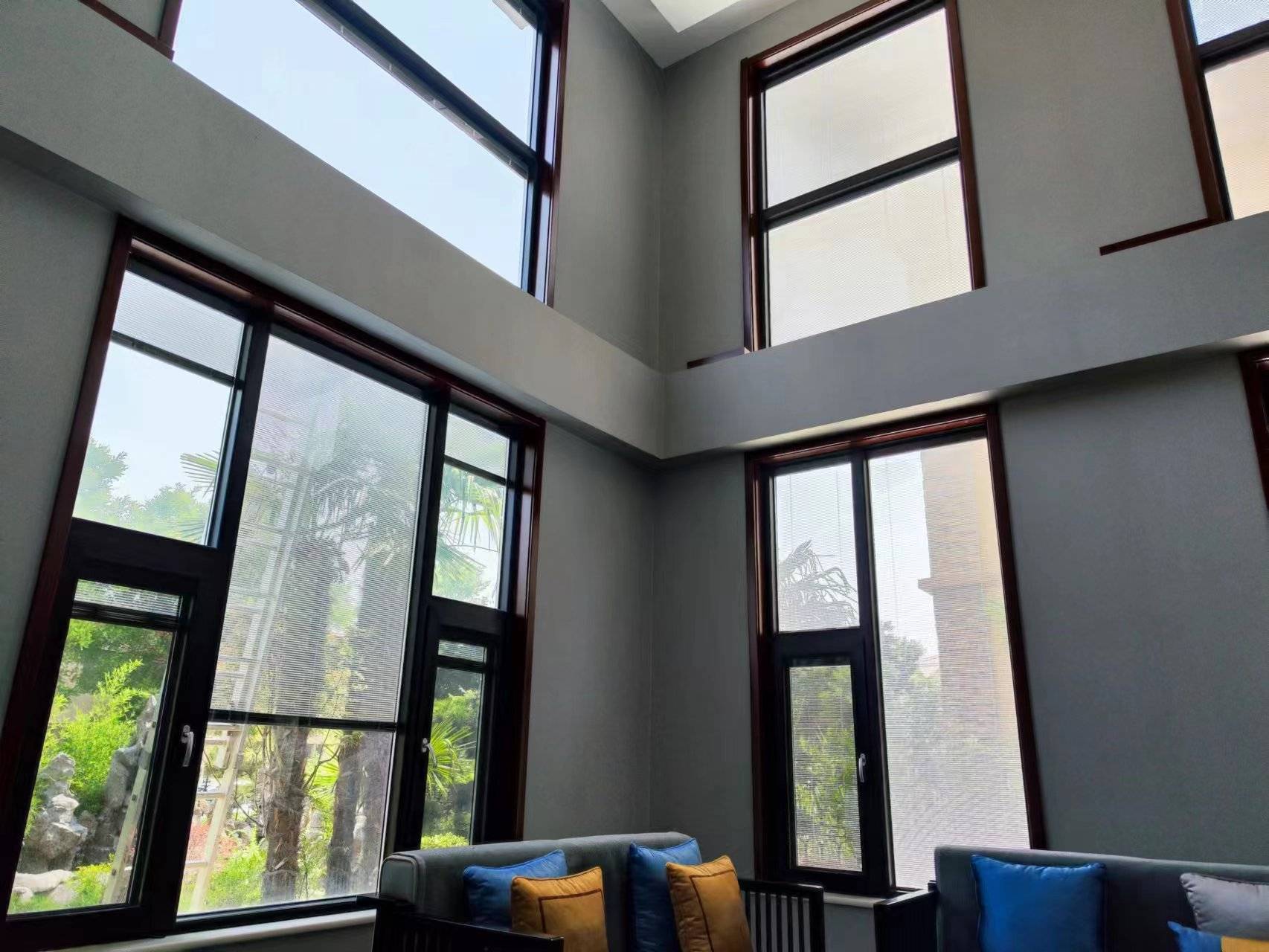
Where does the sealing performance of the FG110F double inward-opening break-through window come from?Not just glass and sealing strips
The FG110F double inward-opening break-through window is an aluminum alloy window product of the Haipaisichuang brand. Sealing performance does not rely solely on glass and sealing strips; the window structure and the profile itself are equally critical factors.
The relationship between the double inward-opening structure and sealing performance
Double inward-opening means the window sash opens toward the interior. When the sash is closed, multiple locking points apply pressure from all sides to the frame, causing the sealing strips to be uniformly compressed along the perimeter, rather than being pulled tight by a single-point latch. This force distribution helps reduce local gaps and has a direct impact on both air tightness and water tightness.
Compared with single inward-opening or sliding windows with fewer locking points, the double inward-opening structure has a structural advantage in the uniformity of gasket compression.
Influence of profile material and wall thickness on sealing
FG110F uses 6063-T5 aluminum alloy profiles with a reference wall thickness of 2.0mm. 6063-T5 is a common grade for aluminum alloy doors and windows. It has good extrusion formability, suitable for the complex cross-section design of thermal break profiles, which helps ensure the flatness of the frame and sash contact surfaces. The 2.0mm wall thickness is a reference configuration; the actual thickness should be evaluated based on project wind pressure and window size. Wall thickness affects profile rigidity. Insufficient rigidity may cause slight deformation when locking points are tightened, leading to uneven gasket compression.
Sealing performance is the result of the combined effect of profiles, structure, glass, and gaskets. Specific configurations should be confirmed with the manufacturer.
Which projects truly need the sealing performance of FG110F? Four typical scenarios
The sealing performance of the FG110F double inward-opening broken bridge window is not a 'standard feature' required for all projects; its value is concentrated in specific scenarios. The judgment criteria are simple:Has your project paid a price due to air leakage, noise, or temperature differences? If so, this product deserves serious evaluation;If it is only for conventional lighting needs, there may be more economical solutions.
Street-facing residences and the need for sound insulation and noise reduction
The pain point for street-facing residences is not 'whether the window can be closed,' butafter closing, whether the noise still penetratesThe sealing performance here directly determines the indoor acoustic environment.
For street-facing projects, two aspects need attention:
- Number of sealing layers between the profile and the opening sashThe FG110F features a double inward-opening structure, where the two sashes form a double-layer sealed cavity when closed, providing one more layer of barrier than a single outward-opening window.Combined with the reference configuration of 5+27A+5 insulating glass, it significantly attenuates mid-to-high frequency traffic noise.
- Sealing treatment at installation jointsOnly half of a window's sealing performance depends on the product itself; the other half depends on foam filling during installation in the opening and waterproof sealing on the exterior side.For street-facing projects, if installation is not standardized, even the best window type will leak sound.
Suitability assessment: If the project is located within 30 meters of an urban arterial road, below 15 floors, or directly facing an elevated highway or rail transit, the sealing structure of the FG110F is worth considering as a candidate solution.
Cold northern regions and thermal insulation needs
The core contradiction for northern projects iscondensation, cold air infiltration, and heat loss caused by large indoor-outdoor temperature differences. Here, sealing performance is not a comfort issue but an energy consumption issue.
The thermal break structure of the FG110F (with insulating strips separating the aluminum profiles) combined with the dual inward-opening sealing design effectively reduces cold bridges in two locations: one is the metal conduction of the profile itself, and the other is the gap infiltration at the edges of the opening sash. The reference configuration of 5+27A+5 insulating glass, with a 27A air layer width, is a relatively large specification among insulating glass units, which helps reduce the overall heat transfer coefficient of the window.
Suitability assessment: If the project is located in a region where the lowest winter temperature is below -10°C and the building has clear energy efficiency acceptance standards, the sealing and thermal break configuration of the FG110F is worth including in the comparison. However, it should be noted thatthe glass configuration can be adjusted according to the energy-saving design standards of the project location—in severe cold regions, triple glazing with two air cavities or Low-E coating may be required, and this needs to be confirmed with the Hipex Creative team regarding the range of glass combinations they can support.
Which projects are not suitable for double inward-opening thermal break windows?
In the following situations, caution is advised—not because the product is inferior, but because the fit is poor:
| Project characteristics | Why it is not recommended |
| Low-rise self-built houses or temporary buildings without strict requirements for sound insulation and thermal insulation | The cost of double inward-opening thermal break windows is higher than that of ordinary sliding windows, and it is a waste if the sealing performance is not utilized. |
| Areas with strict fire protection requirements in high-rise residential buildings | Inward-opening windows may affect fire smoke exhaust or escape route planning, so local regulations must be confirmed first. |
| Window openings in extremely small bathrooms or kitchens | Double inward-opening sashes occupy indoor space, making operation inconvenient in small openings. |
| Projects with highly sensitive budgets and no mandatory energy-saving standards for buildings | The premium for sealing performance cannot be recovered through energy savings in the short term. |
Key trade-offsThe value of FG110F lies in "predictable sealing performance" — the dual inward-opening structure ensures consistent closing status for every window, making it suitable for batch projects with high requirements for installation uniformity. If your project prioritizes ventilation or minimalist appearance over sealing performance, this product is not the optimal choice.
Next step: confirm the actionProvide the Haipaisichuang team with the project's region, building type, opening dimensions, and energy efficiency standard requirements to confirm whether the glass configuration range and wall thickness options supported by FG110F cover your project needs.
How to choose glass configuration and wall thickness?Key variables for sealing performance
The reference configuration for FG110F dual inward-opening thermal break windows is 5+27A+5 insulating glass with a 2.0MM profile wall thickness. This combination is not arbitrary; it corresponds to the basic sealing performance requirements of most residential and commercial projects. But if you are evaluating this product, what you really need to clarify is: **under what conditions is this configuration sufficient, and under what conditions does it need adjustment.**
**
Applicable boundaries of 5+27A+5 insulating glass
5+27A+5 means two 5mm glass layers with a 27mm air layer in between. The 27mm air layer thickness is a relatively large design in insulating glass. The thicker the air layer, the longer the heat transfer path, the better the insulation effect, and the greater the challenge to the sealing system—the thicker the air layer, the greater the overall weight of the glass, and the higher the requirements for profile load-bearing and long-term compression state of the sealing strips.
Scenarios suitable for this configuration:
- Street-facing residences or commercial spaces, where insulating glass is needed to reduce traffic noise transmission
- Cold northern regions, where thermal break profiles combined with insulating glass form a thermal barrier
- Projects sensitive to condensation, where the insulating air layer can reduce condensation on the interior glass surface
Situations requiring configuration adjustments: If the project is located in an extremely noisy environment (such as near an airport or elevated road), 5mm glass with a standard air layer may not be sufficient; laminated insulating glass or unequal-thickness glass combinations may need to be considered;If the project has higher thermal insulation requirements (such as passive house standards), triple glazing with two cavities or filling with inert gas may be necessary. These all fall within the scope of customization. Haipaisichuang supports adjusting the glass configuration according to drawings, but you need to first clarify the specific performance goals of the project.
Is a wall thickness of 2.0MM sufficient?
A wall thickness of 2.0MM is at the upper end of the standard range for aluminum alloy window and door profiles. To determine whether it is sufficient, the key is to look at two variables:Window type dimensions and opening method。
FG110F features a double inward-opening structure. The load-bearing method of inward-opening windows determines that the profile wall thickness is directly related to the window sash dimensions. For a reference sash size of 1000×1000mm (approximately 1㎡), a 2.0mm wall thickness combined with 6063-T5 aluminum alloy profiles is sufficient under normal wind pressure conditions. However, if your project involves the following situations, you need to confirm with the team whether to increase the thickness:
- Single sash area exceeds 1.5㎡, increasing the sash's own weight and the stress on the profile.
- Building height exceeds 30 floors, significantly increasing wind load pressure.
- The project site is prone to typhoons or strong winds, requiring verification of wind pressure resistance levels.
Key trade-offsIncreasing the wall thickness enhances the profile's rigidity and long-term sealing stability (the less the profile deforms, the more uniform the compression of the weatherstripping), but it also increases material costs and the overall window weight. 2.0mm is not a question of "sufficiency" but of "whether it matches your project's operating conditions."
Working conditions that need to be confirmed before custom configuration
Before submitting a customization request to the Haipaisichuang team, it is recommended that you first organize the following information, as these directly determine the configuration plan:
- Maximum size of a single window— Determines whether the wall thickness needs to be increased and whether the glass needs to be thinned to control weight
- Basic wind pressure at the project location— Determines the profile strength grade and the minimum glass thickness
- Noise environment level— Determines whether a laminated interlayer or unequal-thickness glass combination is needed
- Indoor and outdoor temperature differences and humidity conditions— determine whether Low-E coating or warm edge spacer bars need to be considered
- Opening frequency and maintenance methods— the load-bearing capacity of hardware for inward-opening windows and the replacement cycle of sealing strips are directly related to usage frequency
Only after providing these conditions to the team can it be determined whether the reference configuration is directly applicable or whether adjustments to wall thickness, glass combinations, or sealing strip materials are needed. Do not directly apply the reference configuration to place an order without these operating condition data— the reference configuration addresses general needs, but your project may have special variables.
Before choosing FG110F, consider these three points: budget, installation, and customization boundaries
The sealing performance advantage of the FG110F double inward-opening broken bridge window is clear, but 'good performance' does not mean 'suitable for you'. Before confirming the quotation and delivery time with the Haipaisi Chuang team, think through the following three things first to help you avoid the three most common problems: choosing the wrong type, failing to install, and exceeding your budget.
Budget allocation: Where should the money be spent?
The reference configuration of FG110F is 2.0mm wall thickness profiles plus 5+27A+5 insulating glass. This combination already covers the core needs of thermal insulation and sealing. If your budget is limited, prioritize what is more certain:profile wall thickness and glass configuration, rather than pursuing higher specifications in hardware or surface treatment.
- Profile wall thickness (2.0mm): This directly determines the structural strength of the window frame and the risk of deformation under long-term use; it is not recommended to downgrade this part.
- Glass configuration (5+27A+5): The 27A air layer is already a relatively wide cavity, which is practically helpful for both thermal and sound insulation.If the budget is tight, consider adjusting the glass thickness, but do not compress the width of the air layer, otherwise the sealing performance will be significantly compromised.
- Hardware fittings: The double inward-opening hardware system consists of moving parts, and quality differences will become apparent after two to three years of use.Here, it is recommended to maintain the original factory configuration and not to replace them on your own to save budget.
In one sentence:First secure the profiles and glass, then talk about hardware upgrades.
Installation and customization: which pitfalls should be avoided?
The FG110F is an inward-opening window, and there is one easily overlooked point during installation:The opening sash of an inward-opening window occupies indoor space.。 If there are curtain boxes, radiators, furniture, or cabinets near the window, interference may occur when opening. Before placing an order, be sure to measure the clear dimensions inside the window opening and confirm that there are no obstacles in the opening path.
For customization, Hipeisichuang supports customization according to drawings, but you need to clarify three things in advance:
- The mullion layout scheme: Double inward opening means there are two opening sashes. Whether there is a fixed sash in the middle and the width of the fixed sash directly affect the cost and the length of the weatherstripping.
- Glass configuration adjustments: If you need laminated glass or Low-E coating, you need to confirm in advance whether it affects the matching of the profile grooves and the weatherstripping.
- Sample confirmation for bulk orders: For engineering projects, it is recommended to make one sample first to confirm the installation method and sealing effect before placing a bulk order, to avoid batch issues.
In which situations is FG110F not recommended?
FG110F is not a one-size-fits-all solution. In the following three situations, we suggest you reconsider:
- The project requires a minimalist or narrow-frame appearance for the window type.: The double inward-opening structure itself requires a wider frame profile to accommodate the hardware and sealing system. If you are pursuing a visual effect of extremely narrow frames, this product is not a match.
- Installation location is on a high floor with significant wind pressure: Although the 2.0mm wall thickness provides good strength, the deformation of large window sashes under high-rise wind pressure needs to be recalculated by the engineering team.If your project falls into this situation, first provide the window opening dimensions and floor height to the Hipesi Chuang team to confirm whether the profile solution needs to be thickened or reinforced with stiffeners.
- Budget only covers basic configuration but you expect top-tier sound insulation: The 5+27A+5 insulating glass has a good blocking effect on mid-to-high frequency noise, but its attenuation of low-frequency noise (such as subways and heavy vehicles) is limited.If your project is adjacent to such noise sources, you need to additionally confirm whether to upgrade the glass solution, rather than assuming the current configuration can meet the requirements.
Finally, make a judgment.: If your project has clear sealing requirements, the installation conditions are not complex, and you are willing to confirm with samples first, the FG110F is a worthwhile investment. : If your requirements are still changing, or the installation conditions are limited, don't rush to place an order. Sort out the dimensions, mullion divisions, and glass issues mentioned above, and then contact the Haipaisi Chuang team to confirm the matching solution.
Frequently Asked Questions
Q1: Is the 2.0mm wall thickness of FG110F a fixed value? Can thinner profiles be selected to reduce costs? 2.0mm is the wall thickness in the reference configuration, but Haipaisi Chuang supports different wall thickness options.
It should be noted that the wall thickness directly affects the window's strength and wind pressure resistance. Before downgrading, you need to confirm the wind pressure requirements and window opening dimensions for the project area; otherwise, deformation may occur after use.
Q2: Can the 5+27A+5 glass configuration be replaced with laminated glass that has better sound insulation performance? It can be adjusted, but it is necessary to confirm whether the total thickness of the laminated glass matches the groove design of the existing profiles. Laminated glass provides better sound insulation for mid-to-low frequency noise, but it increases the weight of each glass pane, which also affects the load-bearing capacity of the hardware and the installation method.
It is recommended to provide the noise source type and glass dimensions to the Haipaisichuang team, and they will provide a matching solution.
Q3: Is a double inward-opening window more troublesome to clean and maintain than a single inward-opening one? Double inward-opening means both sashes can be opened toward the interior, making it more convenient to clean both the inside and outside of the glass, which is an advantage of the inward-opening structure. For maintenance, the main focus is on the moving parts of the hardware. It is recommended to check the tightness of the hinges and locking points every six months and clean the drainage holes.
Q4: For bulk engineering procurement, what factors generally affect the delivery time? It is mainly affected by three factors: the color and surface treatment of the profiles (powder coating or anodizing), whether the glass configuration requires customization (such as laminated or coated glass), and the batch quantity. It is recommended to lock these parameters during the sample confirmation stage to avoid extended lead times due to changes after bulk ordering.
Q5: If my project's window opening size is not the standard 1000×1000mm, can I still use FG110F? Yes, FG110F supports customization according to drawings. However, please note that changes in window opening size will affect the mullion layout, profile stress calculations, and glass configuration—it is not simply a matter of scaling up or down.
Before placing an order, you need to provide the actual window opening size and opening method requirements, and the Hyperspace Innovation team will confirm the structural solution.
Learn More
If your project is evaluating door and window solutions with high sealing performance requirements, you are welcome to provide information such as the project's location, building type, opening size, and energy efficiency standards. Based on this, we can help match the FG110F configuration solution.
Related Products:FG110F Double Inward Opening Thermal Break Window