
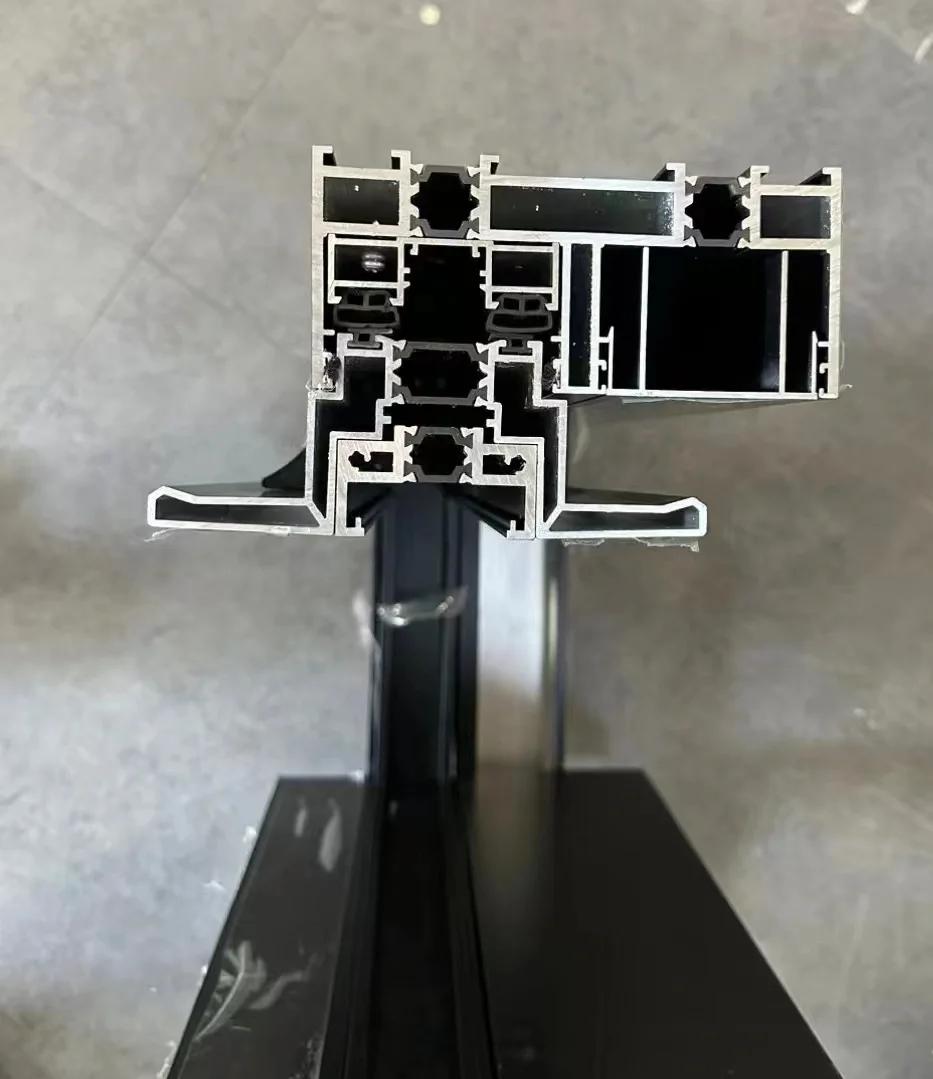
Why is sample confirmation for the FG110F double inward-opening thermal break window the 'quality anchor' for bulk orders?
For bulk orders of FG110F double inward-opening thermal break windows, sample confirmation is not a step that can be skipped, but rather the quality baseline for the entire order. The final performance of a thermal break window depends on the combination of five factors: profiles, glass, hardware, sealing strips, and assembly process. Any deviation in any of these factors will be amplified during bulk delivery. The role of the sample is to solidify the 'expectations' of these five factors into 'physical standards'.
The core role of sample confirmation in bulk procurement
The reference configuration for the FG110F double inward-opening thermal break window is 6063-T5 aluminum alloy profiles, 2.0mm wall thickness, and 5+27A+5 insulating glass, but the word 'reference' means that actual delivery can be adjusted. The core value of sample confirmation is that it turns the parameters on the drawings into a tangible, measurable, and comparable physical object.
Specifically, the sample serves three functions:
- Lock in the visual and tactile standards: Features such as surface finish, color uniformity, gasket flatness, and opening feel cannot be fully described by parameters; they can only be aligned through samples.
- Verify dimensional and assembly precision: The double inward-opening structure demands high tolerance for frame-sash fit. Samples allow for actual measurement of diagonal error, overlap, and sealing compression, preventing batch products from having issues like poor closure or air leakage.
- Establish acceptance reference: After bulk delivery, the buyer can directly compare against the sample to quickly assess batch quality consistency, reducing disputes and return/exchange costs.
Common risks of skipping sample confirmation
: The most common consequence of skipping sample confirmation is not receiving a completely unusable product, but receiving a product that does not match expectations. Such inconsistencies often only surface during the installation phase, and the cost of handling them is far higher than the waiting time for sample confirmation.
Specific risks include:
- Color difference and surface texture deviation: The oxidation or sprayed color of profiles from different batches may have visible differences, especially noticeable in large-area continuous installation.
- Hardware feel and opening/closing smoothness do not match: The debugging level of hardware for double inward-opening windows directly affects daily use experience. Without a sample benchmark, the feel of batch products may be too tight or too loose.
- Sealing performance fails to meet project requirements: If the project has strict indicators for sound insulation or thermal insulation, samples can be used for preliminary sealing checks, but it is difficult to inspect each batch product individually.
- Accumulated dimensional tolerances make installation difficult: especially for projects with tight reserved opening dimensions, the slight positive tolerance of batch windows can become a practical obstacle during installation.
It should be noted that skipping sample confirmation does not necessarily mean the product has problems, but it means you give up the opportunity to discover deviations before mass production. For structurally complex double inward-opening thermal break windows like FG110F, the cost-benefit ratio of sample confirmation is very high—one confirmation yields the acceptance benchmark for the entire batch order.
Next confirmation action: Clearly communicate your project's opening dimensions, glass configuration requirements, and surface treatment needs to the Haipaisichuang team, request samples for the corresponding configuration, and upon receipt, focus on checking the smoothness of opening, the fit of the sealing strips, and the texture of the profile surface.
What are the 4 key items that must be checked when confirming samples for the FG110F double inward-opening thermal break window?
Sample confirmation is a key step in translating order parameters into physical reality. Once the sample of the FG110F double inward-opening thermal break window arrives, it is recommended to check the following 4 items one by one.
Profile material and wall thickness: how to confirm 6063-T5 and 2.0mm
The FG110F reference configuration is 6063-T5 aluminum alloy profile with a wall thickness of 2.0mm. Pay attention to two points when checking:
- Material: Check the material mark or inkjet code on the profile cross-section to confirm whether it is 6063-T5.If there is no mark, a simple scratch test can be done on a non-visible surface; 6063-T5 has moderate hardness, and the scratch will be shallow and uniform.
- Wall thickness: Use a vernier caliper to measure the load-bearing parts of the main frame profile (the main load-bearing edges of the frame and sash), and the measured value should not be less than 2.0mm.If it is lower than 1.8mm, it is necessary to confirm with the manufacturer whether to treat it as non-standard wall thickness.
Glass configuration and dimensions: key points for checking 5+27A+5 and custom specifications
The reference glass configuration is 5+27A+5 (5mm glass + 27mm air gap + 5mm glass). When checking, pay attention to:
- Glass marking: The corner of insulating glass usually has a 3C certification mark and manufacturer's spray code, which can confirm the glass thickness.Both panes of glass should be 5mm, and the width of the air gap should be measured from the side with a caliper; the 27A tolerance is generally within ±1mm.
- Custom sizes: If the order is not the standard 1000×1000mm, use a tape measure to measure the length, width, and diagonal.If the diagonal deviation exceeds 2mm, it may affect installation and requires confirmation with the manufacturer.
3. Hardware and opening methods: Check whether the handle opens smoothly, whether all locking points engage, and whether there is obvious sagging or wobbling when opening inward; confirm that the hardware brand matches the order agreement.
4. Thermal break strips and sealing strips: Observe whether the thermal break strip is continuous, free of fractures, and uniform in width;Press the sealing strip to check its resilience; inferior strips recover slowly and are prone to aging and cracking over time.
Next confirmation actionCheck off each item against the order contract, with special attention to the measured wall thickness and glass markings. If any discrepancy is found, do not sign off immediately; take photos to document the differences, explain the situation to the Haipaisichuang team, and confirm the adjustment direction before proceeding to the batch production stage.
From samples to batch orders: How to lock in quality consistency through acceptance standards?
After sample approval, the key is to translate the sample details into executable batch acceptance standards. The FG110F double inward-opening broken bridge window involves multiple components such as profiles, glass, hardware, and sealing strips; any deviation in any of these components will affect the consistency between the finished product and the sample.
Key points for developing written acceptance standards
Break down the sample into quantifiable indicators, and it is recommended to cover the following four categories:
- Profiles and surface: Specify the wall thickness of 6063-T5 aluminum alloy profiles (FG110F reference configuration is 2.0mm), surface color number, and allowable color difference range, avoiding merely writing "consistent with sample".
- Glass configuration: Specify parameters such as glass thickness tolerance and insulating layer width (FG110F reference configuration is 5+27A+5). Glass is the part most prone to deviation in batch production.
- Hardware and opening: Specify the hardware brand or grade, opening/closing force range, number of locking points, and attach the operational requirements for opening/closing tests.
- Sealing and drainage: Specify the gasket material, sealing method, and the location and number of drainage holes, as these details directly affect sealing performance.
It is recommended to compile the above content into a "Batch Acceptance Comparison Table", listing acceptance items, standard values, inspection methods, and acceptance criteria item by item, and send it to the supplier for confirmation before placing the order.
Sampling inspection and process control during mass production
Set inspection checkpoints according to the three-step process of "first article confirmation - process patrol inspection - outgoing sampling inspection":
| Checkpoint | Inspection focus | Recommended frequency |
| First article confirmation | Full inspection against the acceptance comparison table to confirm consistency with the sample | Mandatory inspection of the first article for each batch |
| In-process inspection | Check the surface of profiles, glass installation, hardware tightening, and gasket continuity | Sample 1 unit for every 50-100 units |
| Factory outgoing inspection | Implement according to the sampling plan agreed upon by both parties, focusing on dimensions, opening, and sealing | Sample inspection by proportion for each batch |
During first article confirmation, it is recommended to continuously inspect the first 3-5 units, as the stability is poor during the initial stage of production line adjustment; continuous inspection can more quickly expose systemic issues. The acceptance criteria should also specify in advance the handling method for failed sampling inspections—whether to reject the entire batch, double the re-inspection, or conduct a full inspection of each unit—to avoid disputes after delivery.
In which situations is it not recommended to place a bulk order directly?First confirm these 3 issues
A bulk order for the FG110F double inward-opening broken bridge window means locking in capital occupation, production lead time, and installation schedule. In the following three situations, it is recommended to pause and not place the order directly.
Risks when project requirements are not yet clear
If the project is still in the solution discussion phase, and the window opening method, mullion dimensions, color, and hardware brand have not been finalized, placing a bulk order at this time carries high risks. The FG110F features a double inward-opening structure. Once bulk production begins, later modifications involve profile cutting, hardware adaptation, and glass configuration adjustments, with rework costs far exceeding those at the sample stage.
Specifically, when the following signals appear, it indicates that the requirements have not yet reached the level for bulk ordering:
- The project drawings only indicate "thermally broken aluminum windows" without specifying the opening type or mullion layout.
- The glass configuration is still undecided between standard insulated glass and Low-E insulated glass.
- The color scheme is not finalized, or the client is still comparing multiple color samples.
- Installation details and closure methods have not yet been aligned with the civil construction contractor.
Precautions for custom configurations that have not been verified.
The FG110F supports adjustments in wall thickness and glass configuration, which is its flexibility, but also a potential risk point for batch orders. If you plan to use a non-reference configuration—for example, changing the glass from 5+27A+5 to a thicker laminated insulated glass, or adjusting the profile wall thickness from 2.0mm to other specifications—it is recommended to first produce a sample and install it in the actual project environment for verification.
Customization points that require special confirmation include:
- Impact of glass configuration changes on profile load-bearing: Thicker glass means heavier sash weight. Whether the hinges and hardware of double inward-opening windows match the load-bearing capacity needs actual testing.
- Matching degree of hardware and profile grooves: Different hardware brands may have different installation dimensions and handle positions. Before mass production, the hardware brand and model must be locked.
- Adaptation of sealing strips to profiles: If the project has special requirements for air tightness, the material and cross-section shape of the sealing strips must fully match the profile grooves.
If this is your first time purchasing FG110F, or if you are not sure about any of the above, the correct approach is to first place an order for 1-2 sample units, complete installation testing, and then proceed to the mass production stage. Sample confirmation is not just a formality, but a way to expose problems at the lowest cost stage.
One-sentence conclusion: Only when the project requirements are frozen, the customized configuration has been verified through samples, and the installation schedule is clear—all three conditions met simultaneously—is it appropriate to proceed directly to a batch order. If any one is missing, it is worth taking the time to clarify first.
Frequently Asked Questions
What is the reference configuration for the FG110F double inward-opening thermal break window?
The reference configuration is 6063-T5 aluminum alloy profiles, 2.0mm wall thickness, and 5+27A+5 insulating glass, but actual delivery can be adjusted according to project requirements.
How should the profile wall thickness be checked during sample confirmation?
Use a vernier caliper to measure the load-bearing parts of the main frame profiles (the main load-bearing edges of the frame and sash), and the measured value should not be less than 2.0mm.If it is lower than 1.8mm, it is necessary to confirm with the manufacturer whether to treat it as non-standard wall thickness.
What should the batch acceptance criteria include?
It is recommended to cover four categories: profiles and surfaces (wall thickness, color number, color difference), glass configuration (thickness tolerance, air gap width), hardware and opening (brand, opening/closing force, locking points), and sealing and drainage (gasket material, sealing method, drainage hole location), and compile them into a "Batch Acceptance Comparison Table".
In which situations is it not recommended to place a batch order directly?
When project requirements are not clearly defined (such as opening method, mullion layout, or color not determined), custom configurations have not been verified (such as glass or wall thickness adjustments), or installation details are not aligned, it is not recommended to place an order directly.It is recommended to place a sample order first to complete installation testing.
Learn More
If you are procuring FG110F double inward-opening thermal break windows in bulk for your project, you are welcome to submit your opening dimensions, glass configuration, and surface treatment requirements to the Haipaisichuang team. We will match corresponding samples for you and assist in developing selection and acceptance criteria.
Related Products:FG110F Double Inward Opening Broken Bridge Window