
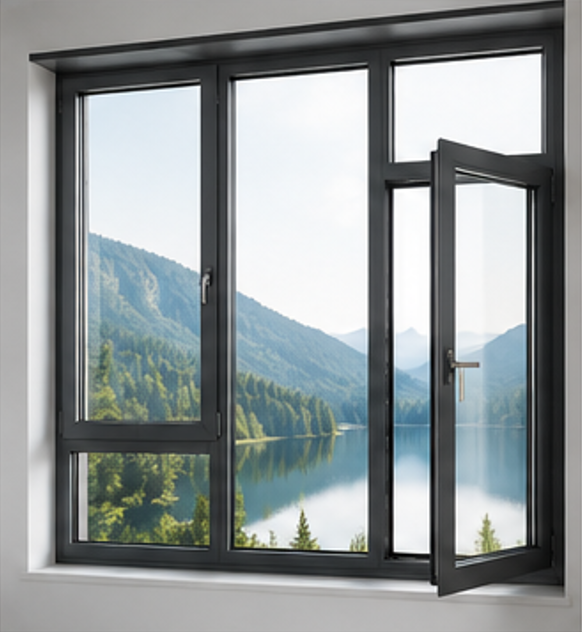
What are the main differences in the price of the FG110F double inward-opening thermal break window?
When purchasing FG110F double inward-opening thermal break windows, the large price differences among suppliers are not due to the model 'FG110F' itself, but rather to four variables that can be freely combined under the same model. Understanding these four variables will help you determine whether a quote is expensive due to reasonable configuration or due to information asymmetry.
From profiles to glass: four core price variables
First, profile wall thickness. FG110F uses 6063-T5 aluminum alloy profiles, but the wall thickness is not a fixed value. 2.0mm is just a reference configuration; in actual projects, wall thickness can range from 1.4mm to 2.0mm or even higher.
For every 0.2mm increase in wall thickness, the profile cost rises significantly, but wind pressure resistance and load-bearing capacity also increase accordingly. For high-rise residences and areas with strong wind pressure, the wall thickness cannot be reduced;For low-rise or non-street-facing projects, it can be appropriately reduced to control the budget.
Second, the glass configuration. The reference configuration is 5+27A+5 insulating glass, but this item has the most flexibility. Switching to Low-E coated glass, increasing glass thickness, filling with argon gas, or upgrading to triple-glazed with two cavities will each raise the unit price.
Glass typically accounts for 30%-40% of the total window cost, so differences in glass configuration are often the biggest source of price gaps in quotes.
Third, the hardware system. The double inward-opening structure relies heavily on hardware—the opening method determines the quantity and precision requirements of hinges, lock points, and transmission devices. Different brands and grades of hardware systems can vary in price by several times.
If the quotation only states "with hardware" without specifying the brand and model, this variable is a gray area left by the supplier for themselves and for you.
Fourth, the surface treatment process. Anodizing, powder coating, and fluorocarbon spraying have increasing costs in that order, and the color and texture also directly affect the overall project effect. For bulk project procurement, the unit price differences in surface treatment are amplified by order quantity, so they deserve separate line-item comparison.
Why can't you just look at the unit price?
Another reason for large differences in supplier quotations is the quotation'sscope of inclusionDifferent. Some quotes only include the profiles and glass, with hardware, gaskets, auxiliary materials, transportation, and installation charged separately;Others are "delivered-to-site prices" or "installation-included prices." The same number can correspond to completely different deliverables.
So when comparing prices, don't first ask "how much per square meter," but instead ask the other party to break down the quote into the four variables mentioned above, and clarify whether hardware, transportation, and installation are included. Only when you have two quotes with the same structure can you see where the price difference lies—whether it's an upgrade in glass, an increase in wall thickness, or simply a larger profit margin for one supplier.
Next step for confirmation: Provide the Haipaisi Chuang team with your project's floor level, window dimensions, whether there are soundproofing or insulation requirements, and whether you need to specify a hardware brand, so they can provide an itemized quote based on the FG110F. This way, you won't get just "a unit price," but a cost breakdown that can be compared horizontally.
How do profile wall thickness and glass configuration affect the final quotation for the FG110F double inward-opening thermal break window?
The quotation differences for the FG110F double inward-opening thermal break window mainly come from two variables: profile wall thickness and glass configuration. These two factors determine material costs, processing difficulty, and final performance, and are also the most confusing points for buyers when comparing prices.
Is 2.0mm wall thickness standard or high-end?
The reference configuration for FG110F is 2.0mm wall thickness, using 6063-T5 aluminum alloy profiles. In the field of thermal break aluminum doors and windows, 2.0mm is on the thicker side—common residential door and window wall thicknesses on the market are mostly 1.4mm-1.6mm, while engineering-grade products typically range from 1.8mm-2.0mm. Therefore, 2.0mm is a standard configuration for FG110F, but in the broader door and window market, it is already a relatively high-end choice.
The impact of wall thickness on quotation is reflected in three aspects:
- Aluminum material usage: As wall thickness increases, the weight per unit length of the profile rises, directly increasing the cost of aluminum ingots.Upgrading from 1.4mm to 2.0mm increases the profile weight by approximately 20%-30%, and this cost is directly reflected in the unit price.
- Processing and molds: Thick-wall profiles require higher precision in cutting, corner crimping, and welding equipment, making scrap rate control more difficult and processing costs correspondingly higher.
- Hardware compatibility: A 2.0mm wall thickness demands higher load-bearing capacity from hardware components, requiring reinforced hardware systems, a cost that is often overlooked.
Decision-making suggestions: If your project is a high-rise residential building or in an area with high wind pressure, a 2.0mm wall thickness can provide better profile rigidity and resistance to wind pressure deformation, and this premium is worth paying. For low-rise or interior window projects, a wall thickness of 1.4mm-1.6mm can also meet basic requirements, so there is no need to pay for strength you won't use.
Cost logic of 5+27A+5 insulating glass and customization options
The reference glass configuration for FG110F is 5+27A+5, which means two 5mm glass panes with a 27mm air layer in between. The core value of this configuration lies in the 27mm air layer—which is significantly wider than common 9A, 12A, and 15A air layers, providing better thermal and sound insulation, but at a higher cost.
The impact of glass customization on the quotation depends on which variable you change:
| Customization direction | Cost change trend | Applicable scenarios |
| Keep 5+27A+5, only change the glass brand | Slight fluctuation (about 5%-10%) | Specific requirements for the glass raw sheet brand |
| Change to 5+12A+5 (air layer becomes narrower) | Significant decrease (about 15%-25%) | Limited budget, insulation requirements not extreme |
| Change to 6mm or 8mm glass | Increase (approximately 10%-20%) | Large-size window sashes require enhanced strength |
| Upgrade to Low-E coated glass | Increase (approximately 15%-30%) | Prominent needs for summer heat insulation or winter heat retention |
| Change to laminated glass | Increase (approximately 20%-35%) | For strong noise environments such as street-facing locations and airports |
Key trade-offs: The 27mm air layer is a performance highlight of the FG110F, but if your project is in a mild climate with low thermal insulation requirements, narrowing the air layer is the most direct way to cut costs. Conversely, if the project is in a cold region or faces high street noise, retaining or upgrading the glass configuration is more effective than switching to a more expensive profile—glass contributes over 70% to the overall thermal and acoustic insulation of the window.
Next step for confirmation: Provide the Haipaisichuang team with your project's city, floor height, window orientation, and noise environment, and let them give matching recommendations for wall thickness and glass configuration based on these conditions. Also confirm whether your project requires custom sizes according to drawings—non-standard sizes involve mold opening or profile cutting losses, and this cost needs to be calculated separately.
Which projects are suitable for choosing the FG110F double inward-opening thermal break window?When is it not worth spending more?
Suitable scenarios for residential and commercial projects
The core value of the FG110F double inward-opening thermal break window lies inthermal insulation, sealing, and the inward-opening structure, so the key to determining suitability is not the project size, but how clear the project's requirements are for these three aspects.
Projects suitable for choosing it:
- Residences facing the street or near main roads: The double inward-opening structure combined with insulating glass (reference configuration: 5+27A+5) has a practical attenuation effect on traffic noise.If noise complaint rates are high in your area, this configuration is a necessity rather than an upgrade.
- Residences in cold northern regions: The thermal break structure addresses the issues of condensation on the interior surface of the profile and heat loss in winter.If the outdoor temperature at the project location is consistently below -10°C in winter, the thermal break is not an option but a requirement.
- Multi-story or high-rise residential communities: The sashes of double inward-opening windows can be opened toward the interior,so replacing glass and hardware does not require outdoor hoisting, and the property's long-term maintenance costs are significantly lower than those of outward-opening windows.For centrally managed residential projects, this advantage directly translates into a lower rate of maintenance complaints.
- Standard floors of commercial office buildings: Inward-opening windows make it easy for cleaning staff to clean the glass from indoors, eliminating the need to hire an additional high-altitude work team.If your commercial project has clear budget constraints for property cleaning, this point is worth including in the selection evaluation.
Scenarios where it is not suitable or not worth spending extra money:
- Temporary transitional buildings or commercial spaces with leases shorter than 3 years: The thermal insulation benefits of thermal break windows require at least one full heating/cooling cycle to materialize, making it difficult for short-term projects to recover the price difference.
- Regions with mild climates (e.g., winter temperatures not below 0°C and summer maximum temperatures not exceeding 30°C): If the annual temperature difference at the project location is small, the energy-saving benefits of the thermal break structure are limited, and ordinary non-thermal break aluminum alloy windows may already meet the requirements.
- Projects with special customization requirements for window appearance: FG110F is a fixed series product. Although it supports customization according to drawings, the customization scope is mainly limited to dimensions, wall thickness, and glass configuration.If you need special-shaped windows, arched windows, or special opening methods, this product is not a suitable starting point.
When the budget is limited, which configurations can be downgraded?
Under budget constraints, the core principle of downgrading is:First ensure sealing and structural safety, then consider insulation and glass upgrades.
Configurations that can be downgraded:
- Glass configuration: The reference configuration of 5+27A+5 insulating glass can be adjusted to 5+12A+5.Reducing the air layer from 27A to 12A will decrease thermal insulation performance, but the loss in sound insulation is relatively small.If noise is not a prominent issue for the project, this downgrade is the most worthwhile to prioritize.
- Profile wall thickness: The 2.0mm wall thickness can be reduced to 1.6mm or 1.8mm, provided thatthe sash area is not large(single sash not exceeding 1.5㎡).Large fan-shaped sashes must maintain a wall thickness of 2.0mm; otherwise, sash sagging may occur after long-term use.
Configurations not recommended for downgrading:
- The thermal break structure itself: Once the thermal break is removed, the product changes from a thermal break window to an ordinary aluminum alloy window. The price will drop significantly, but the positioning and performance of the FG110F will also disappear.If the budget is truly insufficient for a thermal break window, you should directly choose a cheaper non-thermal break product rather than making cuts to the FG110F.
- Hardware grade: The load-bearing and locking of double inward-opening windows depend on the hardware system.Downgrading the hardware may not show problems in the short term, but after 2-3 years, seal strip displacement and loose locking points may occur, and the repair costs will exceed the price difference saved.
Next step for confirmation: Provide the Hipesic team with your project's city, building orientation, floor height, and the maximum dimensions of a single window, and ask them to give specific recommendations on wall thickness and glass configuration based on these conditions. These three pieces of information directly determine which configurations can be downgraded and which must be retained.
How to evaluate the reasonableness of a quote for the FG110F double inward-opening thermal break window?
When you receive a quote for the FG110F double inward-opening thermal break window, don't rush to compare the total price. The price differences for this product mainly come from four variables: profile wall thickness, glass configuration, hardware system, and surface treatment. If these are not clearly stated in the quote, the numbers you see are not comparable.
5 pieces of information that must be included in the quote
A quote that allows you to make a judgment should at least clearly state the following five items:
- Profile wall thickness and alloy grade——The FG110F reference configuration is 6063-T5 aluminum alloy with a wall thickness of 2.0mm. If the quotation only says "aluminum alloy" without specifying the grade and wall thickness, a low price doesn't necessarily mean much.
- Glass configuration——The reference configuration is 5+27A+5 insulating glass. Switching to 6+12A+6, double-silver Low-E, or laminated glass will result in significantly different prices.The quotation must specify the glass structure; otherwise, additional charges are inevitable later.
- Hardware brand and opening method——The double inward-opening structure places high demands on hardware. Price differences between different hardware brands can exceed 30%.The quotation should specify the hardware brand, model, and whether accessories such as screens and restrictors are included.
- Surface treatment method——The costs of powder coating, anodizing, and fluorocarbon spraying increase in that order. Color and film thickness also affect the price.A quote that only mentions 'thermally broken aluminum' without specifying the surface treatment will likely incur additional costs for color changes later.
- Measurement Units and Loss Rules—Is the pricing based on the opening size, the frame outer dimensions, or the net weight of the profiles?What percentage is calculated for loss?These directly determine the final settlement amount.
If any of these items are missing from the quotation, do not guess; directly ask the current website team to supplement them before comparing prices.
Price Relationship Between Sample Confirmation and Bulk Orders
The FG110F double inward-opening thermally broken window supports customization according to drawings, as well as adjustments in different wall thicknesses and glass configurations, which means there is a price ladder between sample confirmation and bulk orders.
The sample stageis primarily aimed at locking in the technical solution, not securing the lowest price. Samples are typically costed on a per-unit basis, including labor for mold development, debugging, and prototyping, so it is normal for the unit price to be higher than the bulk price. What you need to confirm during the sample stage is: whether the profile cross-section matches the drawings, whether the hardware opens and closes smoothly, and whether the glass configuration meets the expected thermal and acoustic insulation.
Once these are confirmed, bulk orders become meaningful.
The price of bulk ordersdepends on three conditions: order quantity, whether the configuration is frozen, and delivery lead time. The larger the quantity, the lower the amortized costs for profile procurement and processing;Freezing the configuration before batch production avoids scrap and rework costs caused by mid-run specification changes;Whether the delivery lead time is tight also affects the production scheduling approach. It is recommended that after sample confirmation, the current website team provide tiered quotes based on the frozen configuration (e.g., three tiers: 50 units, 100 units, 200 units), so you can clearly see the relationship between quantity and unit price, rather than guessing with a vague "better price for larger quantities".
Will customization services affect the final price?
Yes, but it affects the unit price, not the quoting logic. Customization of the FG110F is mainly reflected in three aspects: non-standard dimensions (reference size is 1000×1000mm; exceeding or reducing this affects profile utilization), glass configuration adjustments (changing the thickness of the insulating layer or the type of glass), and the selection of hardware or screens. Each customization changes material costs or processing time, and the quotation should list customization fees item by item, rather than merging them into a single "customization fee" total.
Core actions for judging whether a quotation is reasonableCompare the configuration items on the quotation against the reference configuration of the FG110F item by item, mark which ones match, which are upgrades, and which are downgrades, and then ask yourself—do these differences correspond to your project requirements? If the quotation is significantly lower than the market level corresponding to the reference configuration, it is likely that some configuration has been simplified;if it is significantly higher, check whether it includes upgrade items you do not need.
Frequently Asked Questions
Q: The quotation only lists "thermally broken aluminum windows" and the total price. Can I compare prices directly? No. Quotations lacking profile wall thickness, glass configuration, hardware brand, and surface treatment information are not comparable.
First, ask the current website team to complete these five items before discussing price.
Q: How much higher than the bulk price is it normal for the sample price to be? There is no fixed ratio. Samples include prototyping, debugging, and possible mold costs, which are usually higher than the bulk price.
The key is to confirm whether the sample cost includes mold fees, and whether this fee can be deducted after the bulk order.
Q: How much extra will custom sizes and non-standard sizes cost? It depends on the degree of deviation from the reference size (1000×1000mm) and the utilization rate of the profile. It is recommended to provide drawings directly and let the current website team calculate based on actual profile waste, rather than accepting a vague "non-standard surcharge" ratio.
Q: Can the price for bulk orders still be negotiated? Yes, but only if the configuration has been frozen. After sample confirmation and before bulk ordering, it is reasonable to discuss tiered pricing based on the frozen configuration;if the configuration is still changing, any price negotiated will not be binding.
Learn More
If you are evaluating the configuration options for the FG110F double inward-opening thermal break window for a residential or commercial project, you are welcome to submit your project's city, floor height, window dimensions, sound insulation and thermal insulation requirements, and hardware brand preferences to the Hipex Creative team.We will provide itemized quotations and configuration recommendations based on your specific working conditions, helping you make every decision from drawing confirmation to mass production.
Related Products:FG110F Double Inward-Opening Thermal Break Window