
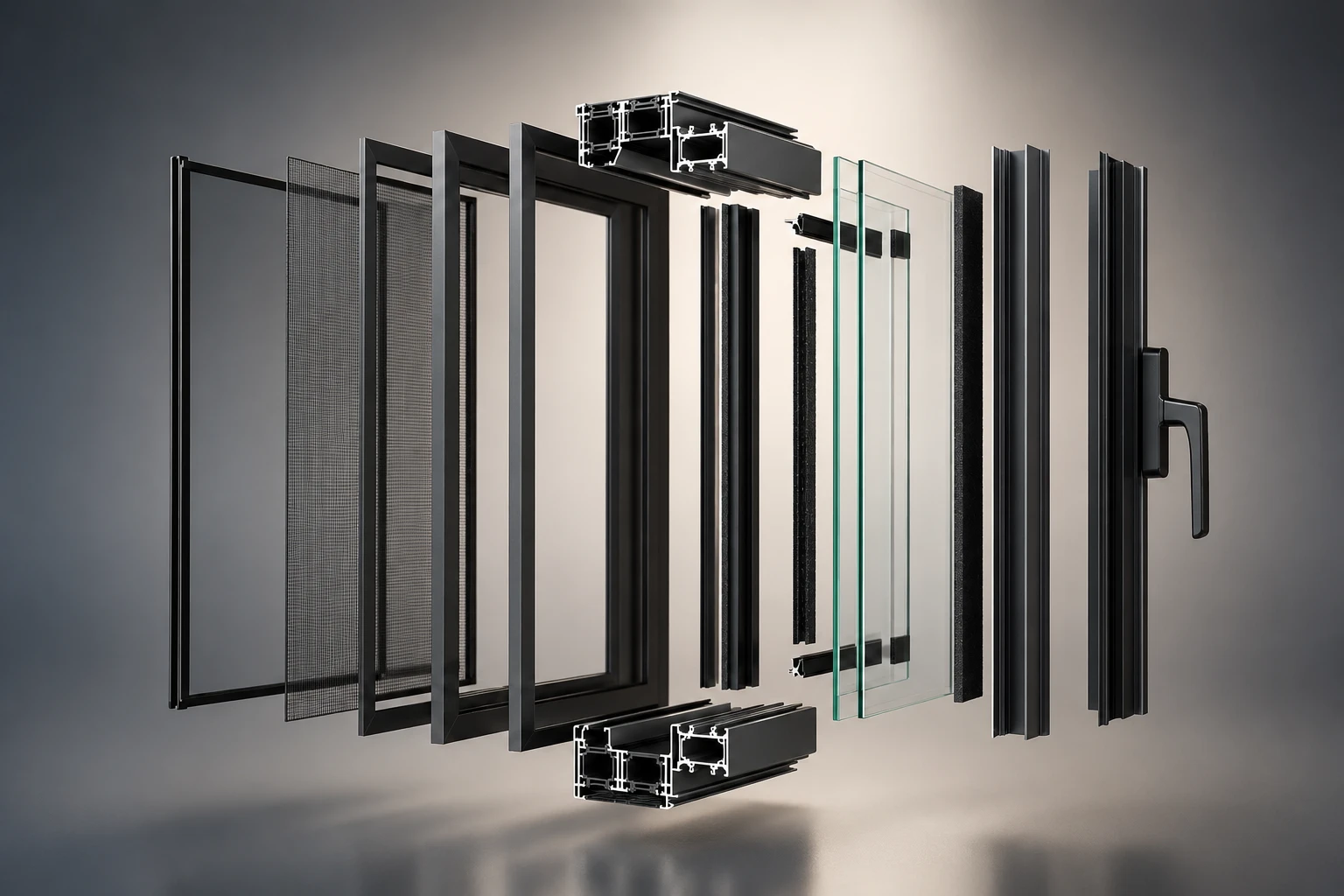
Before bulk customizing 80 Series single casement windows, clarify these 3 core parameters before requesting a quote.
When bulk purchasing 80 Series single casement windows, supplier quotes usually only mention terms like "80 Series," "1.8mm," and "5+22A+5," but what truly affects your project's suitability are the criteria behind these parameters. Below, we break it down by decision priority.
Is 1.8mm wall thickness sufficient?Judge based on floor level and wind pressure.
1.8mm refers to the measured wall thickness of the load-bearing profiles (main frame and sash profiles), not the thickness of the decorative surface. This value corresponds to the thickened grade above the "main profile wall thickness of exterior windows should not be less than 1.4mm" in the GB/T 8478 standard, which is one grade higher than conventional engineering windows. However, whether it is "sufficient" depends not on the value itself but on the installation location.
The judgment method is simple:The lower the floor, the lower the building height, and the smaller the local basic wind pressure, the more sufficient the 1.8mm thickness is;Conversely, for super high-rise buildings or areas with strong winds, a review is needed.。 The specific operation is to provide the supplier with three pieces of data: the basic wind pressure value of the city where the project is located (which can be found in GB 50009), the floor height, and the window opening dimensions, and they will perform the wind pressure resistance verification. If the project is above 100 meters or in a coastal typhoon zone, it is recommended to also ask whether the profile can be thickened to 2.0mm and whether the mullion needs reinforcement—these two factors directly determine whether a series change is necessary.
What problem does the 5+22A+5 glass configuration solve?
5+22A+5 refers to two 5mm glass panes with a 22mm air layer in between. The core value of this configuration isthe balance between sound insulation and thermal insulation.rather than extreme performance.
- The 22mm air layer is thicker than the common 12A and 16A, and the thicker the hollow layer, the better the sound insulation effect for mid-frequency noise (such as human voices and street traffic), while the winter heat transfer coefficient (U-value) is also lower.
- However, note: if the project is in a severely cold region (such as Northeast China or Inner Mongolia), the thermal insulation performance of 5+22A+5 may still be insufficient, and it needs to be upgraded to Low-E coated glass or triple-glazed double-cavity glass;If the project is just an ordinary residential building with average street noise, this configuration is considered 'above adequate' and there is no need to spend extra money.
Key trade-off: This configuration is a 'comfort baseline', not a 'high-performance configuration'. When inquiring about prices, ask clearly whether the glass already includes a Low-E coating—for the same thickness, the price difference between with and without Low-E is about 15%-25%, but the thermal insulation effect is significantly different.
What does 6063-T5 aluminum alloy profile mean?
6063 is an aluminum alloy grade, and T5 is a heat treatment state (air-cooled aging after extrusion). This combination is the mainstream choice for architectural doors and windows, meaning that the profilehas moderate strength, good adhesion for surface treatments (anodizing, powder coating), and stable welding and machining performance.For the purchaser, it solves the reliability issue of "whether the profile will deform or the surface will blister," rather than the performance ceiling issue.
Only one thing needs to be confirmed:What is the surface treatment method?。 6063-T5 itself does not determine the corrosion resistance level; what truly determines the lifespan of coastal projects is the anodized film thickness (recommended ≥15μm) or powder coating thickness (recommended ≥60μm). When inquiring, directly asking "What standard is the surface treatment done to?" is more valuable than asking "Is it 6063-T5?"
Next step: confirm the action: Send the following three pieces of information to the current website team—① the city where the project is located and the floor height;② whether it is coastal or in a typhoon zone;③ whether the glass needs Low-E. Only after these three items are confirmed can we determine whether 1.8mm and 5+22A+5 are suitable for your project, and whether the configuration needs to be adjusted.
What is the process for batch customization?4 key steps from drawing confirmation to sample acceptance
The biggest difference between engineering procurement and retail is that retail buys off-the-shelf products, while engineering buys 'expectations'. The 80 Series thickened single-opening aluminum alloy window supports customization according to drawings, but every number on the drawings will ultimately translate into actual actions on the production line. If the process is followed correctly, batch orders will have fewer reworks and fewer disputes.
Step 1: Drawing confirmation—clarify dimensions, opening method, and hardware color at once.
Customization according to drawings is a basic capability of this product, but "according to drawings" does not mean "accept everything as is." During the drawing confirmation stage, you need to align with the current website team on the following four items; missing any one of them may cause batch rework:
- Dimensions: The reference configuration is 1000×1000mm, but actual construction openings often have deviations.It is recommended to provide the actual measured values of the opening, rather than the marked values on the design drawings, to avoid "drawings are correct, but on-site installation fails."
- Opening method: For single casement windows, the hinge side and opening direction (inward/outward, left/right) must be clearly specified.On the drawings, this parameter is often just a line, but on the production line, it determines the installation direction of the entire set of hardware.
- Hardware color and profile surface treatment: The profile material is 6063-T5 aluminum alloy, but whether the surface is powder-coated, anodized, or fluorocarbon, and the specific color code, must be documented in writing.Color difference control between batches depends on the surface treatment standard you lock in when placing the order.
- Glass configuration: The reference configuration is 5+22A+5 insulating glass, but if you need to adjust the glass thickness or the width of the air gap, you should raise it during the drawing stage, as this affects whether the profile grooves match.
Key trade-offThe stage most worth spending time on during drawing confirmation is converting 'site conditions' into 'drawing parameters'. If you only have design renderings and no actual measured opening data, it is recommended to arrange measurement first before placing the order, rather than placing the order first and supplementing data later.
Step 2: Sample Confirmation - Why is this step necessary before bulk ordering?
Samples are not just a formality; they are the acceptance benchmark for bulk orders. The 80 Series reinforced single-leaf aluminum alloy window supports sample confirmation before entering mass production. The value of this step lies in:
- Locking the visual standard: The biggest fear in bulk orders is not dimensional deviation but 'indescribable' issues - color deviation, surface particles, or poor hardware feel.The sample serves as the physical standard mutually agreed upon by both parties, and subsequent bulk acceptance will be based on it.
- Verify assembly relationships: The coordination among profiles, glass, hardware, and gaskets cannot be fully depicted in drawings.Only after physical assembly can you confirm whether opening and closing are smooth, sealing is adequate, and glass installation is secure.
- Expose hidden costs: Issues discovered during the sample stage are the cheapest to fix.If changes are made after mass production begins, they involve downtime and rework across the entire production line.
Who can skip samples directly? If you have previously placed orders for the same series and configuration, and the drawings for this order are exactly the same as the last time, you can confirm with the current website team whether the previous acceptance criteria can be reused. However, if it involves new dimensions, new glass configurations, or new surface treatments, it is recommended not to skip this step.
Step 3: Mass Production and Process Confirmation
After sample acceptance, the batch production phase begins. At this stage, you do not need to monitor the production line, but you need to confirm two time points with the current website team:the time of the first batch outputandthe rules for process spot checks. The construction period of engineering projects is often constrained by door and window installation. Clarifying the delivery time of the first batch is more valuable for decision-making than a vague "delivery period".
Step 4: Bridging sample acceptance and batch acceptance
The acceptance of batch deliveries should be carried out directly against the sample confirmed in Step 2. It is recommended to conduct random inspections upon receipt based on four dimensions: appearance, dimensions, opening function, and glass configuration. The sampling ratio should be determined based on batch size and project importance. If there are discrepancies between batch acceptance standards and the sample, raise objections based on the sample for the most efficient resolution.
Next step: confirm the actionCompile your measured opening dimensions, opening direction, hardware color requirements, and glass configuration into a document, and send it to the current website team to confirm whether the 80 Series reinforced single-leaf aluminum window can be scheduled for production directly according to your drawing parameters, as well as how the sample production lead time and costs are calculated.
Which projects are suitable for choosing the 80 Series single-leaf window?In which situations is it recommended to switch to an alternative solution?
The applicable boundaries of the 80 Series single-leaf window are clear:Projects with clear requirements, fixed environments, and quantifiable acceptance criteria should be prioritized;Projects with frequently changing requirements or acceptance based on subjective judgment are recommended to be postponed.
Suitable for: residential, high-rise, coastal, commercial streetfront, and 5 other scenarios
- Residential renovation (bedrooms, living rooms): 1.8mm thickened profiles paired with 5+22A+5 insulated glass provide sound insulation and thermal performance that covers daily living needs, suitable for households seeking stability and durability.
- High-rise residential buildings: High-rise buildings experience greater wind pressure; the 1.8mm wall thickness offers more margin in wind pressure resistance compared to conventional thin-wall profiles, suitable for floors with safety requirements.
- Coastal areas: 6063-T5 aluminum alloy profiles have good corrosion resistance, and their service life in high salt spray environments is better than ordinary profiles, making them suitable for coastal projects.
- Batch procurement for engineering projects: Supports customization according to drawings and batch orders. When specifications are unified (such as uniform 1000×1000mm), customization costs can be amortized, and delivery time control is better.
- Commercial street shops: Can be equipped with soundproof glass to meet noise control requirements. The single-opening structure is simple and easy to maintain, suitable for commercial spaces that do not require large opening sashes.
Not suitable for: projects with frequent changes in requirements or lacking acceptance standards
- Frequent adjustments to drawings or specifications: After batch orders lock in specifications, changes involve profile cutting, glass ordering, and hardware matching, resulting in accumulated modification costs.For projects where requirements may change frequently in the short term, it is recommended to clarify the plan before placing an order.
- Lack of quantitative acceptance criteria: If the project does not specify requirements for air tightness, water tightness, or wind pressure resistance levels, and acceptance is based solely on subjective feelings, disputes are likely to arise later.It is recommended to confirm specific indicators in advance.
Budget allocation suggestions
Prioritize budget allocation to key requirements:The profile is the basic framework, while hardware and glass determine the user experience. If the budget is tight, prioritize hardware and glass configuration;If the project is located in a high-rise building or coastal area, it is not recommended to reduce the profile wall thickness. Bulk orders can amortize customization costs; the specific budget ratio should be confirmed with the manufacturer based on project requirements.
Before bulk customization, confirm these 4 things with the manufacturer to avoid pitfalls.
The biggest difference between bulk orders and sample orders is: if the sample is wrong, it can be corrected; if the bulk order is wrong, the entire batch must be reworked. The 80 Series single casement window looks simple in structure, but what truly determines the success of the project is often not the window type itself, but the following 4 easily overlooked details.
Confirm material and wall thickness: don't just look at the series number.
"80 Series" only indicates that the construction depth of the window frame is 80mm, not the profile wall thickness. Even within the same 80 Series, there are significant differences in wind pressure resistance, hardware load-bearing capacity, and price between wall thicknesses of 1.4mm and 1.8mm.
Before bulk customization, clarify the following three points with the manufacturer:
- Specific wall thickness value: Confirm whether it is the nominal wall thickness or the measured wall thickness; engineering acceptance is usually based on the measured value.The reference configuration of this product is 1.8mm thickened profiles, suitable for projects with wind pressure resistance requirements;If the project is a low-rise residential building or interior windows, 1.4mm may be sufficient and more cost-effective.
- Alloy grade: Confirm whether it is 6063-T5 or another grade.The T5 temper state determines the hardness and surface treatment effect of the profile; different grades show significant differences in corrosion resistance in coastal high-salt fog environments.
- Surface Treatment Method: Anodizing, powder coating, or PVDF coating?This directly affects weather resistance lifespan and color difference control; for batch orders, especially confirm the color difference tolerance standard.
Confirm Glass and Hardware: Configuration Determines Performance Ceiling
The sound insulation, thermal insulation, and safety performance of a window are half determined by the profile, and the other half by the glass and hardware. The reference glass configuration for the 80 Series single casement window is 5+22A+5 insulating glass, but your project may require adjustments:
- Whether the glass needs tempering: For high-rise buildings, floor-to-ceiling windows, or glass areas exceeding 1.5 square meters, regulations typically require tempered or laminated glass.Confirm whether the manufacturer supports glass configuration adjustments, and whether such adjustments affect the load-bearing capacity of the profiles.
- Is the thickness of the insulating glass layer adjustable?The 22A insulating layer is a reference value. If the project has higher acoustic insulation requirements, it may be necessary to increase the insulating layer or use a different gas fill.This will affect the overall window thickness, so it is necessary to confirm whether the profile grooves are compatible.
- Hardware brand and gradeThe hardware components in bulk orders determine the long-term feel and lifespan of the windows.Confirm the manufacturer's standard hardware brand, load-bearing grade, and whether specified brands are supported.Note: Changing hardware may affect the opening method and the number of locking points, so this should be confirmed as well.
Control methods for confirming batch consistency
The biggest risk in batch orders is not the quality of a single window, but the differences between batches. Before placing an order, confirm with the manufacturer:
- Whether first article inspection is provided: Before mass production, a sample is made first, and after the purchaser signs off on it, mass production begins.This step locks in key details such as color, opening direction, and hardware positions.
- Color difference control standards: There may be slight color differences between different batches of aluminum alloy profiles. Confirm the standard the manufacturer uses for control (such as ΔE value), and how to handle it if the color difference exceeds the range.
- Opening direction and hardware position: Single casement windows can be left-opening, right-opening, outward-opening, or inward-opening. In batch orders, incorrect direction labeling is the most frequent mistake.Confirm whether the order specifies the opening direction for each window unit, and whether the manufacturer has a pre-shipment verification process.
Confirm the match between drawings and site conditions
Before batch customization, send the manufacturer the actual opening dimensions of the project, the installation method (with auxiliary frame or direct installation), and the wall type (concrete, block, or steel structure). The reference size for the 80 Series single casement window is 1000×1000mm, but the actual opening dimensions of a project are almost never exactly the same. Confirm whether the manufacturer supports custom non-standard sizes according to drawings, and whether non-standard sizes affect wall thickness selection and hardware configuration.
Next steps: Organize the project's opening dimension drawings, floor height, basic wind pressure value for the area, and glass area requirements into a one-page requirements list. Along with your concerns about wall thickness and glass configuration preferences, send it to the current website team to confirm the matching solution. Before placing a bulk order, be sure to request a first article sample and confirm it with your signature before proceeding to mass production.
Frequently Asked Questions
Q: Can the wall thickness of the 80 Series single casement window be 1.4mm? A: The reference configuration for this product is 1.8mm thickened profiles, but customization with different wall thicknesses is supported. 1.4mm is suitable for low-rise residential buildings or non-windward sides, with lower cost;If the project is located in a high-rise building or an area with high wind pressure, it is recommended to maintain 1.8mm.
Whether adjustments can be made and the price difference after adjustment need to be confirmed with the current website team.
Q: Can the glass configuration 5+22A+5 be changed to double laminated or Low-E glass? A: It can be adjusted, but two points need to be confirmed: first, whether the profile groove is compatible with a thicker glass combination; second, whether the hardware load-bearing capacity is sufficient after the glass weight increases. It is recommended to inform the team of the project's specific requirements for sound insulation, thermal insulation, and safety, and they will provide a matching glass solution.
Q: What is the approximate delivery time for bulk orders? A: The delivery time depends on the order quantity, whether non-standard sizes are involved, and special surface treatments. Orders with standard configurations have shorter delivery times, while orders with custom glass or special colors require additional time.
Before placing an order, confirm the current production schedule with the team and include the first article approval time in the project plan.
Q: Will there be color differences between different batches? A: There may be slight color differences between different batches of aluminum alloy profiles. For bulk orders, it is recommended to place a single order for profiles of the same color, and confirm the manufacturer's color difference control standards before production.
If the project is procured in multiple phases, it is recommended to keep the first article sample as the color reference for subsequent batches.
Learn More
If your project is preparing for bulk door and window procurement, you are welcome to compile the opening dimension drawings, floor heights, local wind pressure values, and glass configuration requirements into a document and submit it to the current website team. We will assist in matching the customized solution for the 80 Series thickened single-leaf aluminum alloy window based on your specific working conditions, and clarify the sample production cycle and production scheduling time.
Related Products:80 Series Thickened Single-Leaf Aluminum Alloy Window