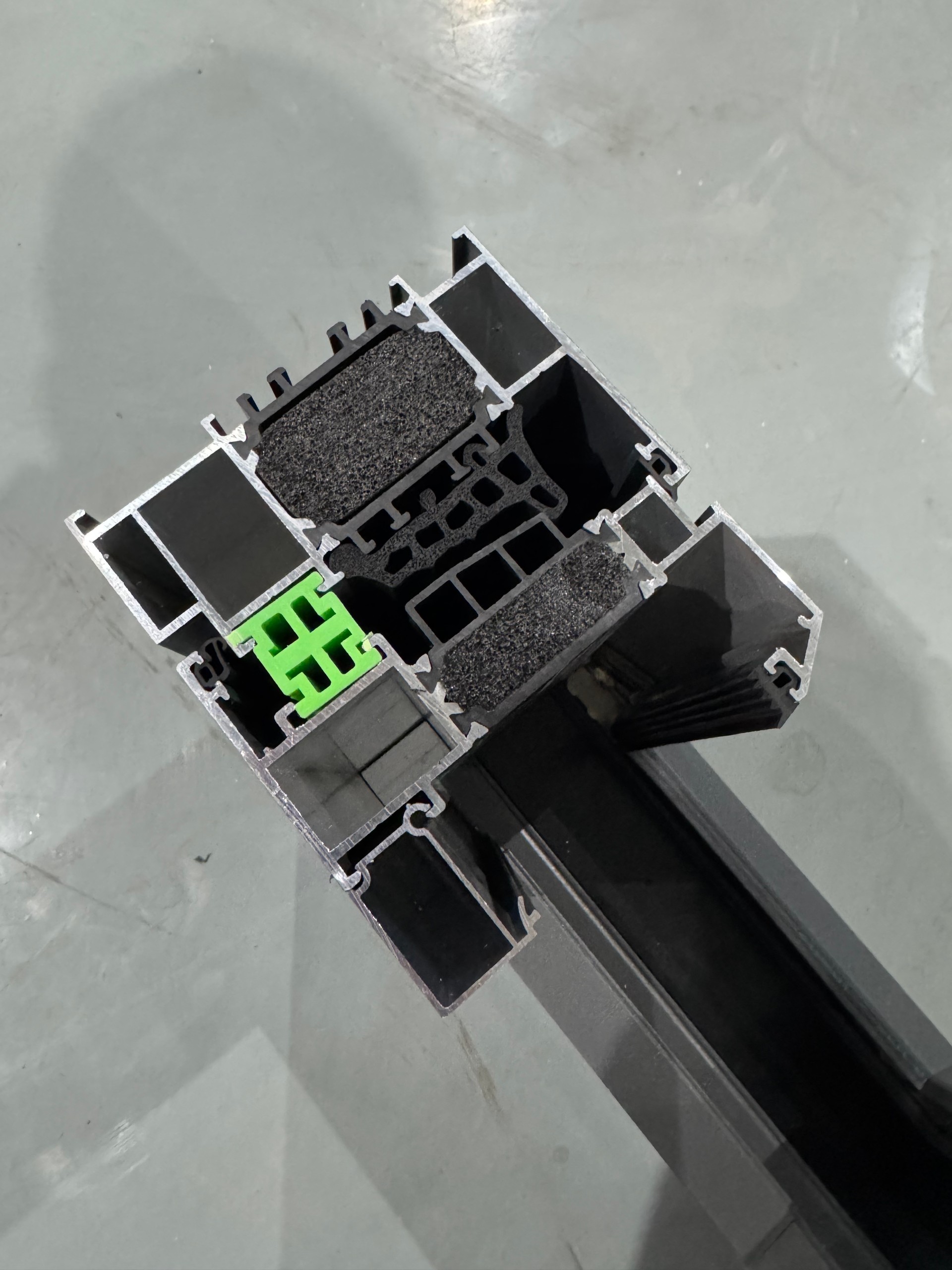
When judging the quality of aluminum alloy window profiles, what are the three core indicators to look at first?
When purchasing aluminum alloy windows, the quality of the profiles directly determines the lifespan, safety, and sound insulation and thermal insulation performance of the windows. Instead of listening to the salesperson talk about "solid materials," it's better to grasp three verifiable hard indicators yourself: material grade, wall thickness, and glass configuration. Understanding these three numbers allows you to judge the baseline level of a window.
Material: What does 6063-T5 aluminum alloy mean?
6063-T5 is the most commonly used alloy grade and temper designation for architectural aluminum profiles. 6063refers to the alloy composition (magnesium-silicon series),T5It refers to the heat treatment state—after extrusion, the profile is air-quenched and artificially aged to achieve stable mechanical properties. In simple terms, this material combination means the profile has good tensile strength, corrosion resistance, and surface treatment adhesion. It is a mature and mainstream choice for door and window profiles—not just "adequate" but a "standard answer" level configuration.
Key point: Confirm that the material certificate provided by the supplier states 6063-T5, not a vague "aluminum alloy." For coastal high-salt environments or high-rise projects, this grade is the baseline; do not downgrade further.
Wall Thickness and Glass Configuration: How to Interpret 1.8mm and 5+22A+5
Is 1.8mm wall thickness sufficient? For an 80 Series window frame, 1.8mm is a thickened specification. The national standard typically requires a minimum wall thickness of no less than 1.4mm for the main load-bearing members of aluminum alloy window profiles. A thickness of 1.8mm means higher resistance to wind pressure deformation and a longer service life, making it especially suitable for high-rise residential buildings or areas with strong wind pressure.
The criterion is simple: if the project is an ordinary multi-story residential building, 1.4mm is also acceptable;if it is a high-rise, coastal, or large-size window sash, 1.8mm is a worthwhile premium.
What are the benefits of the 5+22A+5 glass configuration? The meaning of these numbers is: 5mm glass + 22mm air layer + 5mm glass. The 22mm air layer is the key point—the sound insulation and thermal performance of insulating glass is not necessarily better with a thicker air layer. Around 22mm is precisely the balance point between performance and cost, effectively blocking mid-frequency noise (such as human voices and traffic sounds) while reducing the heat transfer coefficient.
Compared to common 9A or 12A air layers, the thermal and acoustic insulation of 22A is significantly better, making it suitable for bedrooms, street-facing rooms, or spaces with quiet requirements.
| Indicator | Judgment Criteria | Suitable Scenarios |
| Material | 6063-T5 as the baseline | All construction projects |
| Wall Thickness | 1.4mm is sufficient, 1.8mm for reinforcement | High-rise, coastal, large-size window sashes |
| Glass | 5+22A+5 is the comfort configuration | For street-facing, bedrooms, or where sound insulation is required |
Next step: confirm actions: Confirm with the current website team the profile cross-section drawings, material certificates, and whether the glass configuration can be adjusted to other combinations (such as double tempered, Low-E coating) as per project requirements. If your project is high-rise or coastal, directly confirm whether 1.8mm wall thickness and 5+22A+5 are within the standard configuration;If it is an ordinary residential project with a sensitive budget, ask about the alternative solutions and price differences for 1.4mm wall thickness and a thinner air layer.
What types of projects are suitable for the 80 Series thickened single-opening window?In which situations is it not recommended?
Adaptation scenarios for residential and engineering projects
Residential renovation (bedrooms, living rooms): The 80 Series thickened single-opening window, with its 1.8mm profile wall thickness and 5+22A+5 insulating glass configuration, offers significant advantages in sound insulation and thermal performance over ordinary sliding windows. If you are renovating a residence and the window is located near a road or noise source, this configuration can solve practical problems. The reference size of 1000×1000mm also adequately covers the standard window openings in bedrooms and living rooms.
High-rise residential buildings: High-rise buildings have higher requirements for the wind pressure resistance of windows. The 80 Series thickened profile (1.8mm wall thickness) offers greater margin in resisting wind pressure deformation compared to conventional 1.4mm wall thickness products. However, it should be noted that suitability for high-rise buildings depends on floor height, window area, and local basic wind pressure—these need to be calculated based on specific projects, and cannot be concluded simply from the word "thickened."
Coastal or high salt spray environments: 6063-T5 aluminum alloy profiles inherently have good corrosion resistance, and with the thickened design, their expected service life in coastal areas will be better than ordinary profiles. But the actual anti-corrosion performance also depends on the surface treatment process (powder coating, anodizing, or fluorocarbon spraying). When purchasing, you need to confirm the surface treatment options with the current website team.
Engineering projects and distribution channels: Supports batch orders and custom fabrication according to drawings, suitable for engineering contractors and distributors to include as a standard product in their product lines. The reference configuration is clear, facilitating quotation and sample confirmation.
Boundary conditions requiring configuration upgrades
In the following situations, it is recommended to first confirm the matching solution with the current website team rather than placing an order directly:
- Extra-large window openings (single sash exceeding 2 square meters): The 1.8mm wall thickness is sufficient for standard sizes, but as the area increases, the profile rigidity and hardware load-bearing capacity may need to be upgraded.Actual dimensions need to be provided for structural verification.
- Extreme sound insulation requirements (e.g., adjacent to main roads or airport flight paths): 5+22A+5 insulating glass can handle everyday noise, but for high-frequency noise or extreme noise environments, laminated glass or a thicker insulating configuration may be required.
- High-rise buildings (above 100 meters) or typhoon-prone areas: Although thickened profiles help, wind pressure resistance design involves the entire window system (profiles, glass, hardware, installation method), and wind load data for the project location is needed to determine whether it is sufficient.
- Need for inward opening, inward tilting, or casement with top-hung function: This product is a single casement window. If the project requires multiple opening methods, it is necessary to confirm whether this series supports corresponding hardware adaptation.
Who is not suitable for choosing the 80 Series?
- Large-scale projects with extremely sensitive budgets: If the project has extremely strict cost requirements, and the window positions are not facing the street and the floors are not high, products with standard wall thickness (1.4mm) may be more economical.The cost difference of thickened profiles will be amplified in batch procurement.
- Design projects requiring extremely narrow frame visual effects: The 80 Series thickened design means the profile has a wider visible surface, making it unsuitable for projects pursuing an ultra-narrow frame effect.
- The project is still in the stage of frequent plan adjustments.: If the window dimensions, opening method, and glass configuration are not yet determined, it is recommended to finalize the plan first before locking in the product, to avoid modification costs after customization.
How to confirm the profile craftsmanship quality through samples? Three-step judgment method.
Once the sample arrives, don't rush to look at whether the appearance is attractive. The core of profile craftsmanship quality lies in three areas: cross-section, weight, and assembly details. Follow the three steps below, and you can make a preliminary judgment within ten minutes.
Step 1: Inspect the cross-section—wall thickness uniformity and surface treatment.
Hold the sample up to the light and first look at the cut cross-section. Focus on two key points:
Whether the wall thickness is uniform. Use a caliper to measure 2-3 points at different positions on the cross-section (frame, sash, and reinforcement ribs). Taking this product's 80 Series thickened single-hung window as an example, the nominal profile thickness is 1.8mm, and the measured values should fluctuate within the range of 1.7-1.9mm.
If the thickness difference at different positions on the same profile exceeds 0.2mm, it indicates that there may be issues with the extrusion die or process control, and the risk of deformation in subsequent batch orders will significantly increase.
Whether the surface treatment is consistent. Check whether the color and gloss of the anodized film or sprayed coating are uniform on both the inner and outer surfaces of the profile. Pay special attention to corners, grooves, and other areas that are difficult to process—if color differences, missed spraying, or runs appear in these positions, it indicates that the pretreatment or loading process of the surface treatment line is not standardized.
Step 2: Weigh and Check Configuration—Determine Whether the Material Is Substantial
A profile with a thick cross-section does not necessarily mean sufficient material. The most direct way is to weigh it.
Taking a reference size of 1000×1000mm (1㎡) single casement window as an example, the 80 Series thickened profile (1.8mm wall thickness) with 5+22A+5 insulating glass typically weighs between 25-35kg per window. If the sample you receive is noticeably lighter, it is likely that the wall thickness has been reduced or the glass configuration has been replaced. Note: Different hardware and glass configurations will cause weight differences, so this number is not a strict standard, but rather helps you build a sense of what 'substantial material' feels like.
At the same time, verify the configuration sheet: check whether the profile material is marked as 6063-T5 and whether the glass is 5+22A+5 insulating glass. If the sample label and contract configuration are inconsistent, directly raise the issue with the current website team and request a written explanation of the reasons for the discrepancy.
Step 3: Trial Assembly - Check Corner Joints and Hardware Fit
Open and close the sample several times, and pay attention to two details:
- Whether the corner joints are smooth. Run your fingers along the four corners of the window frame; there should be no obvious steps or burrs.Uneven corner joints can cause the weatherstripping to be installed improperly, directly affecting air tightness.
- Whether the hardware components fit and operate smoothly. Check whether the handle turns and the locking points engage crisply, without any sticking or play.Thicker profiles demand higher precision in hardware hole machining; poor coordination can easily lead to abnormal noises later.
About Customization by Drawing
This product supports customization by drawing, including profile series, wall thickness, glass configuration, and dimensions. But before customization, one key condition must be confirmed: which series of profile system is your drawing based on? Different series have different groove widths and hardware installation slot positions; you cannot simply change the dimensions and apply it.
It is recommended to send the drawing to the current website team to confirm whether the profile cross-section matches your hardware and glass bead, and then decide whether to make a sample.
Who is suitable to make this judgment: Buyers who already have clear project requirements, have drawings or reference sample windows on hand, and know exactly what configuration they want. Who should not use this service: Those who are still comparing differences between series and whose requirements are not yet finalized—in this case, sampling can easily waste time and sample fees. It is more efficient to clarify your needs first before entering the sampling stage.
How to choose between the 80 Series and the 70/90 Series?The balance between budget and performance
When purchasing aluminum alloy windows, the series number (70, 80, 90) represents the window frame'sprofile width, in millimeters. This number directly determines the overall thickness and structural space of the window frame, but it is not the case that bigger is always better—it corresponds to different usage scenarios and budget ranges.
The essence of series differences: profile width and applicable boundaries
70 SeriesIt is the entry-level configuration for conventional residential buildings, with relatively small profile cavities, capable of meeting the basic sound insulation and thermal insulation needs of most mid- and low-rise residences. Its advantages are affordable pricing and strong adaptability, but if your project is located in high-rise, street-facing, or coastal areas, the wind pressure resistance and thermal insulation margins of the 70 Series may be relatively tight.
80 Series(such as this product) is a thickened and reinforced configuration. Taking this current 80 Series thickened single-leaf aluminum alloy window as an example, the profile thickness is 1.8mm, the reference glass configuration is 5+22A+5 insulating glass, and the reference size is 1000×1000mm. Compared to the 70 Series, the 80 Series features reinforced profile wall thickness and chamber structure, which means better wind pressure resistance, more stable hardware load-bearing, and a larger insulating glass layer space (the 22A air layer significantly helps with sound and thermal insulation).
It is suitable for high-rise residential buildings, bedrooms/living rooms with sound insulation requirements, and coastal high-salt environments—the corrosion resistance of 6063-T5 aluminum alloy itself is a plus in this scenario.
90 SeriesIt falls into the category of wide-body system windows, typically used for large window sashes, floor-to-ceiling windows, or passive house projects with extremely high thermal insulation requirements. Its profiles are wider, allowing for triple glazing with two cavities or even more complex thermal break structures, but the cost and weight also increase significantly.
Budget allocation suggestions: how to prioritize profiles, glass, hardware, and installation
When the budget is limited, many people struggle with whether to downgrade from the 80 Series to the 70 Series. Here is a clear priority judgment:
- First, determine the profile series (which defines the safety boundary): If the project is above 10 floors, street-facing, or coastal, directly lock in the 80 Series as the starting point, and don't downgrade to 70 to save money.The profile is the skeleton of the window and cannot be replaced later.
- Next, determine the glass configuration (which defines comfort): After the profile is determined, glass is the most significant variable affecting sound insulation and thermal performance.If the budget only allows for one upgrade, prioritize upgrading the glass from standard insulating to a thicker air gap or Low-E coating, rather than switching to a wider profile.
- Do not compromise on hardware (which defines lifespan and feel): Hardware is used every time you open and close, and poor-quality hardware will sag and stick after two years.This part of the budget is not recommended to be saved.
- Installation costs are negotiated last.Installation techniques directly affect waterproofing and airtightness, but they have the most flexibility and can be optimized through bulk orders or centralized construction.
What situations warrant upgrading to the 90 Series? Only when your project meets two or more of the following conditions is the 90 Series worth considering: single window area exceeding 2 square meters, the project has clear passive house or energy-saving certification requirements, or the client has extreme comfort expectations for insulation. If it's just a regular residential single window of about 1 square meter, the 80 Series with thickened configuration already covers performance needs, and the marginal benefit of upgrading to 90 is low, while the cost may be 30%-50% higher.
Conclusion boundary:The 80 Series thickened single aluminum window is suitable for buyers with clear usage scenarios (residential, high-rise, coastal), actual requirements for sound insulation and thermal insulation, and a desire to balance performance and budget. If your project has particularly large window sizes (exceeding 2 m² per sash) or is an energy-saving certification project, you need to confirm with the current website team whether the 80 Series can support the corresponding glass configuration and hardware scheme—this depends on the specific dimensions and glass weight, and needs to be verified against the drawings before finalizing.
Frequently Asked Questions
Is a wall thickness of 1.8 mm necessarily better than 1.4 mm for the 80 Series reinforced single-leaf aluminum window?
Not necessarily. A wall thickness of 1.8 mm is superior to 1.4 mm in wind pressure resistance and durability, but the cost is also higher.If the project is an ordinary multi-story residential building with small window areas and a mild wind pressure environment, 1.4 mm can also meet the requirements;If it is a high-rise, coastal, or large-size window sash, 1.8 mm is more reliable.The key is to judge based on the actual conditions of the project.
Is 5+22A+5 insulating glass suitable for all regions?
5+22A+5 insulating glass offers balanced performance in sound insulation and thermal insulation, making it suitable for most residential and commercial projects.However, in extreme noise environments (such as near airports) or severely cold regions, laminated glass or triple-glazed configurations may be necessary.It is recommended to confirm with the supplier based on the specific project location and noise levels.
How to quickly assess the quality of aluminum window profiles?
Three tips: First, check whether the material certificate indicates 6063-T5;Second, use a caliper to measure whether the wall thickness is uniform (with a tolerance of no more than 0.2mm);Third, weigh the entire window (an 80 Series window of 1 square meter weighs approximately 25-35kg); if it is significantly lighter, the material may be reduced.After receiving the sample, test the opening and closing, and check the smoothness of the hardware and the flatness of the corner joints.
How to choose between the 80 Series and the 90 Series?
The 80 Series is suitable for conventional residential, high-rise, and coastal projects, offering high cost performance.The 90 Series is suitable for large-size window sashes, energy-saving certification projects, or situations with extreme thermal insulation requirements.If the single sash area of the window exceeds 2 square meters or there is a passive house certification requirement, the 90 Series is more appropriate.Otherwise, the 80 Series is sufficient.
Learn More
If you are selecting aluminum windows for your project, feel free to send your project conditions (floor height, window size, location, noise level) to our technical team. We can help confirm whether the 80 Series thickened single-sash aluminum window matches and provide configuration recommendations.
Related Products:80 Series Thickened Single-Hung Aluminum Alloy Window