
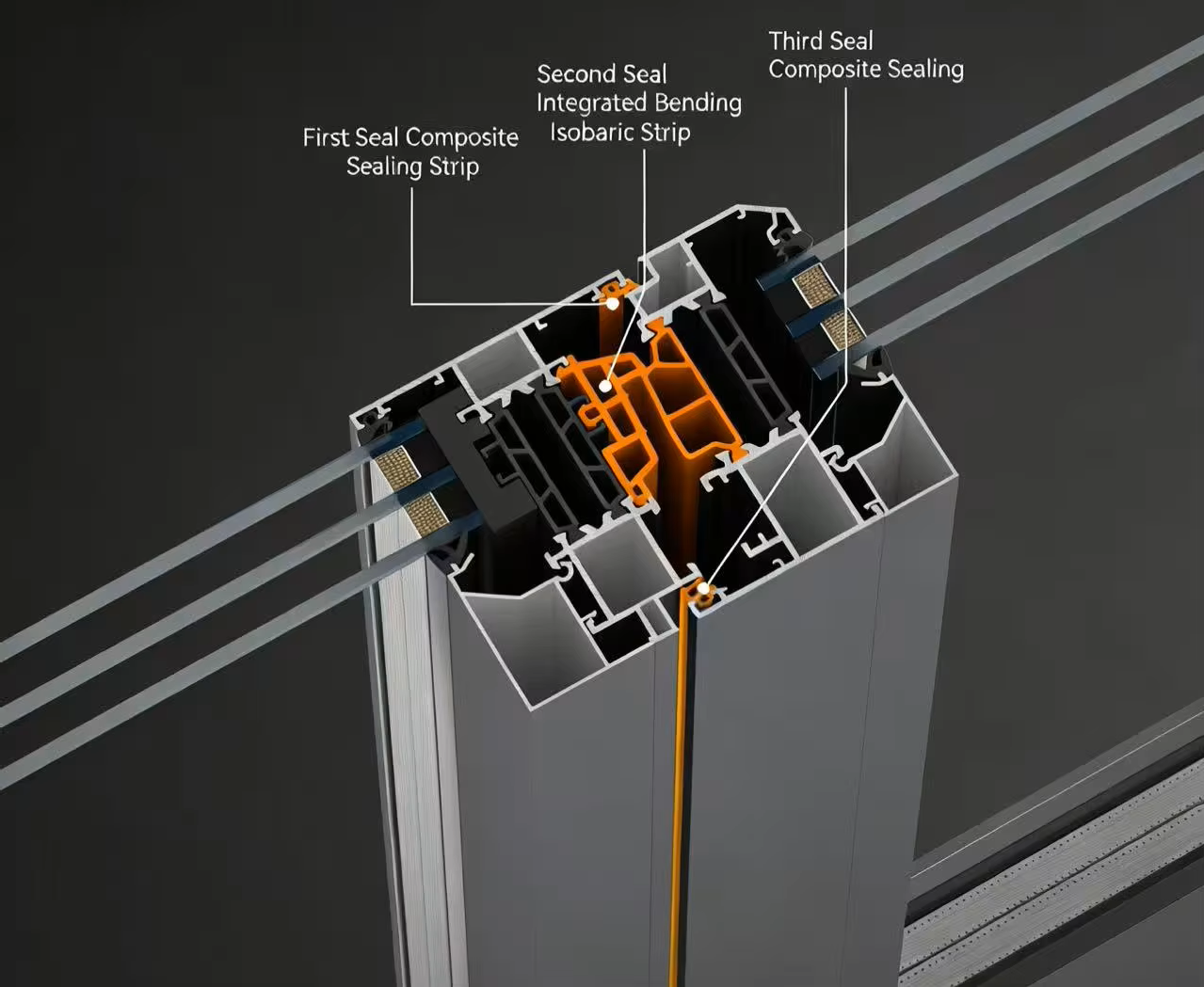
Why is confirming the drawings and technical requirements the first step when bulk purchasing 80 series windows?
Bulk purchasing 80 series windows is completely different from buying a single window. When buying a single window, you can point to one in the sample room and say, "This one."When bulk purchasing, even a 2-millimeter difference in the opening sash size can cause the entire batch of windows to fail to install on the wall or have difficulty opening and closing smoothly. Drawings and technical requirements are the "common language" between you and the manufacturer—without them, all subsequent quotations, production, and installation will become a guessing game.
Key elements for drawing confirmation: window type, dimensions, and opening method
The most basic drawing required for bulk purchasing is theelevation drawing(The position of the display window on the wall and the division) andthe node diagram(showing profile cross-sections, glass rabbets, and seal strip positions). Specifically, the following three points need to be confirmed:
- Window type and opening method: Is it a casement, double casement, or sliding window? Inward opening or outward opening? The opening direction determines the hinge load, hardware model, and screen installation method. For example, the 80 series single-leaf aluminum alloy window defaults to a single outward opening. If you need inward opening or top-hung, you must specify it in advance.
- Rough Opening Size vs. Window Frame Size: Does the drawing indicate the rough opening size or the outer dimension of the window frame?A 10-20mm installation gap is usually left between the two.If the drawing only provides the rough opening size, the manufacturer will default to making the window frame by subtracting the gap from the rough opening. However, if you want the window frame to be flush with the rough opening, you must specify it in writing.
- Mullions and Fixed Panels: Does a large window require a mullion in the middle?What is the ratio of fixed panels to operable panels?This directly affects the profile usage and glass configuration.For example, a window that is 2 meters wide and 1.5 meters high, if a mullion is added in the middle, becomes two 1-meter-wide units. The profile cost increases, but the wind pressure resistance is better.
Technical Requirements Document: From Profile Wall Thickness to Glass Configuration in Writing
The technical requirements document (often called "technical specification" or "procurement specification") is a document that clearly specifies all materials, processes, and performance indicators. It should at least include:
- Profile wall thickness: For 80 series windows, the common profile wall thicknesses are 1.4mm, 1.6mm, and 1.8mm.Is 1.4mm sufficient? This depends on the window size and floor height.The national standard GB/T 8478-2020 stipulates that the minimum wall thickness for main load-bearing profiles of exterior windows is 1.8mm, while non-load-bearing profiles can be 1.4mm.If your window is of standard size (e.g., 1m×1m) and installed on a low floor (≤6 floors), 1.4mm can meet basic usage requirements.However, if the window width exceeds 1.5 meters or is installed on a high floor, it is recommended to use at least 1.6mm or more.Key Trade-off: The thicker the wall thickness, the higher the profile cost (approximately 10-15% increase), but the better the wind pressure resistance and durability.If you are unsure, directly provide our technical team with the window size and installation floor, and we will give you a wall thickness recommendation.
- Glass Configuration: The glass groove depth of the 80 Series window is usually 20-30mm.The reference configuration is 5+22A+5 (i.e., 5mm glass + 22mm air layer + 5mm glass), but you can adjust it based on sound insulation and thermal insulation requirements.For example, for buildings facing the street, it can be changed to triple-pane double-cavity 5+12A+5+12A+5;In cold regions, you can request argon gas filling in the air layer.Note: Changing the glass configuration will affect the overall window weight and hinge load-bearing capacity, so you must simultaneously confirm whether the hardware is compatible.
- Hardware and Accessories: Should it be equipped with domestic handles or imported handles? Should it be equipped with a screen window? Is the screen window an invisible screen or a diamond mesh screen? If these details are not written into the technical requirements, the manufacturer will quote based on default configurations, which may not match your expectations upon delivery.
Next Steps for Confirmation
Before placing a bulk order, please prepare the following two materials and send them to our sales team:
- Building Elevation Drawings(Mark all window opening dimensions, opening directions, and floor heights).
- Technical Requirements List(Specify profile wall thickness, glass configuration, hardware brand, and screen window requirements).
Based on this information, we will match you with the most suitable 80 Series configuration plan and issue a "Technical Confirmation Sheet" that can be signed into the contract. This step cannot be skipped—Without written confirmation, any subsequent modifications may incur additional costs and project delays.
How to make the right choice for profile wall thickness and glass configuration based on project requirements?
For 80 Series windows, profile wall thickness and glass configuration are not about "the thicker the better" or "the more expensive the better," but about finding a balance among safety, cost, energy efficiency, and usage scenarios. Below, we will help you determine directly: under what circumstances is 1.4mm wall thickness sufficient, and when do you need to adjust the glass configuration.
Is 1.4mm profile wall thickness sufficient?Trade-off between Safety and Cost
Whether a 1.4mm wall thickness is safe depends on the project type and installation conditions.
- Suitable Scenarios: Residential projects (self-built houses, commercial housing), ordinary commercial buildings (e.g., small offices, shops).In these scenarios, a 1.4mm wall thickness combined with 6063-T5 aluminum alloy profiles provides sufficient wind load resistance for general needs (typically corresponding to wind load resistance grades 4-5, i.e., withstanding 3000-4000Pa wind pressure).The prerequisite is that the window frame is firmly connected to the wall during installation, and the glass configuration does not exceed conventional sizes (e.g., around 1㎡).
- Unsuitable Scenarios: High-rise residential buildings (over 20 floors), typhoon-prone areas (e.g., coastal cities), large public buildings (e.g., school buildings, hospital lobbies).In these scenarios, wind pressure loads increase significantly, and a wall thickness of 1.4mm may not meet the wind pressure resistance design requirements. It is recommended to upgrade to 1.6mm or 1.8mm wall thickness.Key Judgment Basis: Confirm the local basic wind pressure value with the project designer (refer to GB 50009 or local meteorological data). If it exceeds 0.5kN/㎡, it is recommended to directly consult our team to confirm the wall thickness plan.
Cost Trade-off: A wall thickness of 1.4mm saves approximately 10%-15% in profile costs compared to 1.6mm, and is lighter in weight, requiring less installation labor. If the project budget is tight and wind pressure conditions are not extreme, 1.4mm is the most cost-effective choice.
Glass Configuration Adjustments: Options Beyond 5+22A+5 and Applicable Scenarios
The reference configuration 5+22A+5 (5mm glass + 22mm air layer + 5mm glass) is a general-purpose configuration, but you can adjust it based on climate and energy-saving requirements:
| Project Requirements | Recommended Glass Configuration | Key Trade-off |
| Ordinary residential, mild climate (e.g., Yangtze River Basin) | 5+22A+5 (Standard) | Lowest cost, adequate thermal and sound insulation |
| Cold region (e.g., northern winter below -20°C) | 5+22A+5 Low-E (Low-Emissivity Coating) | Approximately 20% cost increase, but U-value can be reduced from 2.8 to 1.8 W/m²·K, significantly reducing heating energy consumption |
| Hot regions (e.g., South China, Southeast Asia) | 5+22A+5 insulated glass + sun-shielding Low-E | Reduce Solar Heat Gain Coefficient (SHGC) and lower air conditioning energy consumption |
| Noise-sensitive areas near streets, airports, etc. | 5+12A+5+12A+5 (triple glazing with two cavities) | Sound insulation performance improves by approximately 5-8 dB, but weight increases by 30%; window frame load-bearing capacity must be confirmed |
| High-rise buildings or typhoon-prone areas | 6+22A+6 (thickened glass) | Wind pressure resistance is improved, but it is necessary to confirm whether the profile wall thickness matches (recommended 1.6mm or more). |
Key judgment: After adjusting the glass configuration, the load-bearing capacity of the window frame must be confirmed simultaneously. For example, after changing from 5+22A+5 to triple glazing with two cavities, the glass weight increases by about 50%, and a window frame with a wall thickness of 1.4mm may not be able to withstand it long-term, requiring an upgrade in wall thickness or the addition of stiffeners. Next step: Provide our team with the climatic conditions of your project location (minimum winter temperature, maximum summer temperature, typhoon frequency) and noise requirements, and we will provide a matching glass configuration and wall thickness combination solution.
How to choose glass based on climate zone?
In simple terms:
- Hot summer and cold winter regions(e.g., Shanghai, Wuhan): Standard 5+22A+5 is sufficient, optional Low-E for energy saving.
- Severe cold regions(e.g., Harbin): Low-E glass is mandatory, air layer recommended above 20mm.
- Hot summer and warm winter regions(e.g., Guangzhou, Hainan): Prioritize shading type Low-E to reduce solar radiation.
- Mild regions(e.g., Kunming): Standard configuration is sufficient, no extra investment needed.
Unsuitable Scenarios: For projects in extremely cold regions (winter below -30°C) or super high-rise buildings (over 100 meters), the 80 series window may not be the optimal choice. We recommend consulting our team to determine whether an upgrade to a higher series (such as the 90 series or thermal break aluminum series) is necessary.
Why can't the sample confirmation step be skipped? How to complete it efficiently?
For bulk procurement of 80 series windows, sample confirmation is not just a "formality" but one of the key opportunities to identify issues such as profile matching, processing accuracy, and sealing effectiveness in advance. Skipping this step means that problems may only be discovered when the entire batch arrives on site, and the cost and time loss for returns or replacements far exceed those at the sample stage.
Key inspection items for sample confirmation: dimensions, appearance, opening and closing, and sealing
After receiving the sample, focus on checking the following four items, each of which directly affects the pass rate of the batch production:
- Consistency of dimensions with drawings
Use a tape measure to measure the outer edge of the window frame, the diagonal of the sash, and the thickness of the insulating glass (reference configuration is 5+22A+5). Key points to verify:
- Whether the overlap between frame and sash is uniform (usually should be between 6-8mm)
- Whether the glass bead is tightly fitted to the groove without any wobble
- Appearance and surface treatment
Inspect under natural light:
- Whether the profile surface has scratches, color differences, or bubbles (6063-T5 aluminum alloy surface should be uniform and smooth)
- Whether the corner joint is flat, without obvious gaps or glue overflow
- Opening and closing feel
Open and close 5-10 times repeatedly, feel:
- Whether the hinge rotates smoothly, with any abnormal noise or jamming
- Whether the locking points and strike plates engage properly, and whether the window sash shakes noticeably after closing
- Sealing effect
Place a piece of A4 paper between the sash and frame, close the window, then pull the paper:
- If the paper is easily pulled out, it indicates insufficient compression of the sealing strip, and batch products may experience air leakage and water seepage
Sample confirmation process and timeline before mass production
To efficiently complete sample confirmation, it is recommended to follow the steps below to avoid repeated communication:
- Step 1: Provide drawings and configuration list(Before sample production)
Clarify the profile wall thickness of the 80 Series window (1.4mm), glass configuration (5+22A+5), hardware brand, etc., to ensure the sample is consistent with the batch order.
- Step 2: Complete inspection within 3 working days after receiving the sample
Record results one by one according to the above four items. If problems are found (such as dimensional deviation exceeding 2mm, substandard sealing), take photos immediately and mark the problem points, then provide feedback to the production team for adjustment.
- Step 3: Confirm by signing or propose modifications
After the sample fully meets the requirements, both parties sign to confirm the sample status. At this point, the sample becomes the "standard part" for mass production, and subsequent batch products must be consistent with the sample.
Key Trade-off: The sample confirmation stage cannot be compressed in time. If you skip or shorten the inspection to meet the schedule, the probability of dimensional deviation or seal failure in batch products will increase significantly. It is recommended to reserve at least 7 working days for sample production and confirmation.
Next Steps for Confirmation
If you already have drawings or configuration requirements for the 80 Series window, you can directly provide this information to our sales team, and they will arrange sample production and clarify the confirmation milestones. If you are still unsure about the glass configuration or hardware selection, you can first confirm the climatic conditions of the project location (such as wind pressure resistance level, thermal insulation requirements), and we will help you match the most suitable solution.
In the mass production and quality inspection stage, how to ensure product consistency?
The biggest fear with bulk orders is that the sample looks one way, but the mass-produced goods look another. For the 80 Series single-opening aluminum windows, ensuring product consistency does not depend on a single link, but on a closed-loop control from the profile source to factory inspection. Below, we directly break down the control points and standards to help you determine whether a supplier is reliable.
Quality Control Points in the Production Process
Consistency starts with the profile. We use 6063-T5 aluminum alloy profiles, which inherently have stable mechanical properties and processing characteristics. In mass production, there are three core control points:
- Profile cross-section precision: For each batch of profiles, the cross-sectional dimensions must be checked (especially the tolerance range of the wall thickness of 1.4mm).If the profile cross-section deviation exceeds 0.1mm, gaps or jamming may occur in the subsequent assembly of sealing strips and hardware.The purchaser should require the supplier to provide profile cross-section drawings and conduct on-site comparison during first article production.
- Corner Connectors and Corner Assembly Process: The corner strength of 80 Series windows directly affects the overall window stability.In mass production, the pressure of the corner assembly machine and the amount of glue injection must be calibrated once per shift.If glue overflow or gaps are found at the corners, it indicates that the process parameters have drifted and the machine must be stopped immediately for adjustment.
- Glass Configuration Consistency: The reference configuration is 5+22A+5 insulating glass.During mass production, the glass thickness, hollow layer width, and sealant strip type must be exactly the same as the sample.It is recommended to randomly select 3 pieces to measure thickness and dew point when the first batch of glass arrives at the factory, to confirm no difference from the sample.
Factory Inspection Standards and Sampling Plan
Factory inspection is not a full inspection, but a judgment based on statistical sampling. Our standards refer to the following logic:
| Inspection Item | Sampling Ratio | Judgment Criteria |
| Appearance (scratches, color difference, burrs) | 5% sampling per batch | No more than 2 minor scratches on a single window (length <5mm), without exposing the base material |
| Dimensions (width, height, diagonal difference) | 3% sampling per batch | Diagonal difference ≤2mm, width and height deviation ≤±1.5mm |
| Function (opening/closing, locking, sealing) | 2% sampling per batch | Opening force ≤ 50N, smooth locking without jamming, seal strip not detached |
| Glass (thickness, dew point, fragment state) | 1% sampling per batch | Thickness deviation ≤ 0.2mm, dew point ≤ -40°C (or as per project requirements) |
Key Trade-off: The higher the sampling rate, the more consistent the quality, but the higher the cost. For residential projects, 5% appearance sampling + 3% dimensional sampling is sufficient;For public buildings (schools, hospitals), it is recommended to require suppliers to increase the dimensional sampling rate to 10%, and specify in the contract that "if one non-conforming item is found, double the sampling;If it still fails, the entire batch will be returned."
How to ensure product consistency?——Next steps for the purchasing party
- Confirm whether the supplier provides a first article inspection report: Before mass production, require the supplier to produce 3-5 first articles and provide inspection data on dimensions, function, and appearance.After you sign off, mass production must be carried out according to this standard.
- Require retention of batch numbers for profiles and glass: Once a quality issue occurs, it can be traced back to the specific batch.
- Factory arrival inspection time points: It is recommended to arrange factory arrival inspections after profile cutting but before assembly, and before final product packaging.The former checks profiles and glass, the latter checks assembly and functionality.
Unsuitable scenarios: If your project has special requirements for air and water tightness (e.g., coastal high-rise buildings), the above routine quality inspections are insufficient. In such cases, additional batch inspections such as "water spray test" and "air tightness test" are needed, and testing equipment and costs should be confirmed with the supplier in advance.
Common questions
Q1: During mass production, will there be thickness fluctuations between batches for profiles with a wall thickness of 1.4mm? A: Yes. The wall thickness tolerance for 6063-T5 profiles is typically ±0.1mm.
We use a micrometer to randomly inspect 3 pieces from each batch of profiles upon warehouse entry to ensure fluctuations remain within the allowable range. If you have strict requirements for wall thickness (e.g., tolerance ±0.05mm), it must be stated in the contract, and the corresponding precision drawing fee will be charged.
Q2: If the glass configuration is changed from 5+22A+5 to other specifications, how can consistency be better ensured? A: After changing the glass configuration, a first article must be re-made to confirm the width of the air gap and the sealing effect. During mass production, the glass supplier must provide a dew point test report for each batch.
We recommend that you specify in the order that "the glass configuration shall be based on the sample, and the brand or thickness shall not be changed arbitrarily."
Q3: What should be done if the sealing strips on several windows in a batch fall off? A: Sealing strip detachment is usually caused by two reasons: dimensional deviation of the profile groove or aging of the sealing strip material. First, stop installation immediately, take photos of the problematic windows, and record the batch number.
Second, require the supplier to perform a tensile test on the sealing strips of all windows in the same batch (sample 5% per batch). If the detachment rate exceeds 1%, the entire batch of sealing strips should be replaced.
Q4: What should be included in the factory quality inspection report to ensure reliability? A: At least include: product model, batch number, production date, sample size, inspection items (appearance, dimensions, function, glass), judgment results, and inspector's signature. If the project has special requirements (such as wind pressure resistance rating), the corresponding test data should also be attached.
Q5: What is the typical warranty period for bulk orders? A: Typically 1-2 years from the date of shipment. The warranty covers non-artificial damage to profiles, glass, and hardware.
It is recommended to specify in the contract: "If profile cracking, glass self-explosion (non-external force), or hardware failure occurs during the warranty period, the supplier shall provide free replacement and bear the shipping costs."
Learn More
If you already have drawings or configuration requirements for 80 Series windows, you can submit them directly to our sales team, and we will issue a technical confirmation and arrange sample production.If you are still unsure about the selection, you can also provide the climate conditions and floor height of the project location, and we will help match the most suitable wall thickness and glass configuration.
Related Products:80 Series Single-Opening Aluminum Alloy Window