
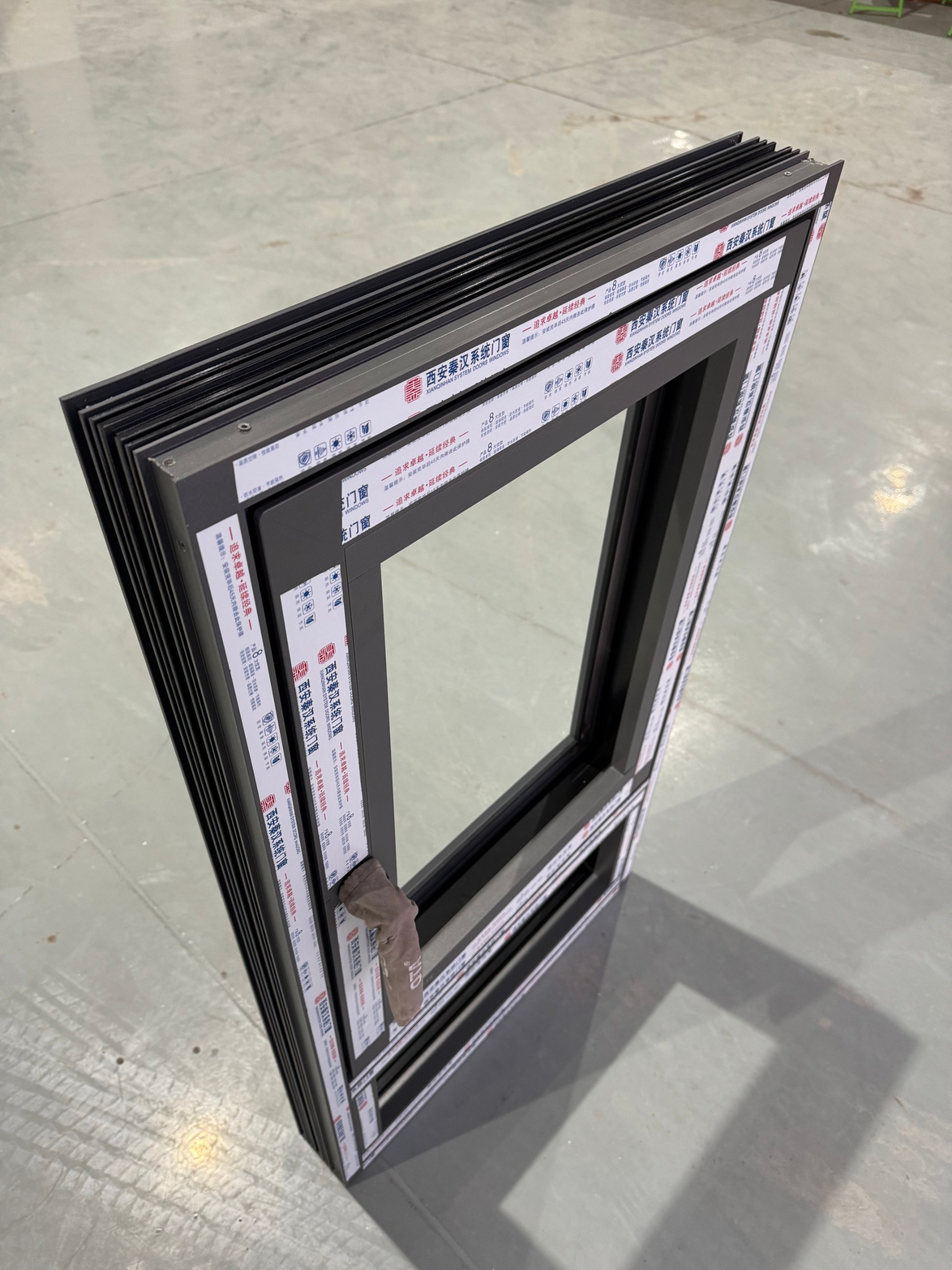
What is the 80 Series thickened single-leaf aluminum alloy window?Why is it suitable for both residential and engineering applications?
First, let's look at a set of reference configurations: 6063-T5 aluminum alloy profiles, 1.8mm wall thickness, 5+22A+5 insulating glass, and a reference size of 1000×1000mm. This configuration is not a random combination; it determines the basic character of this window—striking a relatively conservative balance between cost and performance.。
From the reference configuration, we can see the product positioning: what does 6063-T5 profiles, 1.8mm wall thickness, and 5+22A+5 glass mean?
Each of the three key parameters answers a question:
- 6063-T5 profiles: This is one of the most mature aluminum alloy profiles in the aluminum door and window industry. T5 indicates the heat treatment state, and its comprehensive strength, extrusion formability, and surface treatment compatibility are all stable.It does not pursue extreme performance, but it excels in reliability, batch supply, and good compatibility with surface treatments (such as powder coating and anodizing).For contractors and distributors, this meanssupply stability and predictability in subsequent processing.。
- 1.8mm wall thickness: This is the point of the "thickened" description.Conventional residential window wall thickness is usually around 1.4mm, and 1.8mm means a significant improvement in profile rigidity.The direct benefits are: large-size window sashes are less prone to deformation, hardware screws have stronger holding power, and the upper limit of wind pressure resistance is higher.The trade-off is increased profile usage, making the cost per square meter higher than conventional products.It is suitable for scenarios with clear strength requirements, not for those seeking the lowest unit price.
- 5+22A+5 insulating glass: 5mm glass + 22mm air layer + 5mm glass.The 22mm air layer is significantly wider than the common 9A or 12A, and the wider the air layer, the better the thermal and sound insulation (within a certain range).The positioning of this glass configuration isperformance is significantly better than single glass or narrow air layer configurations, but it has not reached the top-tier level of double silver Low-E or triple glass with two cavities.。
Overall, the subtext of this reference configuration is:Use 1.8mm wall thickness to solve structural strength issues, and wide hollow chambers to address insulation and soundproofing, but avoid over-engineering on glass coating and profile surface treatments.This precisely covers the common pain points that both residential and commercial clients care about most—sturdiness, quietness, and thermal insulation—while keeping the price controllable.
The Different Roles of Single-Casement Windows in Residential and Commercial Projects: Why Discuss the Same Product by Scenario?
The same product plays completely different roles in the two scenarios, which is why we cannot simply say 'this window is good' or 'this window is bad'.
Residential Scenario(Self-built homes, villas, high-end apartments): Windows are items that homeowners interact with daily, and the decision-making logic tends to be 'experience-oriented'. Homeowners care about—whether it is quiet after closing the window, whether it is cold in winter, and whether the sash opens and closes smoothly. The selling point of the 80 Series reinforced single-casement window here is: the 1.8mm wall thickness makes the sash more stable and the push-pull feel more solid;The 5+22A+5 insulating glass has a significant noise reduction effect on street-facing residences.
It is suitable for homeowners who have requirements for living quality and are willing to pay a bit more budget for a 'thicker' option.
Engineering scenarios(Commercial buildings, public construction projects, batch residential projects): The buyers are engineering contractors or developers, and their decision-making logic is oriented toward 'compliance'. What they care about is whether the profile strength can pass wind pressure resistance calculations, whether batch supply is stable, and whether installation efficiency is high. The value of the 80 Series here is: the 1.8mm wall thickness provides higher safety redundancy, especially suitable for high-rise buildings or areas with high wind pressure;The 6063-T5 profile is mature and stable, with small quality fluctuations in batch orders.
It is suitable for projects that need to balance performance and supply certainty.
But note a key difference: residential customers can often order directly based on the reference configuration, because their experience needs are relatively standardized;engineering customers, on the other hand, almost always need to review against project drawings — what is the required wind pressure resistance grade? Is it the curtain wall specification or the window and door specification? Is tempered glass required?
These directly determine whether the reference configuration is sufficient, or whether the wall thickness or glass needs to be upgraded. The first step in engineering procurement is not to look at the product, but to compare project parameters against the table.
Therefore, this window's "dual compatibility" is not because it is universal, but because its basic configuration happens to sit at the intersection of residential experience needs and engineering safety requirements. If your project requirements are significantly higher than the reference configuration (e.g., super high-rise, oversized panels, extremely high acoustic requirements), it is still a good starting point, but you need to confirm the upgrade plan with the team;If the requirements are significantly lower than the reference configuration (e.g., temporary buildings, low-rise warehouses), you may be paying for performance you won't use. The next step is to take your project location, floor height, window dimensions, and acoustic and thermal insulation requirements, and confirm with the current website team whether this reference configuration falls within your requirements range.
How to choose for residential projects?Applicability conditions of the 80 Series single casement window in bedrooms, living rooms, and high-rise residential buildings
When choosing windows for a residence, don't rush to look at profile and glass parameters. First answer three questions: What floor is the house on? Is it noisy outside? Is the local climate windy and rainy? These three conditions directly determine whether the reference configuration of the 80 Series single casement window (1.8mm wall thickness + 5+22A+5 insulating glass) is sufficient, and whether an upgrade needs to be requested from the hyperstron team.
Three key dimensions for residential scenarios: floor height, noise environment, and climate conditions
Floor heightIt affects wind pressure. For ordinary multi-story buildings (below 7 floors) and most mid-to-high-rise buildings (below 30 floors), the 80 Series profile with 1.8mm wall thickness is sufficient for wind pressure resistance under conventional window sizes. However, for super high-rise buildings above 30 floors, or when the area of a single window sash exceeds 1.5 square meters, the deflection requirements of the profile under wind pressure will increase significantly. In such cases, you need to confirm with the hyperstron team the maximum allowable area for the 1.8mm wall thickness under that size, and then decide whether to increase the thickness.
Noise environmentIt determines whether the glass configuration needs to be upgraded. 5+22A+5 means two 5mm glass panes with a 22mm air layer in between. This configuration has a good attenuation effect on mid-to-high frequency noise (such as human voices and traffic sounds), making it suitable for bedrooms and living rooms in ordinary urban residences. However, if the house is adjacent to a main road, high-speed rail line, or airport, the 22mm air layer has limited suppression of low-frequency noise (such as engine rumbling and tire friction). In such cases, laminated glass or unequal-thickness glass combinations should be considered. This falls under glass configuration adjustment. hyperstron supports customization according to drawings, but you need to provide the distance to the noise source and floor information to match the solution.
Climatic conditionsMainly consider coastal high salt spray and typhoon zones. 6063-T5 aluminum alloy profiles themselves have good corrosion resistance, but the key for coastal projects is not the profiles but the salt spray resistance level of hardware and sealing strips. If the project is within 5 kilometers of the coast, it is recommended to confirm with the hyperstron team the salt spray test duration for hardware and the sealing strip material, and upgrade to stainless steel hardware if necessary.
Residential configuration recommendations: When is 1.8mm wall thickness + 5+22A+5 sufficient, and when is an upgrade needed?
| Residential type | Is 1.8mm + 5+22A+5 sufficient? | Signals for upgrade needed |
| Multi-story/mid-to-high-rise, not facing the street | Sufficient | None |
| Mid-to-high-rise, facing urban roads | Sufficient (mainly mid-to-high frequency noise) | Near high-speed rail/airport/main roads, low-frequency soundproofing solution needs confirmation |
| Super high-rise above 30 floors | Needs confirmation | Single leaf area >1.5㎡, or the local basic wind pressure is relatively high |
| Within 5 km of the coast | The profile is sufficient | Need to confirm the hardware's salt spray resistance level, and upgrade if necessary |
Conclusion boundary: If your project is an ordinary urban residence (not super high-rise, not near noise sources, not in a coastal salt spray disaster area), the reference configuration of 1.8mm wall thickness + 5+22A+5 can be used directly as a starting point. Provide the floor, window opening dimensions, and city to the hyperstron team to confirm the wind pressure verification results for this configuration under specific dimensions. If the project hits multiple upgrade signals in the table above at the same time, it is recommended to organize the four pieces of information—floor height, single sash area, distance to noise source, and distance to coastline—at once, and let the team provide a matching solution to avoid repeated communication.
How to choose for engineering projects?How can bulk procurement, custom fabrication according to drawings, and delivery consistency be guaranteed?
The selection logic for engineering procurement is completely different from that for individual home renovation. Individual home renovation focuses on 'whether this window fits in my home,' while engineering projects focus on 'whether this batch of windows can be replicated in hundreds or thousands of units according to the same standard.' The value of the 80 Series reinforced single-leaf aluminum alloy window in engineering projects lies precisely in the last three words: replicability.
Core requirements of engineering projects: bulk orders, specification customization, and quality consistency
Let's first answer the most direct question:Do you support customization according to drawings?
Yes, but you need to understand the boundaries of 'customization.' The customization scope for the 80 Series single casement window is concentrated in three dimensions:overall dimensions, glass configuration, and profile wall thickness. The reference configuration is 1.8mm wall thickness, 5+22A+5 insulating glass, and a standard size of 1000×1000mm, but the opening sizes in engineering projects are rarely exact integers, so dimensional customization is the norm.
The glass configuration can also be adjusted based on the thermal insulation, sound insulation, or safety requirements of the project location.
It should be clear that customization does not mean 'redesign'. The profile series is fixed; you are adjusting parameters within the framework of the 80 Series, not developing a new window from scratch. If your drawings involve special opening methods, irregular mullion layouts, or non-standard hardware, you need to send the drawings to the team in advance to confirm whether they can be implemented within this series.
From drawings to batch delivery: the customization process and engineering adaptability of the 80 Series single casement window
The engineering procurement process typically involves four steps:
- Submit drawings and required parameters—including opening dimensions, opening direction, glass requirements, color requirements, and quantity.
- Sample confirmation—produce samples before mass production to confirm profile cross-sections, assembly effects, and hardware feel.This step is a critical milestone in engineering projects; after sample confirmation, subsequent batch orders use the sample as the acceptance benchmark.
- Batch production scheduling—after confirmation, proceed to batch production, processing uniformly according to the sample standards.
- Batch delivery and spot inspection—Deliver in batches according to the project schedule, and conduct spot inspections against sample standards upon arrival.
How can you better ensure quality consistency for bulk orders? This is the most concerning part of engineering procurement. The 80 Series uses 6063-T5 aluminum alloy profiles, which are extruded from molds. Profiles of the same series and wall thickness have standardized cross-sections, which better ensures "frame consistency" from the source.
Glass configurations and the structure of the insulating layer are cut and processed to the same specifications in bulk orders, avoiding mixing between different batches. What you really need to control is:Clearly define the acceptance criteria during sample confirmation.—Including the color difference range of the profile surface treatment, the hardware brand and model, and the treatment method of the rubber strip joints, these details should be written into the procurement requirements so that there is a basis for batch delivery.
Who is suitable for this solution? If your project has regular opening dimensions, mainly single-leaf opening methods, clear requirements for sound insulation and thermal insulation (which can be covered by thickened profiles and insulating glass), and you need a standardized product that can be quickly replicated and delivered in batches, the 80 Series is suitable.
Who needs to be cautious? If your project involves a large number of special-shaped windows, corner windows, or special opening combinations, or if you have very strict brand color number requirements for the profile surface color, you need to first confirm whether these requirements exceed the customization scope of the 80 Series. In addition, if your project has specific numerical requirements for sound insulation levels (for example, needing to reach a certain dB value), you cannot just look at the "insulating glass" configuration; you should send the specific glass combination and testing requirements to the team to confirm the matching solution.
In what situations is the 80 Series not recommended?Selection boundaries and alternative solution judgment
Three scenarios unsuitable for choosing the 80 Series single casement window
Scenario 1: Unclear requirements or frequent changes. If the project has not yet determined the opening dimensions, floor location, or performance requirements, do not lock in the 80 Series first. Once the selection is finalized, subsequent changes involve chain adjustments to the profile cross-section and glass configuration, and the rework cost is higher than the initial confirmation cost.
It is recommended to first sort out the requirements list before entering the selection stage.
Scenario 2: Oversized window openings or ultra-high floors, where wind pressure resistance requirements exceed the capability of the 80 Series. The 80 Series thickened profile has a wall thickness of 1.8mm, with a reference size of 1000×1000mm, suitable for conventional residential openings. If the opening width significantly exceeds the reference size, or the project is located in a high-rise strong wind pressure area, the profile cross-section of the single casement window may not be sufficient to support the wind pressure resistance requirements.
Such projects should directly evaluate 90 Series or higher-grade profiles, rather than stacking configurations on the 80 Series.
Scenario 3: For extreme thermal insulation requirements, a thermally broken aluminum structure is necessary. The 80 Series uses standard aluminum alloy profiles without a thermally broken structure. If the project is located in severely cold or hot regions with explicit energy-saving targets for thermal insulation, the thermal conductivity of standard aluminum cannot meet the requirements, so thermally broken aluminum doors and windows should be selected.
The core difference between thermally broken aluminum and standard aluminum lies in whether there is a thermal break strip inside the profile to block heat transfer, and this structural difference determines the upper limit of thermal insulation performance.
Balancing Budget and Performance: When to Upgrade and When to Simplify?
Recommended Budget Allocation Priorities:
| Priority | Stage | Reason |
| 1 | Glass configuration | Directly affects sound insulation and thermal insulation performance, offering the highest cost-effectiveness for upgrades |
| 2 | Hardware fittings | Determine daily usage experience and service life |
| 3 | Installation auxiliary materials and sealing process | Affects waterproofing and air tightness, low cost share but high risk impact |
| 4 | Profile series | Under the premise of meeting wind load resistance, there is no need to blindly pursue thicker profiles. |
Cases where upgrading to 90 series or thermally broken aluminum is necessary: The opening size exceeds the reference range of the 80 series and additional mullions cannot be added;If the project is located in a typhoon-prone area or is a super high-rise building, the wind pressure resistance check may fail;Energy-saving acceptance has mandatory requirements for thermal insulation coefficients, which ordinary aluminum alloys cannot meet.
Cases where the configuration should be simplified: For temporary buildings, warehouses, and other spaces with no requirements for air tightness and thermal insulation, a more economical series can be selected;For small openings (such as bathroom windows), the proportion of 80 series profiles is too high, making the cost uneconomical;When the budget is limited and there is no need for sound insulation or thermal insulation, thickened profiles are an over-specification.
Conclusion boundary: For projects with conventional residential bedrooms or living rooms, openings near the reference size, non-strong wind pressure areas, and no special thermal insulation requirements, the 80 series thickened single casement window is a suitable choice and does not require an upgrade. If any of the conditions such as opening size, floor height, wind pressure, or thermal insulation requirements exceed the above ranges, it is recommended to first confirm the specific parameters and then determine whether an upgrade is necessary.
Frequently Asked Questions
Q: How do I decide between the 80 Series and the 90 Series? It mainly depends on the opening size and floor height. If the opening is around 1000×1000mm reference size and not in a high-rise strong wind pressure area, the 80 Series is sufficient;If the opening is significantly larger or the floor is higher, it is necessary to determine whether to upgrade to the 90 Series based on wind pressure calculation results.
Q: How significant is the thermal insulation difference between the 80 Series ordinary aluminum alloy and the thermal break aluminum? The thermal break aluminum adds a thermal break strip inside the profile, which blocks heat conduction through the metal, providing better thermal insulation performance than ordinary aluminum alloy. If the project area has clear requirements for insulation or energy-saving acceptance standards, directly choose broken bridge aluminum;In mild climate regions, there is no need to increase the budget for this.
Q: When the budget is limited, which part is most worth investing in? Prioritize the glass configuration and hardware quality with more certainty. Glass directly affects the daily experience of sound insulation and thermal insulation, and hardware determines the smoothness of opening and closing and service life. These two are costly to replace later.
For the profile, there is no need to pursue a higher series as long as it meets wind pressure resistance.
Q: The 80 Series supports customization according to drawings. Are there any restrictions on the customization scope? It supports adjusting the wall thickness and glass configuration within the single casement window frame, but the profile series itself determines its performance upper limit. If the customization requirements involve changes to the opening method or improvements in wind pressure resistance, it is necessary to first confirm whether they exceed the applicable range of the 80 Series, and then decide whether to upgrade the series.
Learn more
If you are evaluating window selection for residential or engineering projects, you can directly provide the project city, floor height, window opening dimensions, noise source distance, and sound insulation and thermal insulation requirements. The team will help you confirm the applicable conditions or match an upgrade solution based on the reference configuration of the 80 Series thickened single-opening window.
Related products:80 Series thickened single-opening aluminum alloy window