
What is the FG110F double inward-opening thermal break window?What role does the glass configuration play in the entire window?
Basic definition and structural characteristics of the FG110F double inward-opening thermal break window
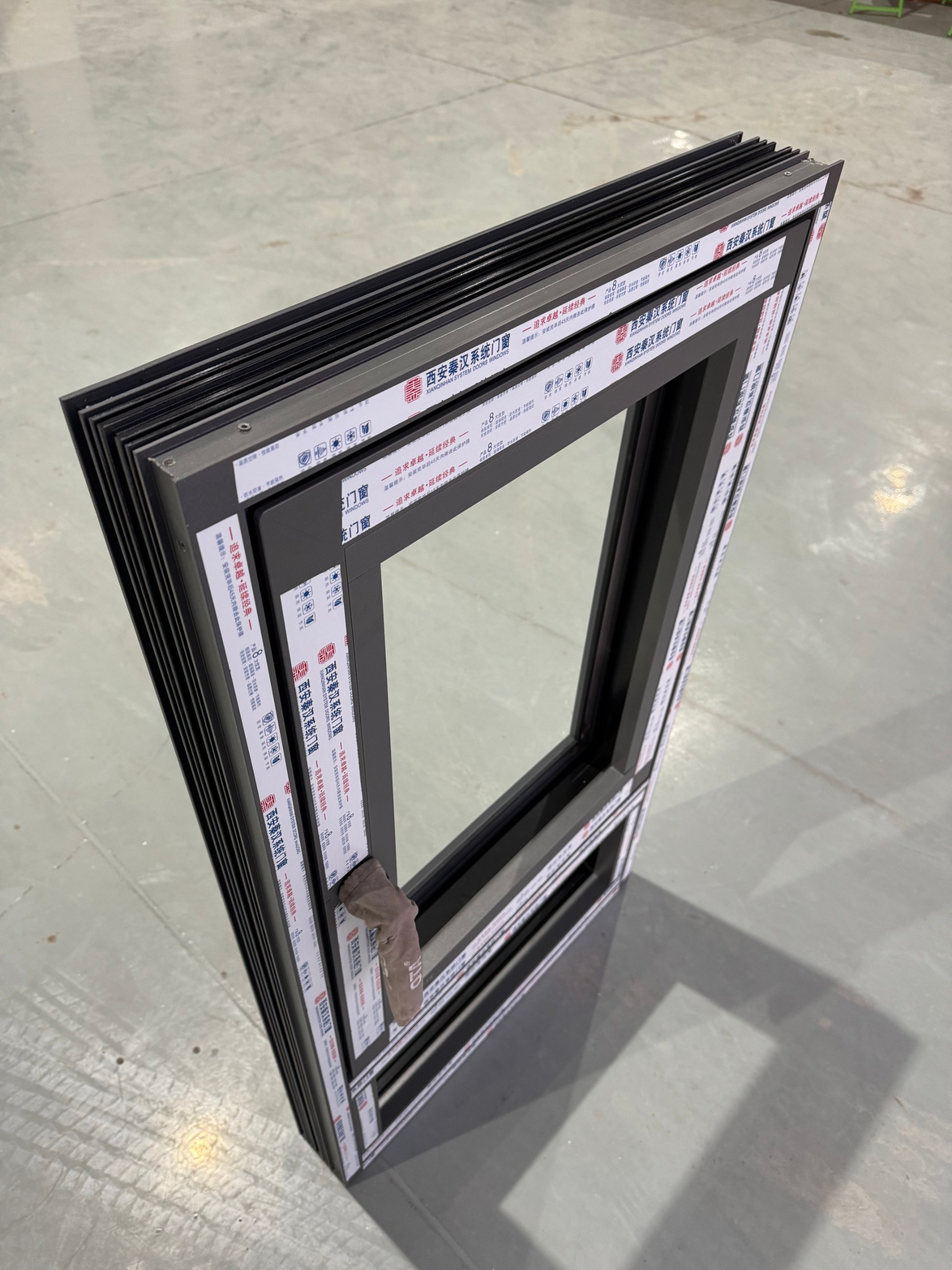
The FG110F double inward-opening thermal break window is an aluminum alloy window product under the Haipaisichuang brand. Breaking down this name: "FG110F" is the product series code, representing a design with a frame profile width of 110mm level;"Double inward-opening" means that the window sash can open toward the interior, usually in the form of two sashes or a combination of one fixed and one inward-opening sash;"Thermal break" refers to the use of thermal barrier strips in the middle of the aluminum alloy profiles to disconnect the metal connection between the indoor and outdoor sides, thereby blocking the path of rapid heat conduction through the metal frame.
This window uses 6063-T5 aluminum alloy profiles with a profile wall thickness of 2.0mm. 6063-T5 is a common alloy grade and temper state in architectural aluminum profiles. T5 indicates that after high-temperature extrusion, the profile is cooled and then subjected to artificial aging treatment, with strength and corrosion resistance meeting the conventional requirements for building doors and windows. A wall thickness of 2.0mm is considered a relatively solid configuration in aluminum alloy doors and windows, providing practical significance for resistance to high-rise wind pressure and long-term stability in use.
Practical impact of glass configuration on sound insulation, thermal insulation, and safety performance
The reference glass configuration for the FG110F double inward-opening thermal break window is "5+27A+5". The meaning of this set of numbers is: each side has 5mm thick glass, with a 27mm wide air layer in the middle, forming an insulating glass unit as a whole. In 27A, the "A" stands for air layer (Air). The 27mm air layer width is a relatively wide specification in insulating glass, being considerably wider than the common 9A, 12A, and 15A.
The wide air layer has a direct impact on the overall window performance. The thermal insulation principle of insulating glass is essentially to reduce heat conduction through the air layer—the thermal conductivity of air is much lower than that of glass itself. The wider the air layer, the greater the thermal resistance, but it should also be noted that beyond a certain width, air will form convection within the cavity, which actually weakens the insulation effect.
A 27mm air layer is in a relatively reasonable range. Combined with thermal break aluminum profiles, the overall window's heat transfer coefficient (U-value) can be controlled at a good level.
In terms of sound insulation, insulating glass has a good attenuation effect on medium and high frequency noise. The symmetrical configuration of 5mm+27A+5 has a certain suppression effect on traffic noise in scenarios such as street-facing residences and areas near schools. But it should be clear: insulating glass is not 'more reliable for sound insulation'; its ability to block low-frequency noise (such as subways and heavy vehicles) is limited. If the project has higher requirements for sound insulation, consideration should be given to laminated glass or unequal thickness glass configurations.
In terms of safety performance, 5mm glass is a conventional thickness for architectural glass and meets the usage requirements of general civil buildings. However, if used for floor-to-ceiling windows, large fixed panels, or scenarios with anti-theft needs on lower floors, it is recommended to confirm with the Haipaisichuang team whether an upgrade to tempered glass or laminated glass is needed—this falls under the customization scope of glass configuration, not a limitation of the FG110F profile itself.
The key conclusion of this section isThe profile structure of the FG110F double inward-opening thermal break window determines the overall frame performance of the entire window (thermal insulation, sealing, and opening method), while the glass configuration determines the actual sound insulation, thermal insulation, and safety performance of the entire window. The relationship between the two is like that of a "skeleton" and "function"—no matter how good the profile is, if the glass configuration does not match the usage scenario, the overall window performance will be compromised. Therefore, when selecting, do not only look at the profile series; the glass configuration must be confirmed together with the project requirements.
Can the glass configuration be customized?Customization boundaries and working conditions that must be confirmed
Customization is possible, but it is not unlimited. The reference configuration for the FG110F double inward-opening thermal break window is 5+27A+5 insulating glass, which is the baseline solution provided by the manufacturer based on the profile structure and conventional performance. In actual projects, the glass thickness, the width of the air gap, and whether tempered or laminated glass is used can all be adjusted within the allowable range of the profile's groove.
The key point is:The customization limit is determined jointly by the glass groove size of the profile and the overall load-bearing capacity of the window, not by "the thicker, the better."
Which glass parameters can be adjusted: thickness, number of layers, air gap, and glass type
- Glass thickness: 5mm is the reference configuration, and it can be adjusted to 6mm or 8mm.Each increase in thickness raises the weight of a single pane by approximately 20%-60%, requiring simultaneous verification of hinge load capacity and the risk of sash sagging.
- Air gap width: 27A is the reference value. A wider air gap provides better thermal and acoustic insulation, but it cannot be installed if it exceeds the upper limit of the profile groove.The specific upper limit needs to be confirmed by the manufacturer based on the profile cross-section drawing.
- Number of layers and type: Double glazing is the base, upgradeable to triple glazing with two cavities;Glass types can be tempered, laminated, or Low-E coated.Laminated glass helps with safety and sound insulation, while Low-E helps with thermal insulation, but combining both will significantly increase costs.
- Non-adjustable items: The total glass thickness cannot exceed the maximum clamping thickness of the profile's designed groove; otherwise, sealing or glazing bead fixation will fail.
List of working condition information that must be provided to the manufacturer before customization
If any of the following information is missing, the manufacturer cannot provide an accurate custom solution:
- Climate zone of the project location—This determines whether Low-E, triple glazing, or a wider insulating glass unit is needed.The configuration logic for cold regions is completely different from that for hot-summer and cold-winter regions.
- Window location and orientation—Street-facing sides require soundproofing configurations, while west-facing sides require heat insulation configurations; the priority of trade-offs varies by orientation.
- Single sash opening size and window type—The larger the opening sash, the heavier the glass, and the higher the load-bearing requirements for hinges and hardware.Before ordering custom glass, the grid dimensions must be determined first.
- Whether specific performance requirements need to be met—For example, if the project contract specifies a heat transfer coefficient K value or sound insulation level, the glass configuration must be derived from the target value rather than selected based on experience.
- Sample window confirmation method—Whether sample confirmation is required before bulk ordering, and what glass configuration is used for the sample, directly affects whether the final bulk solution can be implemented.
Next steps: Organize the above five items of information into a requirements table, and submit it along with the opening dimensions and opening method to the Haipaisichuang team. The manufacturer will confirm the upper limit of the glass thickness allowed by the profile groove, and provide an executable configuration solution accordingly. If the project has clear indicators for sound insulation or thermal insulation, be sure to state the target values directly during inquiry, rather than just saying "better glass".
How to choose the glass configuration?Selection logic and recommendations for different scenarios
The reference glass configuration for the FG110F double inward-opening broken-bridge window is 5+27A+5 insulating glass, but this configuration is not one of the key options. The choice of glass configuration is essentially a trade-off among sound insulation, thermal insulation, daylighting, and cost. Below, the selection logic is given for three typical scenarios.
Select configuration by scenario: street-facing residences, cold northern regions, and commercial office buildings
Street-facing residences—prioritize sound insulation; the width of the insulating air layer is the key variable.
Street noise is mainly low- and mid-frequency traffic noise, and the sound insulation effect of the glass configuration mainly depends on the thickness of the air layer and the total mass of the glass. The 27mm air gap of 5+27A+5 is already a relatively wide configuration, which has a good attenuation effect on mid-to-high frequency noise. If street noise is particularly severe, consider adding an extra pane (such as 5+9A+5+9A+5 double air gap) or using asymmetric glass with different thicknesses (such as 5+12A+6). The latter can break up resonance frequencies and provide better sound insulation than equal-thickness symmetric configurations.
You need to confirm with the Haipaisichuang team whether the profile groove of FG110F can accommodate thicker glass combinations—this is the key constraint determining whether an upgrade is possible.
In cold northern regions—prioritize insulation and focus on the whole window's K value rather than just the glass.
Thermally broken aluminum profiles solve the frame conduction problem, while the glass is the weak point in whole-window insulation. 5+27A+5 insulating glass is sufficient for most northern cities, but in severe cold regions (such as where the average winter temperature is below -15°C), it is recommended to ask whether an upgrade to Low-E coated insulating glass is possible. Low-E coating can significantly reduce radiant heat transfer. Combined with the 27A air gap, the whole-window insulation performance will have a perceptible improvement.
Note: Low-E glass slightly reduces light transmittance (about 5%-8%), so projects sensitive to daylighting need to weigh the trade-off. In addition, the double inward-opening structure itself has good sealing performance, but it is necessary to confirm whether the grade of the sealing strip between the glass and the profile matches the selected glass thickness.
Commercial office buildings—balance performance and maintenance, and standardized configurations are more reliable.
The demand for glass in office buildings is usually a balance among sound insulation, thermal insulation, and sun shading. 5+27A+5 as a standard configuration performs well in most office building projects. If there is a large curtain wall facing west or south, online Low-E glass can be considered to reduce summer air conditioning load.
For commercial projects, it is recommended to prioritize standardized configurations because the cost of replacing glass later is much higher than in residential buildings—non-standard glass sizes and configurations directly affect maintenance efficiency.
Budget allocation principle: priority of glass, profiles, and hardware
When the budget is limited, it is recommended to allocate in the following order:
- Hardware (Highest Priority)。The hardware system of double inward-opening windows determines the smoothness of daily use and its lifespan.Poor-quality hardware may develop issues such as sagging, sticking, and poor sealing after 2-3 years, and replacing the hardware requires removing the window, which is extremely costly.It is not recommended to save on this part.
- Profile Wall Thickness (Second Priority)。The FG110F uses 6063-T5 aluminum profiles with a wall thickness of 2.0mm, which is already an engineering-grade standard.If the project is on a high floor or experiences high wind pressure, maintaining a 2.0mm wall thickness is a reasonable choice;It is not recommended to reduce to 1.4mm or 1.6mm to save costs, as the safety redundancy of high-rise buildings is more important than the cost savings.
- Glass (Final Optimization)。Glass configuration is the easiest of the three to adjust later—as long as the profile grooves allow, the glass can be replaced in the future without altering the frame.Therefore, when the budget is tight, start with the standard 5+27A+5 configuration, and upgrade to Low-E or thicker glass later if needed.
Core Trade-off Logic: Hardware and profiles are the parts that are "set once, for life," while glass is the part that can be "upgraded later." When the budget is limited, spending money on non-replaceable components and using standard glass initially is the most prudent decision path.
Next Step Confirmation: Provide the Haipaisichuang team with the following four pieces of information: the project city, floor height, distance from the street (or actual noise measurements), and the average minimum winter temperature, to confirm the maximum glass combination thickness supported by the FG110F profile grooves, and whether a Low-E glass solution is available. Only with these four conditions can we provide configuration recommendations precise to the specific number of glass layers, film system, and thickness.
In which situations is blind customization not recommended?Selection Boundaries and Decision Recommendations
The FG110F double inward-opening broken-bridge window supports adjustments to glass configuration and wall thickness, but this does not mean that every project should take the customization route. Customization means longer communication cycles, sample confirmation costs, and tolerance pressure in mass production. In the following three situations, it is recommended to return to standard configurations first rather than directly adding complexity.
Three situations where customization is not recommended: unclear goals, insufficient information, and frequent expectation changes
- Unclear goals: They only say "good sound insulation" or "good thermal insulation" without specifying the region's lowest winter temperature, the street-facing noise level in decibels, or the window area and orientation.Without these conditions, there is no basis for adjusting the glass configuration, and the customized solution may not necessarily be more suitable than the standard configuration.
- Insufficient information: The project is still in the conceptual stage, with wall thickness, opening dimensions, and opening methods yet to be determined.Customizing the glass configuration at this point means any subsequent change could lead to rework, with costs far exceeding those of replacing standard products.
- Frequent changes in expectations: If multiple parties are involved in the decision-making chain and requirements are adjusted every week or two, customization will only amplify communication costs.Standard configurations at least offer more certainty in delivery time and price stability, while customization shifts uncertainty onto your project schedule.
Final Decision Framework: Clarify Needs, Confirm Samples, Evaluate Long-Term Maintenance
To determine whether FG110F is suitable for your project, follow these three steps:
- Clarify your core requirements. Write down the one aspect of this project that you cannot compromise on: is it thermal insulation, sealing, or the convenience of inward-opening cleaning?If the standard configuration (5+27A+5 insulating glass, 2.0mm wall thickness) already meets your needs, there is no need for customization.
- Confirm samples. Before placing a bulk order, request the Haipaisichuang team to provide a physical sample or section corner of FG110F, focusing on checking the profile wall thickness, the sealing method of the glass gasket, and the feel of the inward-opening hardware.Sample confirmation is a key step for low-cost error correction before customization.
- Evaluate long-term maintenance. Customized glass configurations mean that the cycle and cost of subsequent patching and replacement differ from standard products.If your project has maintenance pressure in the later stage, or the client may request glass replacement in the coming years, the availability of spare parts for standard configurations is significantly better than for non-standard solutions.
Next steps:
If you can clearly answer "what is the one thing this project cannot compromise on," and the answer points to glass performance, then with the climate conditions of the project location, opening dimensions, and opening method, confirm the range of glass configuration adjustments and delivery impact for FG110F with the Hipex Creative team. If you cannot answer, first inquire about pricing based on the standard configuration, and discuss customization options after sample confirmation.
Frequently Asked Questions
Q1: Is the 5+27A+5 insulating glass in the standard configuration of FG110F sufficient? For most residential and commercial projects, this configuration is sufficient to meet basic thermal insulation and sound insulation needs. Only in extreme climates or with clear noise sources should you consider adjusting the glass configuration.
Q2: Will customized glass configurations affect delivery time? Yes. Non-standard glass requires separate procurement and processing, and delivery time is usually longer than for standard configurations.
The specific number of days affected depends on your project quantity and glass specifications, and you should confirm with the Haipaisichuang team.
Q3: What should I do if my project requirements are still changing? It is recommended to first lock in the standard configuration as a baseline plan, and then evaluate whether customization is needed after the core project parameters are determined. This helps avoid rework costs caused by requirement changes.
Q4: What is the minimum order quantity for customization? FG110F supports sample confirmation and batch orders, but whether there is a minimum order quantity requirement for non-standard glass configurations needs to be confirmed based on the specific glass specifications and project quantity. It is recommended to mention this when requesting a quote.
Learn More
If you are selecting the glass configuration for the FG110F double inward-opening thermal break window for your project, you are welcome to submit the project location, opening dimensions, opening method, and performance goals to the Hipeisichuang team. We will assist you in confirming a feasible configuration plan and delivery time impact based on the profile groove and load-bearing conditions.
Related Products:FG110F Double Inward-Opening Thermal Break Window