
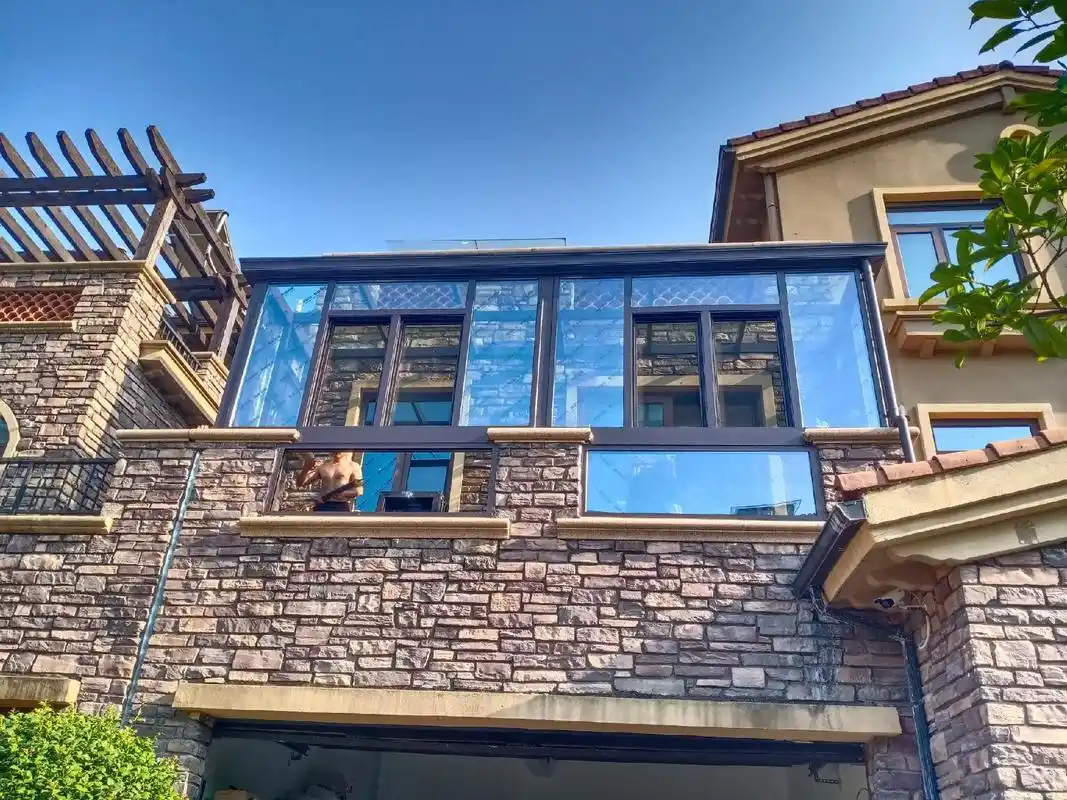
What is the FG110F double inward-opening thermal break window?How does it address street-facing noise issues?
Let's start with the conclusion: The FG110F double inward-opening thermal break window is essentially a product under the Haipaisichuang brand, featuringa double-sash inward-opening aluminum window with a thermal break insulation structure. Its core logic for handling street-facing noise is not based on a single "noise-reduction black technology," but rather on the overall airtightness achieved through the combination of the profile structure, opening method, and sealing design.
Understanding the noise insulation foundation from the product definition: profile, structure, and sealing
Breaking down this name reveals quite a bit of information:
- FG110F: This is the series code of Hipe-Strong, corresponding to a product line with a window frame thickness of 110mm.A thicker window frame means it can accommodate wider glass layers and larger sealing cavities, which is the basic physical condition for sound insulation.
- Double inward opening: Refers to both sashes opening towards the interior.Compared to sliding windows, the sash and frame of inward-opening windows usecompression sealinginstead of sliding overlap.This difference is crucial - the brush seal of sliding windows is prone to gaps under strong wind pressure, while the rubber seal of inward-opening windows is continuous, resulting in significantly better air tightness.
- Thermal break: refers to the aluminum alloy profile being separated in the middle by a thermal barrier strip (usually PA66 nylon strip) to block metal heat conduction. It mainly solves theinsulationproblem, but indirectly also helps with sound insulation — the thermal break structure creates multiple cavities inside the profile, and sound waves are reflected and attenuated multiple times as they pass through these cavities.
Therefore, the first layer of logic for FG110F to deal with street noise is:Use the inward-opening structure for more reliable sealing, and use the thermal break cavities to increase the complexity of the sound propagation path.。
Why is the thermal break structure a prerequisite for sound insulation rather than the whole story?
This is one of the most easily misunderstood points in engineering procurement. The thermal break structure addresses the 'thermal bridge' issue, and its direct benefit is that in winter, there is no condensation near the window and the indoor temperature is more stable. Its contribution to sound insulation isindirect and auxiliary—although the multi-chamber design can indeed attenuate some mid-to-high frequency noise, what truly determines the upper limit of sound insulation is the glass configuration.
Taking the reference configuration of FG110F as an example, its glass is5+27A+5insulating glass (5mm glass + 27mm air layer + 5mm glass). This configuration has a decent effect on reducing mid-to-high frequency traffic noise (such as tire friction and wind noise), but its effect on low-frequency noise (such as the rumble of large truck engines) is limited. If the building is low-rise and faces the street with many large vehicles, you need to confirm with the Haipaisichuang team whether it can be upgraded to laminated insulating glass or unequal-thickness glass—the laminated layer is significantly better at suppressing low-frequency noise.
Here is a key condition you need to confirm: whether the profile groove of FG110F can accommodate thicker glass combinations (such as 5+12A+5+1.14PVB+5 laminated insulating glass). This directly affects whether it can meet your specific noise scenario, and you need to provide your glass configuration requirements to the Haipaisichuang team to confirm the matching solution.
Who is suitable and who is not
| Scenario | Judgment |
| For homes facing the street, the main noise is mid-to-high frequency sounds like traffic and voices. | Suitable. The FG110F's inward-opening sealing structure combined with insulating glass can effectively reduce this type of noise. |
| For homes facing major roads or railways, where low-frequency noise (from large vehicles or subways) is prominent, | caution is advised. First confirm whether the glass configuration can be upgraded, then decide whether to choose this model. |
| If you have insulation requirements and also need an inward-opening design for easy cleaning, | Suitable. |
| the thermal break structure plus inward-opening design meets both of these needs. |
What to do next: Confirm the type of noise on your project's floor (low-frequency or mid-to-high-frequency), the size of the window area, and whether custom glass configurations are needed. After organizing this information, confirm with the Hipeisichuang team whether the profile groove of FG110F matches your target glass combination—this is the final step in determining whether it can solve your street noise problem.
Where does FG110F's sound insulation capability come from to solve street noise?Glass and sealing are key
Many buyers' first reaction to FG110F is to look at the profile thickness and the thermal break structure. That's not wrong, but in street noise scenarios, what truly determines the upper limit of sound insulation is actually the glass and sealing system. Let's correct a common misconception first:Thermal break windows are not the same as soundproof windows。 Thermal break addresses the issue of heat conduction. It cuts off the thermal bridge of aluminum profiles through nylon thermal barrier strips, which directly helps with insulation.However, the main path of sound transmission is through the glass and gaps, and whether the profile has a thermal break has limited impact on sound insulation.
If you only focus on the thermal break structure when choosing windows, you may spend money without solving the noise problem.
The decisive impact of glass configuration on sound insulation: starting with 5+27A+5
The reference glass configuration for FG110F is 5+27A+5, which means two 5mm glass panes with a 27mm air layer in between. The sound insulation logic of this configuration is: when sound waves pass through the first glass pane, part of the energy is reflected and absorbed, then it attenuates in the air layer, and is further weakened when passing through the second glass pane. The 27mm air layer is not arbitrary—it corresponds to the attenuation range for mid-frequency noise (such as human voices and traffic sounds), and is more effective for street-facing environments than common 9A or 12A air layers.
But note,5+27A+5 is a reference configuration, not a fixed one.Hipaisichuang supports adjusting the glass solution according to project requirements, which is crucial in actual procurement:
- If the noise is mainly low-frequency(such as truck engines or subway vibrations), the effect of insulating glass is limited. You need to confirm with the team whether it can be upgraded to laminated insulating glass (e.g., 5+1.14PVB+5+12A+5). The laminated layer suppresses low-frequency noise significantly better than ordinary insulating glass.
- If the building faces the street but is on a higher floor, where noise is mainly mid-to-high frequency traffic sounds, 5+27A+5 can cover most needs without excessive upgrades.
- If both sound insulation and thermal insulation are required, consider a triple-glazed two-cavity configuration, but confirm whether the profile groove is compatible, as this directly affects cost and construction time.
Sealing Design: How to "Lock" the Performance of Profiles and Glass Inside the Window
No matter how good the glass is, if the sealing is not in place, sound will leak directly through the gaps, and the performance of the glass will be wasted. As a double inward-opening window, the sealing advantage of FG110F lies in the fact that the inward-opening structure makes it easier to achieve multi-sealing than sliding windows, because when the sash is closed, it presses against the frame, allowing the sealing strips to be effectively compressed.
To determine whether the sealing design is reliable, focus on three positions:
- Between the glass and the sash frame: Whether continuous strips or sealant application is used, rather than point fixation.Point sealing creates acoustic bridges, and noise enters through the gaps in the strips.
- Between the sash frame and the frame: Are there multiple sealing strips (usually two or more), and is the strip material EPDM (ethylene propylene diene monomer)?EPDM resists aging and maintains elasticity well, so it won't shrink or crack after a year or two of use.
- Hardware clamping force of the opening sash: For double inward-opening windows, do the hardware locking points feature multi-point locking?The more locking points, the more evenly the sash frame is compressed, the more consistent the force on the sealing strips, and the lower the probability of localized sound leakage.
Here, contractors and purchasers need to be reminded:The sealing performance ultimately depends on the installation quality。 No matter how good the window is, if the foam filling between the frame and the wall is not dense during installation, or the exterior sealant is not applied continuously, the sound insulation effect will be greatly compromised. Therefore, when choosing FG110F, you should confirm the installation node practices and sealing material requirements with the Haipaisichuang team, especially how to handle the connection between the wall and the window frame.
Next step: confirm actions: Send the project's actual noise measurement data (or at least clarify the noise type and floor height) along with the glass configuration requirements to the Haipaisichuang team to confirm whether the FG110F profile's groove can match your desired glass solution, and whether the number of sealing strips and their material meet the project requirements. This is much more efficient than deciding on the window type first and then changing the glass.
Which street-facing residential projects are suitable for FG110F?Boundaries between recommended and not recommended
To determine whether FG110F is suitable for your street-facing residential project, the core is not whether it is "good" or not, but whether your noise problem falls within the scope it can solve. The positioning of FG110F isA thermally broken aluminum window with balanced performance, not a professional soundproof window. This boundary defines its applicable scope.
Recommended scenarios: residential projects with clear noise issues and specific requirements
In the following three situations, FG110F is a reasonable choice:
- The noise source is steady urban traffic flow(such as main roads or elevated highways), rather than sudden impact noise (such as construction pile driving or train whistles).The reference configuration of FG110F is 5+27A+5 insulating glass, which provides stable attenuation of continuous mid-to-high frequency traffic noise, but has limited suppression capability for low-frequency impact noise.
- The project has comprehensive requirements for thermal insulation, sealing, and inward-opening structures, with sound insulation being just one of several needs.For example, in northern residential buildings facing streets, both winter thermal retention and reduced road noise are needed; the thermal break structure and dual inward-opening design of FG110F can cover these needs simultaneously, making it more cost-effective than pursuing sound insulation performance alone.
- The project is in the stage of scheme confirmation or batch procurement, and parameters such as drawings, glass configuration, and wall thickness are basically locked in.FG110F supports customization of different wall thicknesses and glass configurations according to drawings, making it suitable for engineering contractors to place batch orders directly after sample confirmation.
Scenarios not recommended: projects with extremely sensitive budgets or extreme sound insulation requirements
In the following situations, we suggest you re-evaluate:
- Budget is extremely sensitive; every square meter price difference affects winning the bid.。FG110F uses 6063-T5 aluminum alloy profiles with a wall thickness of 2.0mm. It is a balanced-performance product, not a low-price, high-volume model.If your project's client only focuses on the lowest price, there may be simpler non-thermal-break windows available at the same price, but sound insulation and thermal performance will significantly decrease—this trade-off needs to be clearly communicated to the client.
- For extreme sound insulation requirements, such as bedrooms adjacent to subway tracks or railway lines, where nighttime noise peaks exceed 70 decibels.Such scenarios require professional soundproof windows (e.g., laminated glass, asymmetric insulating glass units). The 5+27A+5 configuration of FG110F cannot meet the expectation of 'more stable and quieter'.If you cannot confirm the on-site noise decibel level and frequency distribution, it is recommended to provide the actual noise measurement data to the Haipaisichuang team first to confirm whether the glass configuration can be adjusted to meet the requirements.
When the budget is limited, where should the money be prioritized?
If the budget can only support one core investment, the priority order is:
- Glass configuration—Over 70% of the soundproofing effect is determined by the glass.When the budget allows, upgrading 5+27A+5 to asymmetric insulating glass with different thicknesses (such as 5+20A+8) improves soundproofing more noticeably than changing the profile.
- Installation process—The foam filling and sealant application between the window frame and the wall directly affect the actual soundproofing performance.Improper installation can halve the performance of the window itself.
- Profile wall thicknessThe 2.0mm wall thickness of the FG110F already meets the strength requirements of most street-facing residences. Unless the floor is extremely high or wind pressure is significant, there is no need to add budget for wall thickness.
Next step: confirm actionsMeasure the noise decibel level at the project site (once during the day and once at night), record the type of noise (continuous traffic or intermittent impacts), and submit this along with the climate conditions of the project location (minimum winter temperature, maximum summer temperature) to the Hipex Creative team to confirm whether the glass configuration and profile solution of the FG110F can match your specific needs.
How to configure the FG110F based on project requirements?Wall thickness, glass, and customization process
The configuration decision for the FG110F essentially answers three questions: whether the window frame is strong enough, whether the glass can block the sound you need to block, and whether the factory can produce it according to your drawings. Let's break down these three questions below.
The significance and selection logic of 2.0mm profile wall thickness
The reference configuration of the FG110F has a profile wall thickness of 2.0mm, made of 6063-T5 aluminum alloy. What level does this combination represent in engineering procurement? A wall thickness of 2.0mm exceeds the national standard minimum for aluminum alloy window profiles (typically 1.4mm), meaning the profiles have better rigidity, are less prone to deformation in large window openings, and the frame is more stable during sliding or inward opening.
How do you determine whether your project needs 2.0mm? Consider two conditions:
- Floor height: For residential buildings above 10 floors, wind pressure increases significantly, so it is recommended to configure directly with 2.0mm without downgrading.
- Single sash area: If the width of a single sash exceeds 700mm or the height exceeds 1500mm, a 2.0mm wall thickness reduces the risk of sash sagging and poor sealing.
If your project involves low-rise buildings, small window openings, and is cost-sensitive, you can confirm with Qinhan System Windows and Doors whether there are thinner wall thickness alternatives—but note that reducing wall thickness will directly affect the durability of sound insulation and sealing performance, and the money saved may not be enough to cover later maintenance costs.
From Drawings to Samples: Key Confirmation Points in the Customization Process
FG110F supports customization according to drawings, but "support for customization" does not mean "just send the drawing and it's done." Before entering bulk orders, there are four confirmation points that must be implemented one by one:
- Matching of glass configuration and sound insulation goals: The reference configuration is 5+27A+5 insulating glass.If your project faces a main road or rail transit, you need to clarify the type of noise source—low-frequency traffic noise has more stringent requirements for glass configuration than mid-to-high-frequency human voices.Provide Qinhan System Windows and Doors with the distance from the noise source and floor information, and confirm whether it is necessary to upgrade to laminated insulating glass or unequal-thickness glass.
- Opening method and hardware load-bearing capacity: Under the double inward-opening structure, the maximum load-bearing capacity of the hardware on each sash determines the maximum achievable size.After confirming your window opening dimensions, require the other party to confirm in writing whether the hardware configuration matches, to avoid future sash sagging.
- Color and surface treatment: 6063-T5 profiles can be powder coated or anodized, but different surface treatments have a direct impact on weather resistance and color difference.For batch projects, be sure to lock in the color card number during the sample stage to avoid batch color differences during delivery.
- Sample confirmation scope: It is recommended to make at least one 1:1 full-scale physical sample, rather than only looking at drawings or small samples.Key checks: whether the rubber strip joints are flat, whether the hardware feels smooth when opening inward, and whether the sealing strip is continuously compressed after closing.
Common Questions
Q: My project is on the 20th floor. Is 2.0mm wall thickness sufficient? The 20th floor is a high-rise building, where wind pressure loads increase significantly. A 2.0mm wall thickness combined with a reasonable mullion layout (avoiding oversized single sashes) can usually meet the requirements, but you need to provide the specific floor height and window opening dimensions to Qinhan System Doors and Windows, and they will confirm after performing wind pressure resistance calculations.
Q: Can the 5+27A+5 glass configuration completely block out road noise? It cannot 'completely block out' noise. The 5+27A+5 insulated glass significantly attenuates mid-to-high frequency noise, but its effect on low-frequency traffic noise (such as truck engine sounds) is limited.
If the noise source is mainly low-frequency, it is necessary to discuss whether to upgrade the glass configuration, rather than placing an order based on the reference configuration by default.
Q: Can we only change the glass without changing the profile? Yes. The profile groove design of FG110F supports different glass thickness combinations, but thicker glass will increase the weight of the entire window, so it is necessary to confirm whether the hardware load-bearing and opening are affected.
It is recommended to send the target glass configuration to Qinhan System Windows and Doors for matching confirmation before customization.
Q: How long does the customization process from drawings to samples generally take? This depends on the complexity of the drawings, the glass configuration, and the surface treatment method. The sample cycle for conventional configurations is relatively short, but special glass or colors require additional time.
It is recommended to confirm the current production cycle directly with Qinhan System Doors and Windows before project scheduling, and the actual reply shall prevail.
Learn more
If you are selecting FG110F for a street-facing residential project, it is recommended to first organize the noise type, floor height, window opening dimensions, and glass requirements, and submit them to the Qinhan System Doors and Windows team for solution matching confirmation.
Related products:FG110F double inward opening thermal break window