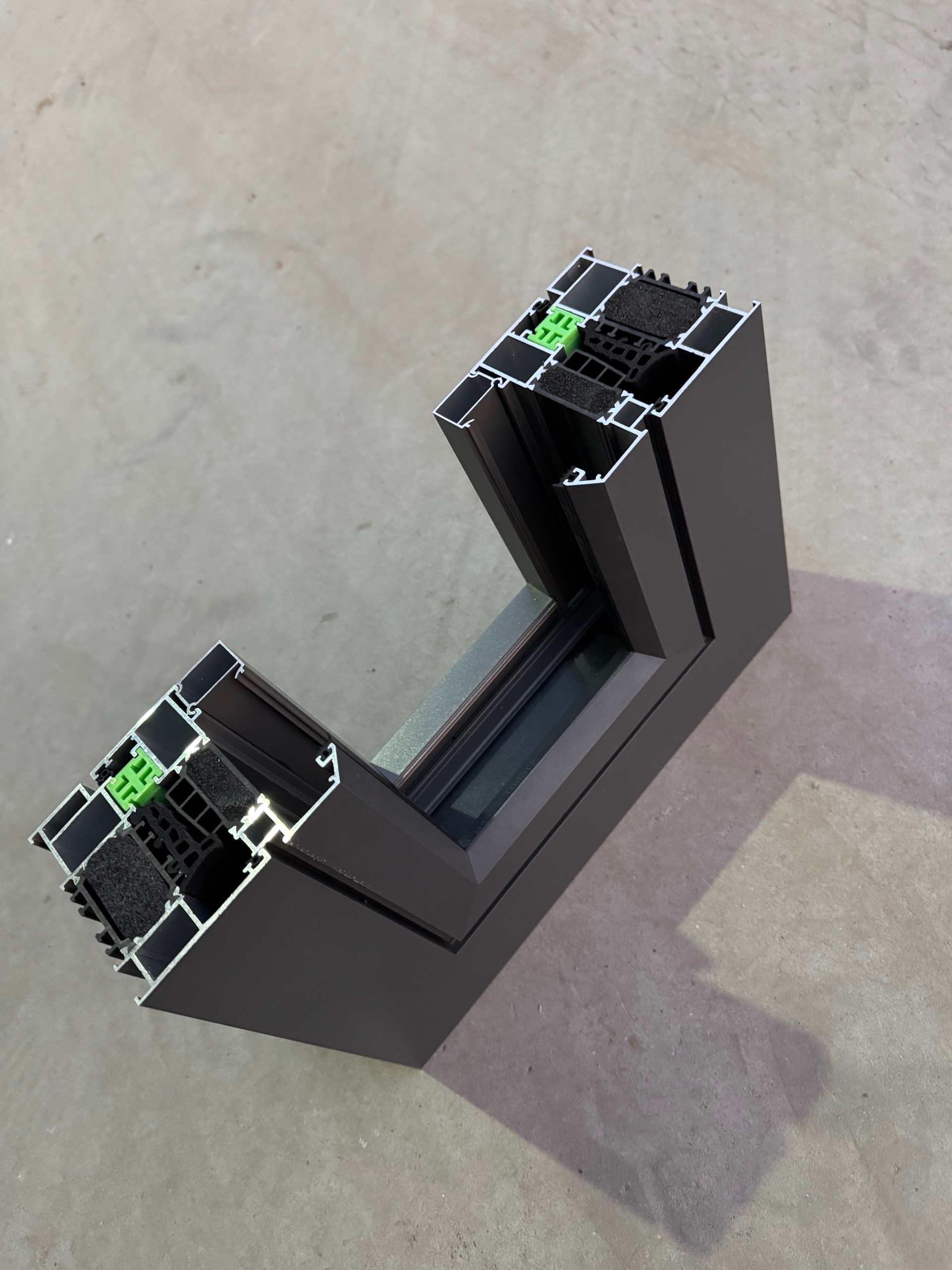
Introduction
Two Materials, Two Philosophies
When you search for new windows in 2026, two frame materials dominate the results: aluminium (slim, strong, modern) and uPVC (budget-friendly, thermally quiet, low-maintenance). Global search interest confirms both are on the rise — queries such as “upvc double glazed windows” and “upvc tilt and turn windows” grew by roughly +100% and +120% in a single week, while “aluminum window trim” and “window flashing” climbed +40% and +50%. Buyers are not just comparing prices; they are researching installation, repair, maintenance and long-term value.
This guide compares the two materials across the metrics that actually decide a purchase — thermal performance, cost, lifespan, sound insulation, maintenance, sustainability and market outlook — backed by real figures and citations. The global uPVC doors and windows market alone was valued at US$42.15 billion in 2025 and is forecast to reach US$56.5 billion by 2031, a CAGR of about 5.0%.
US$42.15B
Global uPVC doors & windows market, 2025
£475 vs £325
Avg cost per window: aluminium vs uPVC (UK 2026)
40–50 yr
Aluminium lifespan (uPVC: 20–30 yr)
≈5%
Energy to recycle aluminium vs primary production
The Quick Answer
There is no single “best” material — the right choice depends on your budget, design language and how long you plan to stay in the property.
Verdict at a glance
Choose aluminium for lifespan (40–50 years), slim sightlines, premium aesthetics and infinite recyclability — if you can absorb a roughly 25–40% higher upfront cost. Choose uPVC for the lowest first cost, comparable thermal performance with double glazing, and near-zero maintenance — if 20–30 years of service life is enough.
Aluminium
Best for modern builds, large glazing spans, coastal and harsh climates, long-term ownership, and buyers pursuing LEED / BREEAM credits.
uPVC
Best for budget-constrained residential projects, standard casement and tilt-and-turn windows, and quick, low-maintenance replacements.
Section 01 · Performance
Thermal Performance & U-Values
The single biggest driver of long-term cost is how much heat the window loses — measured by the U-value (W/m²K). Lower is better.
The frame material matters far less than many buyers assume once a thermal break is involved. A standard double-glazed uPVC window achieves a whole-window U-value of about 1.4–1.6 W/m²K, while a thermally broken double-glazed aluminium window reaches 1.2–1.4 W/m²K — statistically comparable. The story changes dramatically without a thermal break: because aluminium conducts heat roughly 200 times faster than PVC, plain (non-thermally-broken) aluminium frames run as high as 4.0–6.0 W/m²K and are inefficient in cold climates. With triple glazing, premium aluminium can push down to 0.8–1.0 W/m²K.
| Whole-window U-value by configuration (W/m²K, lower is better) Configuration Aluminium uPVC | ||
| Single pane, no thermal break | ~5.5 W/m²K | ~4.5 W/m²K |
| Double glazing, no thermal break | ~3.2 W/m²K | ~2.2 W/m²K |
| Double glazing + thermal break | 1.2–1.4 W/m²K | 1.4–1.6 W/m²K |
| Triple glazing (premium) | 0.8–1.0 W/m²K | ~1.0–1.3 W/m²K (5–7 chamber) |
Sources: Axiom Eco Homes / BFRC energy ratings (2026); SGL Doors & Windows (U-value tables); mcwindow.com.au (multi-chamber uPVC Uf values).
U-value comparison — lower is better
Whole-window U-value (W/m²K) at key specification levels
Takeaway: At equal specification, thermally broken aluminium and uPVC deliver comparable insulation. The glazing unit, not the frame, becomes the dominant factor in energy performance — an insight that matters for both energy bills and insulation upgrades.
Section 02 · Price
Cost Comparison: Aluminium vs uPVC
Price is where uPVC wins clearly on paper — but the gap narrows when you spread cost over a much longer service life.
2026 UK averages put an aluminium window at roughly £475 (range £350–£600), versus £325 for an equivalent uPVC window (range £250–£400). Aluminium typically sells 25–40% above a comparable uPVC unit. For a whole house of 10 windows, that difference can run into thousands of dollars or pounds — which is exactly why “upvc windows price” and “aluminum window price” are such heavily searched terms.
| UK average installed cost per window, 2026 Material Typical range Average | ||
| uPVC uPVC window | £250 – £400 | £325 |
| AL Aluminium window | £350 – £600 | £475 |
| AL Aluminium sliding window | £340 – £990 | £665 |
Sources: Checkatrade (aluminium vs uPVC cost, 2026); Prime Glazing (25–40% price premium).
Average cost per window (UK, 2026)
Average installed cost in £ (bar = average; error line = typical range)
Lifecycle cost: the long-term picture
Because aluminium lasts 40–50 years versus 20–30 years for uPVC, lifecycle cost analysis flips the conclusion. Estimates suggest uPVC runs roughly £20–£30 per year across its life, while aluminium runs £15–£24 per year — meaning over the full lifecycle, the more expensive frame can end up cheaper per year of service. This is the key argument for anyone planning to stay put for 15+ years.
Source: Axiom Eco Homes / BFRC lifecycle data (uPVC vs aluminium comparison 2026).
Section 03 · Durability
Lifespan, Durability & Warranty
Durability is aluminium’s strongest practical advantage — it typically outlives uPVC by a factor of two.
Industry lifecycle data puts aluminium frames at 40–50 years (some sources up to 60), versus 20–30 years for uPVC. Aluminium resists corrosion in salt-spray tests for 1,000+ hours and tolerates extremes from −40°C to 120°C without warping or cracking, making it the material of choice in coastal and harsh climates. uPVC, especially on south-facing elevations, can become brittle and discoloured after prolonged UV exposure — a common driver behind searches like “upvc paint” and “aluminum window repair”.
| Material longevity & service characteristicsAttributeAluminiumuPVC | ||
| Typical lifespan | 40–50 years | 20–30 years |
| Climate resistance | −40°C to 120°C, corrosion-resistant | UV can cause brittleness / discolour |
| Colour retention | Powder-coated, long-lasting | May yellow with prolonged sun exposure |
| Reusability after life | 100% infinitely recyclable | Recyclable, but limited cycles |
Sources: Axiom Eco Homes / BFRC lifecycle (lifespan data); Echeng Windows (salt-spray & temperature tolerance); Inspired Glazing (ROI & lifespan).
Section 04 · Aesthetics
Design, Window Frames & Finish
Aesthetics increasingly decide the choice — and search data shows it. “Aluminum window trim” (+40%), “black uPVC windows” (+50%) and “aluminium window” (+20%) are all rising.
Aluminium’s high strength-to-weight ratio allows slimmer frames and larger glass areas, giving a minimalist, contemporary look that uPVC’s bulkier profiles cannot match. Aluminium also accepts a far wider range of finishes — powder-coated colours, anodised and custom trim — which is why “aluminum window trim” and “painting aluminum window frames” keep climbing. uPVC has closed the colour gap in recent years, with multi-chamber profiles and black uPVC windows now widely available, but it still reads visually “heavier” than aluminium at the same opening size.
Aluminium — looks & feel
- Slim sightlines, maximum glass & natural light
- Wide range of powder-coated / anodised finishes & trim
- Modern, premium aesthetic; supports large spans
- Higher cost and more custom options to manage
uPVC — looks & feel
- White finish matches most homes; low visual risk
- Black / coloured profiles now available
- Bulkier profiles reduce glass area
- Colour options still fewer than aluminium
Source: Prime Glazing (slim frames & light); APRO (design comparison).
Section 05 · Acoustics
Sound Insulation & Acoustic Performance
For homes near roads or railways, acoustic performance matters as much as thermal performance.
Aluminium systems generally achieve a higher sound-reduction rating (Rw 30–45 dB) than uPVC (Rw 28–38 dB), largely because the stiffer frame supports thicker, better-sealed glazing. That said, the glazing package again does most of the work: a double-glazed unit with low-E coating and a 20mm thermal break typically delivers 35–40 dB of reduction regardless of frame material.
Source: SGL Doors & Windows (acoustic Rw table); Echeng Windows (thermal-break sound reduction).
Section 06 · Upkeep
Maintenance, Repair & Repainting
Both materials are relatively low-maintenance, but their failure modes and upkeep differ — and buyers are actively searching for it (“upvc paint” +60%, “painting aluminum window frames” +30%, “aluminum window repair” +9%).
uPVC: essentially maintenance-free — wipe-clean, no repainting required. The main long-term risks are UV discolouration and stiffening hinges; when colour fades, owners often look into “upvc paint” to refresh the frame rather than replace it.
Aluminium: powder-coated and anodised finishes are durable and only need occasional cleaning; “aluminum window repair” and “painting aluminum window frames” are rising searches, mainly for older, non-powder-coated installations that need refinishing. If you are painting aluminium frames, surface preparation (degreasing and priming) is the difference between a 2-year and a 15-year finish.
Sources: Echeng Windows (maintenance & durability); APRO (maintenance comparison).
Section 07 · Green
Sustainability, Recycling & Carbon Footprint
For green-building credits (LEED, BREEAM) and eco-conscious buyers, lifecycle impact is the deciding metric — and aluminium wins on circularity.
Aluminium is infinitely recyclable without any loss of quality, and recycling it uses only about 5% of the energy required to produce primary aluminium. Roughly 75% of all aluminium ever produced is still in active use today. uPVC is recyclable up to a limited number of cycles (estimates range from 7 to 10) and the material degrades slightly each time; a meaningful share of end-of-life uPVC still ends up in landfill. uPVC does carry a lower initial embodied-carbon footprint, but aluminium’s longevity and infinite recyclability give it the edge over a cradle-to-grave assessment.
Data point: recycled aluminium needs only ≈5% of primary-production energy — one of the strongest circular-economy credentials of any building material.
Sources: Hydro (via Meichen Windows, recycling energy); IN Windows (75% of aluminium still in use & uPVC cycles); WindowCost (cradle-to-grave comparison).
Section 08 · Configurations
Window Types: Double Glazed, Tilt & Turn, Sliding
The configuration you choose often matters more than the frame material. Search growth is exploding here: “upvc tilt and turn windows” (+120%) and “upvc double glazed windows” (+100%).
| Popular configurations and what they suitWindow typeBest forNotes | ||
| Casement | Standard homes, good ventilation | Largest product segment (~38% of uPVC market) |
| Tilt & turn | Ventilation + secure top-hung opening | Fastest-growing query (+120% this week) |
| Sliding | Wide openings, modern terraces | “Aluminum sliding window” +4%, screens popular |
| Double glazed | Energy efficiency & noise | “upvc double glazed windows” +100% |
| Sash / window screens | Traditional look, insect protection | "window screen replacement" +50% |
Two rising topics deserve special attention. Window flashing (+50%) and aluminum flashing (+30%) are about waterproofing the joint where the frame meets the wall — poor flashing is the #1 cause of leaks and rot, and it is a hot search because many installs fail there. Window screen replacement (+50%) reflects the practical reality that screens wear out long before the frame does, so buyers plan for replaceable screens. And rising queries for aluminum window parts (+20%) and aluminum window manufacturers (+10%) show that sourcing spare hardware and choosing a quality supplier are increasingly part of the decision.
Sources: Dataintelo (casement = 38.2% of market). Search-interest growth rates reflect Google Trends-style weekly deltas supplied with this brief.
Section 09 · Outlook
Market Size & Regional Trends
The numbers behind the trend lines — and why “upvc windows melbourne” (+80%) and “upvc windows newcastle” (breakout) matter.
The global uPVC doors and windows market was worth US$42.15 billion in 2025, forecast to reach US$56.5 billion by 2031 (≈5.0% CAGR). Asia-Pacific accounts for roughly 44% of revenue, and residential applications about 67%Within product types, casement windows hold the largest share at 38.2%. Regional search surges such as “upvc windows melbourne” (+80%) and “upvc windows newcastle” (breakout) signal that coastal and northern-hemisphere cold-climate markets are actively comparing uPVC against aluminium for energy and corrosion reasons.
Sources: Mordor Intelligence & Research and Markets (US$42.15B → US$56.5B); Dataintelo (market snapshot); Ken Research (APAC 44.1% / residential 67%).
Global uPVC doors & windows market, 2025 → 2031
Market value in US$ billions (forecast)
Section 10 · Guide
Which Should You Choose? A Decision Guide
Use this simple flow to reach a recommendation in under a minute.
1 · How long will you stay?
- 15+ years or forever → lean aluminium (lower cost per year)
- Under 10 years / resale-focused → uPVC is enough
2 · What is your design language?
- Modern / minimalist, large glass → aluminium
- Traditional white homes → uPVC blends in
3 · What is the climate?
- Coastal, salty, extreme heat/cold → aluminium
- Mild inland → uPVC performs well
4 · Budget & green goals?
- Hard budget cap → uPVC (25–40% cheaper)
- LEED/BREEAM or low lifecycle footprint → aluminium
FAQ
Frequently Asked Questions
Are aluminium windows better than uPVC?
Neither is universally better. Aluminium lasts 40–50 years, is infinitely recyclable and offers slimmer frames, but costs roughly 25–40% more upfront. uPVC is cheaper with comparable U-values once double-glazed and thermally broken, but typically lasts 20–30 years. The best choice depends on budget, design preference and how long you plan to stay.
Which is cheaper: aluminium or uPVC windows?
uPVC is cheaper. UK 2026 averages are about £325 per uPVC window versus £475 per aluminium window (Checkatrade). Aluminium typically sells 25–40% above an equivalent uPVC unit.
Which window frame lasts longer?
Aluminium lasts longer — typically 40–50 years versus 20–30 years for uPVC (British Fenestration Rating Council lifecycle data). Over a full lifecycle, aluminium can be more economical despite its higher upfront cost.
Are aluminium windows energy efficient?
Yes, with a thermal break. Thermally broken double-glazed aluminium reaches U-values of 1.2–1.4 W/m²K, matching uPVC. Non-thermally-broken aluminium (4.0–6.0 W/m²K) is not efficient and should be avoided in cold climates.
What is a uPVC window?
uPVC (unplasticised polyvinyl chloride) is a rigid PVC used for window frames. It is low-cost, moisture-resistant and a poor heat conductor, giving good insulation, but it typically lasts 20–30 years and is less recyclable than aluminium.
Can I paint aluminium or uPVC frames?
Yes to both, with different prep. Aluminium frames should be degreased and primed before painting (a proper prep separates a 2-year from a 15-year finish). uPVC can be painted with special uPVC paint, usually to refresh faded colour rather than replace the frame.
Sources
References & Citations
All figures in this article are drawn from the following cited sources (accessed September 2026). External links open in a new tab.
- Checkatrade — Aluminium vs uPVC windows: how much do they cost in 2026? (cost: £475 vs £325)
- Axiom Eco Homes — uPVC vs aluminium windows comparison 2026 (U-values, lifespan, lifecycle cost, BFRC)
- SGL Doors & Windows — aluminium vs vinyl vs uPVC material comparison (U-value & acoustic tables)
- Mordor Intelligence — UPVC doors & windows market (US$42.15B → US$56.5B, CAGR 5.0%)
- Dataintelo — uPVC windows market report (casement 38.2% share)
- Ken Research — Global UPVC window & door market (APAC 44.1%, residential 67%)
- Meichen Windows — are aluminium windows better than uPVC? (recycling uses ≈5% energy, Hydro)
- IN Windows — uPVC vs aluminium pros, cons & costs (75% of aluminium still in use; uPVC cycles)
- Echeng Windows — uPVC vs aluminium: full comparison on value (salt-spray 1000h, −40°C to 120°C, maintenance)
- Prime Glazing — how much do new windows cost? (25–40% price premium, slim frames)
- MC Window — aluminium vs uPVC vs timber comparison (multi-chamber uPVC Uf 1.0–1.3)
- WindowCost — uPVC vs timber vs aluminium cost & lifespan (cradle-to-grave sustainability)