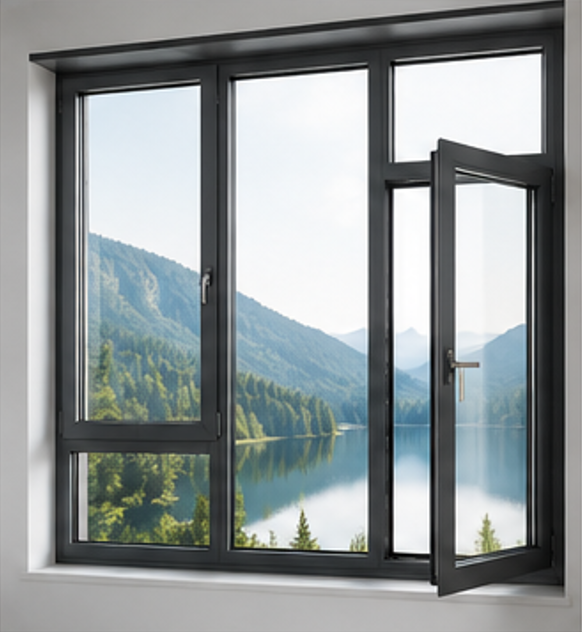
How to Determine if 55 Series Single-Opening Aluminum Alloy Windows Meet Your Project's Basic Needs?
Before selection, use self-assessment to determine if 55 Series Single-Opening Aluminum Alloy Windows are suitable for your project's basic needs, avoiding wasted effort on mismatched solutions.
Review Your Own Needs: First Clarify Usage, Scenario, and Maintenance Expectations
Clarify three core questions:
- Usage and Scenario: Is the project for residential window configuration or engineering project procurement? Is the location low-rise, mid-rise, or high-rise?
- Performance Expectations: Is the primary demand for ventilation and lighting, or are there higher requirements for sound insulation, thermal insulation, or wind pressure resistance?
- Maintenance Mode: Is the project intended for long-term self-ownership, or will it be maintained by the owner after delivery?
Align with Product Positioning: What Level of Problem Does the Hyperstron 55 Series Primarily Address?
The Hyperstron 55 Series single-opening windows use 6063-T5 aluminum alloy, with a reference wall thickness of 1.4MM and standard insulated glass, positioning them as a balanced and practical standard solution.
- Typical Applicable Scenarios: Suitable for multi-story and small high-rise residential buildings, standard commercial space window configurations, and general models for distribution channels. They meet the mechanical and climatic requirements of most conventional scenarios.
- Potential Boundaries: For super high-rise buildings, strong typhoon areas, or projects with strict thermal insulation and sound insulation requirements, this standard configuration may be insufficient. Higher series or custom solutions may need evaluation.
It is suitable when needs are clear and scenarios are conventional; caution is advised when needs are vague or performance requirements are stringent. If needs are unclear, direct selection may lead to mismatched configurations. It is recommended to confirm needs first, then evaluate the selection plan for 55 Series single-opening aluminum alloy windows.
After Receiving Product Data, Which Parameters Directly Determine if the Plan Can Be Implemented?
Upon receiving the product data for 55 Series Single-Opening Aluminum Alloy Windows, quickly interpreting key parameters is the first step in assessing plan feasibility. You need to convert technical numbers into decision-making criteria.
Interpret Core Parameters: How Profiles, Glass, and Dimensions Affect Performance and Cost
The parameters in the data are directly linked to product performance and cost. Focus on the following points to build an initial impression:
- Profile Thickness (1.4mm): This is the foundation of the window frame's structural strength. 1.4mm is a common national standard thickness, providing reliable stability for most conventional residential and engineering scenarios. If the project is high-rise or has special wind pressure resistance requirements, confirm if this thickness meets standards.
- Glass Configuration (5+12A+5): Refers to an insulated structure with two 5mm glass panes and a 12mm air layer. This configuration provides basic sound insulation and thermal performance, a common balance point between performance and cost.
- Reference Dimensions and Material (1000*1000mm, 6063-T5 Aluminum Alloy): Reference dimensions are the basis for calculating single-window material usage and cost. 6063-T5 aluminum alloy has good overall performance. Actual project dimensions may vary, affecting unit price and design.
Identify Key Information: Capture Signals Matching Your Needs from the Data
The parameter table is a checklist for matching your needs. Focus on the following signals:
- Are Parameters Adjustable? The "1.4mm" and "5+12A+5" in the data are typically standard configurations, but not fixed. You need to confirm if these parameters can be adjusted within a certain range, such as increasing profile thickness or changing glass type. Clarifying adjustability is key to assessing plan flexibility.
- Match with Your Needs: Quickly evaluate the following:
- Scenario Match: Does the standard configuration meet your basic residential or engineering usage needs?
- Regulatory Match: Are there special energy-saving or wind pressure resistance standards at the project location? Do the data parameters comply?
- Next Steps: After reviewing the data, prepare the project's specific scenario, performance requirements, and procurement mode. Confirm details with suppliers to convert general data into a specific plan suitable for the project.
Under What Conditions Is the 55 Series Single-Opening Aluminum Alloy Window a Clear and Prioritized Recommendation?
When project requirements closely align with the product's standard configuration and there are clear expectations for the procurement process, the 55 Series Single-Opening Aluminum Alloy Window is a clear and prioritized recommendation. This is especially suitable for target-oriented engineering firms, distributors, and brand buyers.
Clear Scenario: Direct Match and Cost Advantages Under Standard Requirements
For standard "residential window configurations" or conventional "engineering project procurement," when performance requirements such as 1.4MM wall thickness 6063-T5 profiles and 5+12A+5 glass configurations are well understood, the 55 Series provides a directly matching solution. Its base configuration meets reliable structural strength and basic thermal needs, and it typically offers cost advantages, suitable for cost-sensitive bulk projects.
Clear Decision: Projects with Clear Expectations for Sample Confirmation and Mass Production
When the project plan is determined and ready for sample confirmation and mass production stages, choosing the clearly specified and maturely produced 55 Series product can significantly reduce communication costs and accelerate progress. Market positioning shows this product is common in wholesale and supply information, facilitating quick order fulfillment, especially for scenarios with clear delivery expectations.
In summary, the core of choosing the 55 Series lies in clear needs and clear goals, which helps efficiently advance to the "sample confirmation" and "bulk order" stages.
How to Set Decision Boundaries: When to Consider Upgrading the Plan or Supplementing More Information?
When you preliminarily judge that the 55 Series single-opening window matches the project based on existing data (1.4MM profile thickness, 5+12A+5 insulated glass), the next step is to define clear decision boundaries. This helps you determine when the standard plan is sufficient and when more communication costs are needed to obtain custom plans or complete information.
Boundary One: Performance or Custom Needs Exceed Standard Configuration
The standard configuration (5+12A+5 insulated glass) provides basic insulation and sound insulation performance. To determine if an upgrade is needed, compare your specific performance indicators with this standard.
- For Sound Insulation Needs: If your project is in a high-noise environment like near an airport or elevated road, or has strict quiet requirements for bedrooms or conference rooms (e.g., requiring sound insulation exceeding 40 decibels), the 55 Series' reference glass configuration may be a bottleneck. At this point, you need to clearly inform our team of the specific decibel requirements so we can assess if adjusting glass thickness, adding laminated layers, or filling with inert gases can meet it, which typically involves configuration upgrades.
- For Custom Appearance or Functions: If your project requires special opening methods (e.g., tilt-and-turn), non-standard sash dimensions, or specific colors and surface treatments, the standard model may not fully satisfy. This falls into deep customization, requiring detailed drawings or clear needs in early communication to assess technical feasibility and cost impact.
When to Stop Self-Estimation and Consult Directly? When you find yourself needing precise sound insulation coefficients (STC/Rw values), wind pressure performance data, or when the project party raises a functional requirement not found in the standard configuration list, it's time to provide specific parameters and seek custom plans from us. This avoids later plan changes due to information gaps.
Boundary Two: High Project Uncertainty or Need for Long-Term Deep Collaboration
Investing more time in upfront communication is particularly valuable in the following situations:
- Project in Early or Variable Planning Stage: If you only have preliminary architectural drawings and the window opening dimensions, quantities, or grid schemes are not yet finalized, do not rush to finalize the 55 Series' final quote. Instead, we recommend conducting technical feasibility communication to understand size limits and process requirements, leaving room for subsequent design changes. This is more efficient than re-negotiating later due to size changes.
- Establishing Long-Term Supply Relationships or Complex Projects: For annual procurement framework agreements, large-scale batch projects, or projects requiring continuous after-sales maintenance, upfront deep communication is crucial. We need to fully understand your project management processes, quality acceptance standards, and potential on-site issues. Investing time to confirm compatibility is a necessary investment to reduce risks and ensure smooth delivery in subsequent large-scale collaborations. This transcends simple product selection and enters the realm of supply chain collaboration.
Core Judgment Criteria: If your needs are "one-time procurement, clear specifications, and clear delivery," then the confirmation process based on existing data is efficient. If your needs involve "plan co-creation, long-term collaboration, or risk sharing," then upfront deep communication is not an extra cost but a foundation for project success.
Frequently Asked Questions
Q1: When Should You Consider Abandoning the 55 Series and Directly Choosing a Higher-Grade Series (e.g., 60 Series)? When your core needs (e.g., thermal insulation value K-value, wind pressure resistance level) are clearly beyond the performance range provided by the 55 Series in common configurations after preliminary assessment, consider higher series. For example, in severe cold regions, where higher requirements exist for the window frame's own thermal insulation cavity structure.
This requires joint assessment based on your project's location and specific climate parameters.
Q2: If I Only Need to Change the 55 Series' Glass from 5+12A+5 to Triple-Glazed, Is It Customized? This is an adjustment within standard configuration range. We support different glass configuration options, such as upgrading to triple-glazed or Low-E glass.
You only need to specify the glass configuration requirements during confirmation, and our team will provide corresponding quotes and performance explanations.
Q3: For Long-Term Collaboration, What Non-Product Points Are Primarily Confirmed in Upfront Communication? For long-term collaboration, we will focus on confirming the following with you to ensure smooth cooperation:
- Order and Delivery Processes: Your ordering habits, project node requirements, and logistics and warehousing coordination methods.
- Quality and Acceptance Standards: Your specific acceptance standards for profile surfaces, installation gaps, hardware feel, etc.
- After-Sales and Collaboration Mechanisms: Clear feedback paths, responsibility definitions, and response processes for installation or quality issues.
- Technical Support Needs: Whether technical guidance or training is required for your installation team.
Q4: If My Needs Are Between "Sufficient" and "Need Upgrade," How Would You Advise? We suggest you prioritize. First, clarify the most non-negotiable performance or functional points (e.g., sound insulation is a red line that must be met), then conduct specialized communication on this single issue to assess the possibility and cost of partial upgrades based on the 55 Series, rather than considering a complete series change from the start.
This helps you resolve core conflicts in the most economical way.
Further Understanding
If you need further selection advice, feel free to submit your working condition parameters, and our technical team will provide a professional judgment.
Related Products: 55 Series Single-Opening Aluminum Alloy Windows